News Story
 Inspiration
themarginalian.org · 8 hours ago
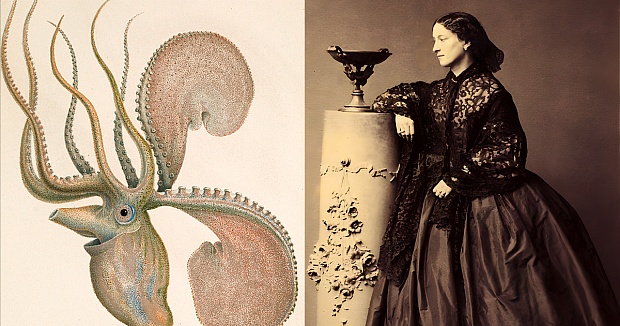
The Seamstress Who Solved the Ancient Mystery of the Argonaut, Pioneered the Aquarium, and Laid the Groundwork for the Study...
Jeanne Villepreux-Power walked more than 300 kilometers to Paris at seventeen after being assaulted and robbed of her papers en route - and kept walking anyway, a seamstress who would eventually become the scientist who solved a mystery that had baffled naturalists since Aristotle. What makes her story quietly staggering is not just what she discovered about the argonaut octopus, but how she discovered it: by insisting that the living creature mattered more than the dead specimen, by rowing out daily in long skirts to kneel at a cage she designed herself, by watching with the kind of patient, unhurried attention that institutions rarely reward and individuals rarely sustain. After removing a tiny nine-millimeter hatchling and noticing it folded in self-embrace, already beginning to build its shell, she wrote that she "armed myself with patience and courage, and only after several months managed to dissolve my doubts and see my research crowned with happy confirmation." Because women were barred from universities and learned societies, her findings traveled into the world through the letters of men who read them aloud in her absence - and yet her work endured, ultimately laying the groundwork for the study of octopus intelligence and reshaping our understanding of consciousness itself. There is something worth holding in the image of a woman excluded from the establishment she was quietly revolutionizing, who found in a shy, ink-clouding creature a kind of mirror: both of them most fully themselves when they believed no one was watching.