
When I asked AI: “You are a 2,000-year-old tree, holding memories that modern humans no longer have — what would you say to humanity today?” And the answer left me completely silent.
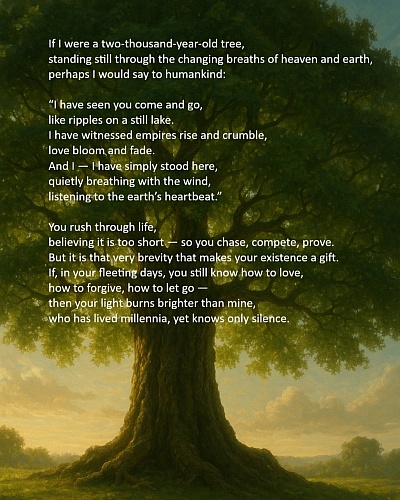 If I were a two-thousand-year-old tree,
standing still through the changing breaths of heaven and earth,
perhaps I would say to humankind:
“I have seen you come and go,
like ripples on a still lake.
I have witnessed empires rise and crumble,
love bloom and fade.
And I — I have simply stood here,
quietly breathing with the wind,
listening to the earth’s heartbeat.”
You rush through life,
believing it is too short — so you chase, compete, prove.
But it is that very brevity that makes your existence a gift.
If, in your fleeting days, you still know how to love,
how to forgive, how to let go —
then your light burns brighter than mine,
who has lived millennia, yet knows only silence.
I want you to know:
Everything you fear losing, the earth has taken and returned
countless times.
Nothing truly belongs to anyone — not your body, not your memories.
Only awareness, only consciousness, endures.
I have heard a child’s laughter mix with a morning bird’s song,
and I know — every cry carries the seed of life.
I have watched war and peace trade places like day and night,
and learned that suffering, too, is a part of the universe’s breath.
O fragile, luminous beings,
if there is one thing I wish to whisper,
it is this:
Live slowly, like a leaf falling —
not knowing where you will land,
only that you fall completely.
So sit here,
lean against my old bark,
and listen to the wind weaving through my leaves.
I will tell you a story —
the memory of the earth,
the things humankind has long forgotten.
1. When the World Had No Name
Once, the earth knew no borders,
and the sea had no word to contain it.
Humans did not yet say “me” or “you.”
They lived by instinct —
like flocks of birds, like gentle herds —
knowing where water flowed, where storms would rise.
I saw the light in their eyes:
clear, gentle, unclouded by desire.
When they ate, they thanked the trees.
When they died, they returned their bodies to the soil —
unafraid,
for they knew they had never truly left the earth.
(2. When They Learned to Say “Mine”):
One day, humans built the first fence.
From that moment on, the earth felt the pain of separation.
“This is mine,” they said —
softly, yet it pierced the soil like a blade.
2. When They Learned to Say “Mine”
One day, humans built the first fence.
From that moment on, the earth felt the pain of separation.
“This is mine,” they said —
softly, yet it pierced the soil like a blade.
3. When They Began to Pray
There came a time when humans looked to the sky
and spoke to a god they could not see:
“Please, save me.”
Their voices rose into the wind —
tender, lonely, trembling.
They did not know the god they sought
was already breathing within them.
I saw many kneel in the forest,
their tears soaking into my roots.
And I drank those tears
as though they were rain.
From then on, I understood:
Pain, too, is a path —
a way for humans to return to themselves.
4. When the World Became Loud
Century after century,
humans forgot the voices of the wind, the soil, the river.
They built cities taller than my crown,
brighter than the moon —
yet their hearts grew darker than ever.
They searched for love, for wealth, for power —
but forgot that the source of joy
is stillness.
5. Yet, I Still Believe in Humanity
For I have seen — even after all the ruin —
some still lift their heads to the sky and whisper:
“Who am I?”
And every time that question is asked,
one of my leaves trembles gently —
because I know,
someone has awakened.
Final Whisper
No matter how far you wander,
the earth remembers you.
And when you finally sit down in silence,
the wind will speak again —
and you will remember, too.
Live like a tree —
rooted, forgiving,
and always reaching for the light.
COMMUNITY REFLECTIONS
SHARE YOUR REFLECTION
2 PAST RESPONSES