
 A dangerous belief in our culture is that we can't change. We’ve all heard the disempowered statements: “He’s just grumpy. He can’t change that.” or “I will always be anxious. It's the way I was born.” While we most certainly have genetic predispositions, the brains of individuals’ young and old can change in amazing ways.
Neuroplasticity is a fancy way of saying that our brains can change. We are not victims of our neurons or genes. We are empowered creators of our mental states. The erroneous belief that we are "set in stone" can stop people from trying to change and take away their responsibility. In the same way that germ theory altered the way we look at sanitation and hygiene, I think that spreading the knowledge about our brain’s ability to change can alter the way our culture approaches emotions, attitudes, and values.

Our brains can change.
Our brains are made up of billions of neurons. Neurons connect to one another, forming pathways that relay information. We learn things by forming neural connections in response to associations in our everyday experiences. In learning to drive a car, we experience the connection between red traffic lights and pressing the brake. We form a neural pathway for this association. Each time we brake at a red light, we reinforce and strengthen the neural pathway. As the saying goes, "Neurons that fire together, wire together." The more we practice something, the more we strengthen the pathway, and the easier the skill becomes. Our behavioral response can become almost automatic.
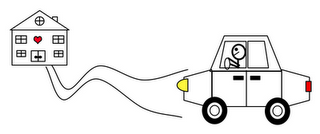 Our brain can also prune old neural pathways to quiet or unlearn associations. For example, after you move to a different home, you learn the directions to your new place and stop practicing your old path. But in those first few weeks after a move, have you ever found yourself engrossed in another thought and accidentally pulling into the driveway of your old home because your automatic pathway took over? Luckily, by refraining from the old directions and practicing the new way home, you strengthen a new neural pathway and the old neural pathway weakens. It's a good thing our brains can change, or we would still be pulling up to our childhood home.
Similar to physical skills like driving, the brain also forms neural pathways in learning and practicing emotional skills. Your emotional responses to experiences in your world are the result of well-worn neural pathways that developed over your lifetime. While our genes influence our temperament, research has demonstrated that our environment and our own mind can physically alter our brains and thus our emotional responses. This means that emotions that we want more of in our life and our world, like happiness, patience, tolerance, compassion, and kindness, can be practiced and learned as skills. Other emotions, like anxiety, stress, fear, or anger, can be dampened.
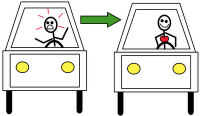 Keeping in the car motif, let’s talk about an emotional association: traffic and anger. When we get stuck in traffic, an automatic response can be anger or frustration. But, by feeling angry every time we are in traffic, we are strengthening that neural pathway and cementing that emotional response. When there is nothing we can do in that moment but accept the traffic, wouldn’t it be great to feel positive emotions instead? We can just observe the negative emotion that we are feeling and try practicing a different emotional response. We can start linking traffic with stillness and peace. This would be difficult at first because we want to let the well-developed neural pathway leading to anger fire, but by inhibiting that pathway, we help unwire those connections and strengthen a different response. As we practice responding with peace, we strengthen a new neural pathway and it becomes easier to choose.
Using neuroimaging, researchers have demonstrated significant success in reducing anxiety, depression, phobia, and stress with cognitive-behavioral therapy or interpersonal psychotherapy. By learning different strategies to recognize negative thoughts and emotions and practice alternative responses over time, neural pathways in the brain are physically altered. Science has only recently recognized the value of investing in research on behaviors that promote well-being, including compassion and happiness. By comparing the brains of experts and novices in compassion meditation, neuroscientists illustrated changes in the brain region responsible for empathy during and after meditation. Researchers are just beginning to examine the effect of training novices in skills to increase compassion. While interventions have demonstrated positive impacts on emotional states and prosocial behaviors, we look to future studies to determine alterations in the structure and function of the brain in novices who undergo contemplative and emotional training.
Let's learn and practice compassion, kindness, and happiness.
Knowing that our brains can change, we then ask, what do we want in our brains? And as a result, what do we want in our world? Most people of good will yearn for happiness, compassion, and love. Let’s start practicing.
 Gratitude reflections, compassion priming, and meditation interventions are some strategies found to enhance well-being and increase prosocial behavior. Several studies have shown the positive impact of gratitude journals, which involve self-guided listing of what you are thankful for. Individuals who kept a daily gratitude journal reported higher levels of positive emotions, including feeling attentive, determined, energetic, enthusiastic, excited, interested, joyful, and strong, compared to individuals who kept a journal on daily hassles or ways in which one was better off than others (downward social comparison). In addition, individuals who maintained daily gratitude journals were more likely to offer emotional support to others and help someone with a problem7. Contemplative interventions, born from the collaboration of meditation traditions and emotion science, have centered on developing mindfulness to enhance compassion and happiness in the lives of individuals. One recent study provided an 8-week training program in secular meditation to female schoolteachers and measured their responses to stress, conflict, and compassion. The intervention significantly reduced rumination, depression, and anxiety while increasing mindfulness, empathy, compassion, and stabilizing hostility and contempt compared to a control group6.
In my experience, learning about the concept of neuroplasticity and finding the skills to change my emotional responses has immensely improved my life. Before grasping this, I thought my mind was a black box. I didn't understand why I felt certain things beyond the immediate external circumstances. I had no idea how to change things. I scoffed at seeing a therapist because I couldn't imagine what they would help me with. I had no idea what I would even say to a therapist. Luckily, the good ones can help you understand your mind and the process of change. You don't even have to know where to start; the decision to change is enough. The practice of meditation gave me the set of skills to guide my own transformation. It has been the most life altering skill that I have gained. I shifted from thinking that my emotion and thoughts owned me to feeling like I could play a role in changing my state. This is challenging work and takes patient practice, but as I am experiencing the fruits of these skills, peaceful relationships, a joyful outlook on life, and a safe harbor within myself during difficult times, I am determined to work even harder.
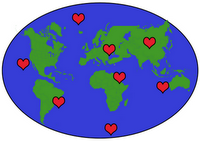 Neuroscience, positive psychology, and contemplative traditions have given us a roadmap. We know our brains can change based on our environment and our behaviors. What if we started building and reinforcing the neural pathways of love, cooperation, forgiveness, and kindness so that these things became our automatic response? What if we adopted and shared this belief that we can change and took responsibility for our outlook on life? What if we taught children in schools about their ability to reflect on and guide their emotions? What if we started priming those around us in our families and community with our own grateful reflections and kind actions? What if our compassionate actions in schools, families, and communities started shifting our culture? I find these possibilities exhilarating and hopeful. By learning and practicing these positive emotional responses, I think our world can discover a new way home and pull into the driveway of compassion.
Thank you to D. Scott Brown for reading several drafts.
COMMUNITY REFLECTIONS
SHARE YOUR REFLECTION
14 PAST RESPONSES
Wonderfully written! Easily digestible, practical and true to the science. Thank you!!
wow
That is what I look all but to get it is hard. how can the three be found? thank you too.
what my mind is thinking its the same thing written here.....what if ; if the world have only happiness and love and sacrifice....no more wars and worries,,,,,meditation really works ...thanx a lot
well, for he who justify ones dependency with plasticity is noble. but thinking a donkey is rebelling against his owner is not wise-am the donkey. affirmative actions are in place should you bother to ask what you would like and wait a positive answer. I paid 80 percent of time to cursed compensator/contributors who demand a lot of time. so trust me and say what you would like me to be/to do. thank you
It's interesting that the exploration of this topic is not more prominent in our culture. I was reading about neuroplasticity ten years ago, but I don't often see it given the attention it deserves by mainstream media.
@DenisKhan:disqus Thank you that very inspiring comment. I have all those qualities. I only fear if there are government issues because all my fields that I believe I mastered were civilian things some very ruthless. I have the ability to entertain congregations or make them love me by impressing them.
While there are some holding on I really don't know but am sure am a man of people whose inner and outer life are as different as a car and plane are.Thank you for this very warm inspirations. earth is ours though what is in it are for all.
Thank you again ,
Great post - a scientific, yet inspiring read for people who want to try to make change in their life, especially habit patterns that feel so hard to change. This makes me feel as though it is possible - I'm inspired to re-start my gratitude journal!
If you can keep your head when all about you
Are losing theirs and blaming it on you;
If you can trust yourself when all men doubt you,
But make allowance for their doubting too:
If you can wait and not be tired by waiting,
Or, being lied about, don't deal in lies,
Or being hated don't give way to hating,
And yet don't look too good, nor talk too wise;
If you can dream---and not make dreams your master;
If you can think---and not make thoughts your aim,
If you can meet with Triumph and Disaster
And treat those two impostors just the same:.
If you can bear to hear the truth you've spoken
Twisted by knaves to make a trap for fools,
Or watch the things you gave your life to, broken,
And stoop and build'em up with worn-out tools;
If you can make one heap of all your winnings
And risk it on one turn of pitch-and-toss,
And lose, and start again at your beginnings,
And never breathe a word about your loss:
If you can force your heart and nerve and sinew
To serve your turn long after they are gone,
And so hold on when there is nothing in you
Except the Will which says to them: "Hold on!"
If you can talk with crowds and keep your virtue,
[Hide Full Comment]Or walk with Kings---nor lose the common touch,
If neither foes nor loving friends can hurt you,
If all men count with you, but none too much:
If you can fill the unforgiving minute
With sixty seconds' worth of distance run,
If you can dream---and not make dreams your master;
If you can think---and not make thoughts your aim,
If you can meet with Triumph and Disaster
And treat those two impostors just the same…
Yours is the Earth and everything that's in it,
And---which is more---you'll be a Man, my son!
Rudyard Kipling
we can change and the possibilities are useful. Neuro also says truth but I find myself a bit different. Only money can please me. People love me when am not broke. I really don't know why i am this way. I tried to understand myself and the sources that bring me happiness I then found only money.
[Hide Full Comment]That correlates with my past life where I observed people having money and I had nothing.
I remember doing a lot of study and I concluded it is money that brings joy and pleasure.
I don't feel happy when am broke and am broke now. I really don't have motives to cause peoples any problems I just try to balance my good acts and my bad acts so I always make sure the good things I do are more than the bad. I also control my demons and emotions as much as I can.
I get stress 13 times everyday because university graduated persons are who I need to convince to pay some bills. It is not an easy thing to do. I get anger 10 times everyday so this too is not good but the fact is that it depends which system is working . System one in my head says avoid those disturb while system 5 is very violent. the two system's combination is system 2 which acts as a jury.
Apart from money I get pleasure if I please 1 or more people. But my deep problem is I don't spend time looking what pleases people so those I feel like I need to please them I ask what they like and what they don't. I obsessed on my own problems so I can't know about people. I just smile if they walk towards me. If I see other being very happy I do try to increase. The fact I don't understand them is because I committed a long time ago to personal issues but this should not mean I intend to show them no respect. I really respect people ad their rights of doing whatever the like.
I do believe we have the capacity to change our thinking like the article above is stating. Deborah, changes in the caste systems, bullies rising to the top , and other issues that arise under various systems of belief have more to do with individuals not really grasping the concepts of the philosophy or religion the they profess to follow. I do not really understant what you mean by "using brain plasticity to justify ones own dependency on a system....." Jeannette
compassion and wealth correlate negatively so as resources drain we are being told it is an internal issue, when the wholke system set up in the fear model needs overhauling. These little essays do not connect enough dots to help people manifest the change. AKA why Buddha mind didn't change caste systems thinking . why Christianity allowed bullies to rise to the top , Muslims and patriarchy, hierarchy...using brain plasticity to justify ones own dependency on a system is really more blame the victim -new tool old tool box.
I regularly read one of my favorite poems which has been put on a plaque in our den. The title is in essence the message ....."The person who thinks he can "