
“We strive toward knowledge, always more knowledge, but must understand that we are, and will remain, surrounded by mystery.”
“Our human definition of ‘everything’ gives us, at best, a tiny penlight to help us with our wanderings,” Benjamen Walker offered in an episode of his excellent Theory of Everythingpodcast as we shared a conversation about illumination and the art of discovery. Thirty years earlier, Carl Sagan had captured this idea in his masterwork Varieties of Scientific Experience, where he asserted: “If we ever reach the point where we think we thoroughly understand who we are and where we came from, we will have failed.” This must be what Rilke, too, had at heart when he exhorted us to live the questions. And yet if there is one common denominator across the entire history of human culture, it is the insatiable hunger to know the unknowable — that is, to know everything, and to know it with certainty, which is itself the enemy of the human spirit.
The perplexities and paradoxes of that quintessential human longing, and how the progress of modern science has compounded it, is what astrophysicist and philosopher Marcelo Gleiser examines in The Island of Knowledge: The Limits of Science and the Search for Meaning (public library).
Partway between Hannah Arendt’s timeless manifesto for the unanswerable questions at the heart of meaning and Stuart Firestein’s case for how not-knowing drives science, Gleiser explores our commitment to knowledge and our parallel flirtation with the mystery of the unknown.
Artwork from 'Fail Safe,' Debbie Millman's illustrated-essay-turned-commencement address on courage and the creative life.
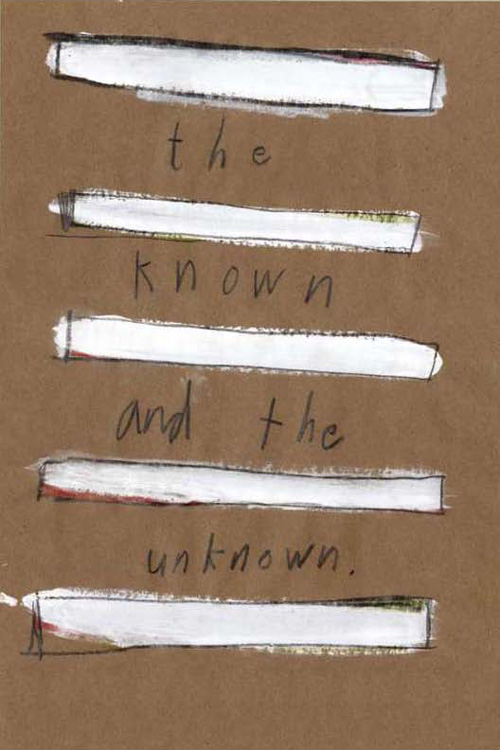
What emerges is at once a celebration of human achievement and a gentle reminder that the appropriate reaction to scientific and technological progress is not arrogance over the knowledge conquered, which seems to be our civilizational modus operandi, but humility in the face of what remains to be known and, perhaps above all, what may always remain unknowable.
Gleiser begins by posing the question of whether there are fundamental limits to how much of the universe and our place in it science can explain, with a concrete focus on physical reality. Echoing cognitive scientist Alexandra Horowitz’s eye-opening exploration of why our minds miss the vast majority of what is going on around us, he writes:
What we see of the world is only a sliver of what’s “out there.” There is much that is invisible to the eye, even when we augment our sensorial perception with telescopes, microscopes, and other tools of exploration. Like our senses, every instrument has a range. Because much of Nature remains hidden from us, our view of the world is based only on the fraction of reality that we can measure and analyze. Science, as our narrative describing what we see and what we conjecture exists in the natural world, is thus necessarily limited, telling only part of the story… We strive toward knowledge, always more knowledge, but must understand that we are, and will remain, surrounded by mystery… It is the flirting with this mystery, the urge to go beyond the boundaries of the known, that feeds our creative impulse, that makes us want to know more.

A 1573 painting by Portuguese artist, historian, and philosopher Francisco de Holanda, a student of Michelangelo's, from Michael Benson's book 'Cosmigraphics'—a visual history of understanding the universe.
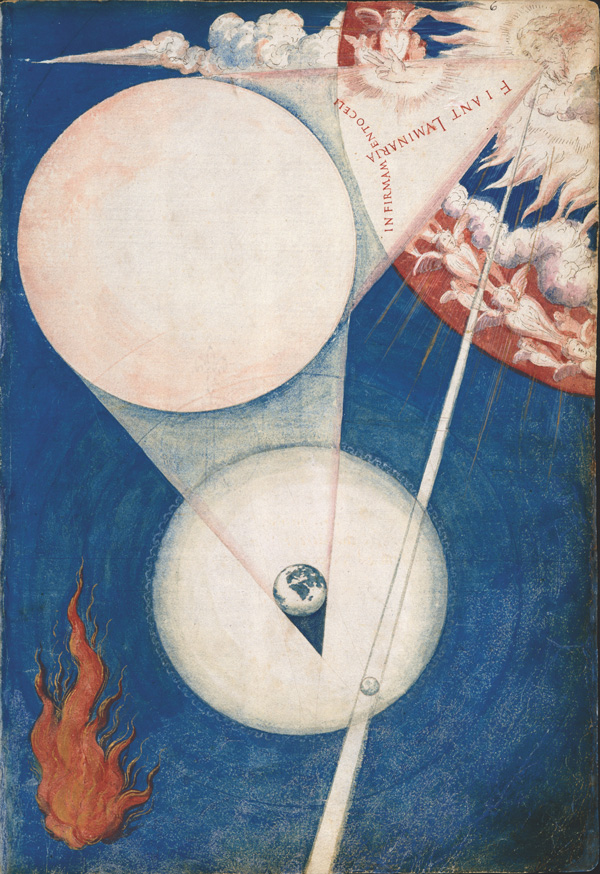
In a sentiment that bridges Philip K. Dick’s formulation of reality as “that which, when you stop believing in it, doesn’t go away” with Richard Feynman’s iconicmonologue on knowledge and mystery, Gleiser adds:
The map of what we call reality is an ever-shifting mosaic of ideas.
[…]
The incompleteness of knowledge and the limits of our scientific worldview only add to the richness of our search for meaning, as they align science with our human fallibility and aspirations.
Gleiser notes that while modern science has made tremendous strides in illuminating the neuronal infrastructure of the brain, it has in the process reduced the mind to mere chemical operations, not only failing to advance but perhaps even impoverishing our understanding and sense of being. He admonishes against mistaking measurement for meaning:
There is no such thing as an exact measurement. Every measurement must be stated within its precision and quoted together with “error bars” estimating the magnitude of errors. High-precision measurements are simply measurements with small error bars or high confidence levels; there are no perfect, zero-error measurements.
[…]
Technology limits how deeply experiments can probe into physical reality. That is to say, machines determine what we can measure and thus what scientists can learn about the Universe and ourselves. Being human inventions, machines depend on our creativity and available resources. When successful, they measure with ever-higher accuracy and on occasion may also reveal the unexpected.
[…]
But the essence of empirical science is that Nature always has the last word… It then follows that if we only have limited access to Nature through our tools and, more subtly, through our restricted methods of investigation, our knowledge of the natural world is necessarily limited.
And yet even though much of the world remains invisible to us at any given moment, Gleiser argues that this is what the human imagination thrives on. At the same time, however, the very instruments that we create with this restless imagination begin to shape what is perceivable, and thus what is known, marking “reality” a Rube Goldberg machine of detectable measurements. Gleiser writes:
If large portions of the world remain unseen or inaccessible to us, we must consider the meaning of the word “reality” with great care. We must consider whether there is such a thing as an “ultimate reality” out there — the final substrate of all there is — and, if so, whether we can ever hope to grasp it in its totality.
[…]
Our perception of what is real evolves with the instruments we use to probe Nature. Gradually, some of what was unknown becomes known. For this reason, what we call “reality” is always changing… The version of reality we might call “true” at one time will not remain true at another.
[…]
As long as technology advances — and there is no reason to suppose that it will ever stop advancing for as long as we are around — we cannot foresee an end to this quest. The ultimate truth is elusive, a phantom.
Artwork by Marian Bantjes from 'Beyond Pretty Pictures.
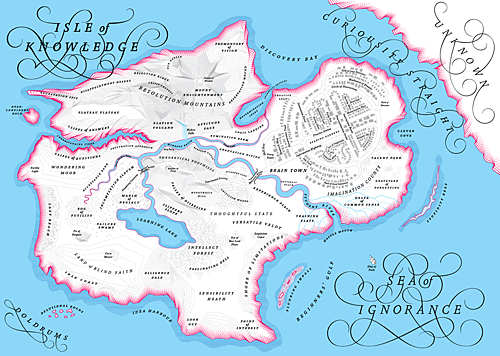
To illustrate this notion, Gleiser constructs the metaphor after which his book is titled — he paints knowledge as an island surrounded by the vast ocean of the unknown; as we learn more, the island expands into the ocean, its coastline marking the ever-shifting boundary between the known and the unknown. Paraphrasing the Socratic paradox, Gleiser writes:
Learning more about the world doesn’t lead to a point closer to a final destination — whose existence is nothing but a hopeful assumption anyway — but to more questions and mysteries. The more we know, the more exposed we are to our ignorance, and the more we know to ask.
Echoing Ray Bradbury’s poetic conviction that it’s part of human nature “to start with romance and build to a reality,” Gleiser adds:
This realization should open doors, not close them, since it makes the search for knowledge an open-ended pursuit, an endless romance with the unknown.
Gleiser admonishes against the limiting notion that we only have two options — staunch scientism, with its blind faith in science’s ability to permanently solve the mysteries of the unknown, and religious obscurantism, with its superstitious avoidance of inconvenient facts. Instead, he offers a third approach “based on how an understanding of the way we probe reality can be a source of endless inspiration without the need for setting final goals or promises of eternal truths.” In an assertion that invokes Sagan’s famous case for the vital balance between skepticism and openness, Gleiser writes:
This unsettled existence is the very blood of science. Science needs to fail to move forward. Theories need to break down; their limits need to be exposed. As tools probe deeper into Nature, they expose the cracks of old theories and allow new ones to emerge. However, we should not be fooled into believing that this process has an end.
I recently tussled with another facet of this issue — the umwelt of the unanswerable — in contemplating the future of machines that think for John Brockman’s annual Edge question. But what makes Gleiser’s point particularly gladdening is the underlying implication that despite its pursuit of answers, science thrives on uncertainty and thus necessitates an element of unflinching faith — faith in the process of the pursuit rather than the outcome, but faith nonetheless. And while the difference between science and religion might be, as Krista Tippett elegantly offered, in the questions they ask rather than the answers they offer, Gleiser suggests that both the fault line and the common ground between the two is a matter of how each relates to mystery:
Can we make sense of the world without belief? This is a central question behind the science and faith dichotomy… Religious myths attempt to explain the unknown with the unknowable while science attempts to explain the unknown with the knowable.
[…]
Both the scientist and the faithful believe in unexplained causation, that is, in things happening for unknown reasons, even if the nature of the cause is completely different for each. In the sciences, this belief is most obvious when there is an attempt to extrapolate a theory or model beyond its tested limits, as in “gravity works the same way across the entire Universe,” or “the theory of evolution by natural selection applies to all forms of life, including extraterrestrial ones.” These extrapolations are crucial to advance knowledge into unexplored territory. The scientist feels justified in doing so, given the accumulated power of her theories to explain so much of the world. We can even say, with slight impropriety, that her faith is empirically validated.
A 1617 depiction of the notion of non-space, long before the concept of vacuum existed, found in Michael Benson's book 'Cosmigraphics'—a visual history of understanding the universe.
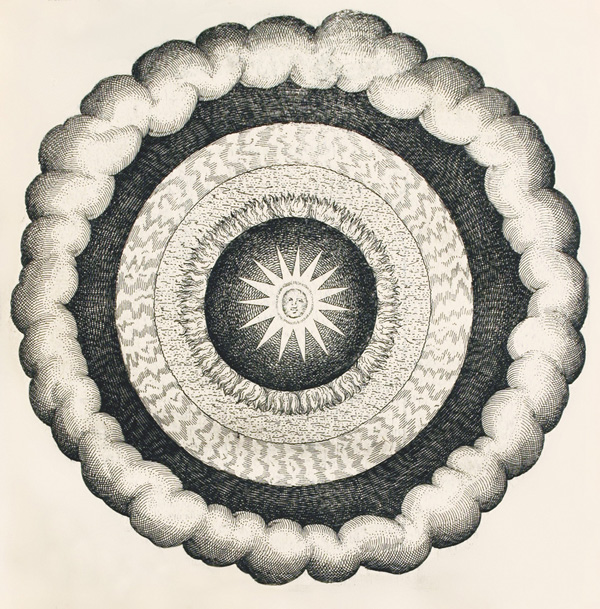
Citing Newton and Einstein as prime examples of scientists who used wholly intuitive faith to advance their empirical and theoretical breakthroughs — one by extrapolating from his gravitational findings to assert that the universe is infinite and the other by inventing the notion of a “universal constant” to discuss the finitude of space — Gleiser adds:
To go beyond the known, both Newton and Einstein had to take intellectual risks, making assumptions based on intuition and personal prejudice. That they did so, knowing that their speculative theories were necessarily faulty and limited, illustrates the power of belief in the creative process of two of the greatest scientists of all time. To a greater or lesser extent, every person engaged in the advancement of knowledge does the same.
The Island of Knowledge is an illuminating read in its totality — Gleiser goes on to explore how conceptual leaps and bounds have shaped our search for meaning, what quantum mechanics reveal about the nature of physical reality, and how the evolution of machines and mathematics might affect our ideas about the limits of knowledge.
COMMUNITY REFLECTIONS
SHARE YOUR REFLECTION
3 PAST RESPONSES
Very good article. Iacocca of Chrysler motors used to tell his engineers 'don't try to develop a product 100% perfect otherwise you will be late to enter the market and lose it'. At the beginning of 20th Century many Physicists believed and said that everything whatever to be known is already now known. But then Einstein and Aspect Experiment and Heisenberg and many new revelations made us realize that 100% knowledge is not possible.
What a cool article. I have so much to say on this. Mystery has been central to my knowledge base for forever. I will reframe an assertion made several times in the article: those that have successfully combined action with intuition have given us the best we've got.
I'm going to take it one step further and offer the same extrapolation made in other notable cultures around the world, which is that action and intuition have masculine and feminine traits, respectively. The making of things, esp. an environment for good living, is masculine, active. The making of people is feminine, intuitive. Nothing a man makes can match the creative power of what the woman has in store. Or, hell, I don't know, maybe it can, but, a whole new person -- that's up there. And all of that is intuitive. All she needs is to eat and live well and be happy in order to express her strongest power. A man needs to make things to show his creative output.
I hope this type of understanding can empower people and help heal the rift between the sexes. I see a tendency in our culture to lessen expressions of both masculinity and femininity. Personally I think it is a put-on by the controllers to keep control of the controlled. Humankind is not androgynous, not even those born with both male and female traits. There is no just-human. There are male humans and female humans. The universe seems to be a lot like that, as various cultures have asserted over the ages, and neither action nor intuition accomplishes anything good when they are divorced from each other. Just a thought.
[Hide Full Comment]The sea of ignorance begins with ignoring. What do we ignore, and just as importantly, why? What's the hidden agenda in ignoring? What are we pursuing while we simultaneously ignore? Before we ponder the mysteries of the cosmos, we would do better pondering the mysteries at street level, because at street level we are losing life and love on planet earth. Look around. No need to look to the stars for answers to life and love. We are losing our children's health, the minds of the young and the elderly; the bodies of all peoples and all creatures of land, sea, or air, even the seeds of plant and crop life are fodder now for gambling with the manipulation of genes. We douse all of life and all the living with lethal cides of all kinds and sorts that pollute the soils, waters, and air upon which all of life depends. We make weapons larger and more deadly, and march with them around the world reeking havoc and suffering, leaving destruction and chaos behind, and proclaim liberty all the while. Why? Do we really believe that are weapons are speaking for us about freedom, or any other worthwhile message? We chop down ancient and magnificent forests teeming with life and diversity to build more unsustainable buildings, or to burn away in kitchen ovens or to fuel more unsustainable houses and cars with lethal and explosive energies. Or, we eliminate forests, meadows, and wetlands to build and "economically" develop ever more and more glittering "manmade" grandiose cities and suburbs, all of which are non self-sufficient and unsustainable, devoid of the natural world, and heat-producing from all the concrete and asphalt "manmade" materials with which they are built. Why?
If we can't answer these questions, we won't need to be pondering what is "out there"in the cosmos. We are trading away love and life itself for what? We are all still standing here looking on, our pockets full of the money of our schemes and endeavors, and what has happened to life and love while we "ignore" life and love?
Newtown and Einstein might well be two significant scientists, and yet, their work is still exclusively promoted and applauded, force-fed to new generations, while the great science of others is ignored, suppressed, hidden, and buried, revelatory and illuminating scientists like Walter Russell and Viktor Schauberger, Dr. Brian O'Leary, and others, scientists who didn't lose sight of the workings of nature, natural processes, and natural laws. Why do we promote some scientists, and bury the work of others? We invest in ignorance, and ignore at our own great and perilous folly. Our money and the power that it buys, no matter how much of them we possess, can never and will never be able to replace life and love. Why is this? This is truly the first mystery worth pondering. What is it about life and love that is freely bestowed and is also priceless?
Spend some time looking around our planet earth while it is still here, because we are quickly losing touch and understanding with it. And without it, well, the stars will be looking on with great, mystifying sadness. We threw away life and love on our one shared planet home, and we didn't even question why.
[Hide Full Comment]