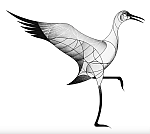
At the confluence of a bird's two windpipes, sitting directly over its heart, is a sound-making organ no larger than a lentil -- and from this tiny syrinx, a dozen rings of bone and two dozen muscles craft what biologist David Haskell calls the work of "quick-fingered jewelers of air." His essay is an invitation to cross one of the oldest divides on Earth: the 300 million years of evolutionary separation between birds and mammals. We hear differently, think differently, perceive time differently -- and yet, Haskell argues, when a human mind truly meets a bird's call, "a new language is born." He traces how bird voices encode seasons within seasons, reveal individual personalities, carry irony and humor and courtship and grief -- a grammar as intricate as any human tongue. This is not merely poetic: laboratory studies confirm that bird utterances are "organized by rules, powered by creativity, and shaped by culture and context." What Haskell offers, quietly and without sentimentality, is a case that listening to birds is not a hobby but an ethical practice -- a way of weaving ourselves back into a community we have nearly forgotten we belong to. Step outside, he suggests, and give them the simple gift of your attention.