
[Helen is a mindfulness instructor, and member of the Auroville community in South India. In 2025, she and fellow Aurovilian Nikethana embarked on a year-long exploration of kindness — interviewing community members, facilitating meditations and sharing circles, and studying what happens when we pay close attention to the care quietly flowing between us. What follows is her account of that journey.]
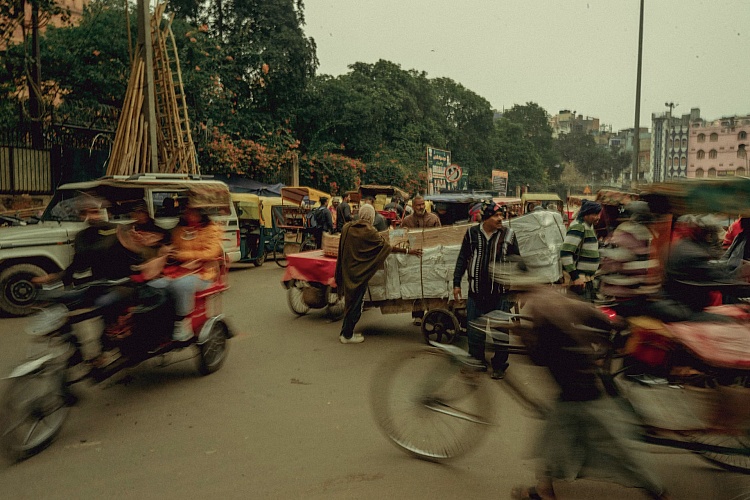 I was on my motorbike, weaving through Indian traffic — the honking, the swerving, the near-misses that never quite become misses — when something shifted inside me. A few days earlier, I had sat with a woman named Nausheen for our kindness project, and she had said something I couldn't stop turning over. She told me that kindness is so intrinsic to life that we don't even see it. Like breathing — we only notice it in the absence.
Those words rewired something. Suddenly the traffic looked different. I realized that every moment on that road, we are choosing not to hit each other. Not just from self-preservation, but from genuine care. We could strike someone more vulnerable and walk away unharmed, but we don't. The chaos I had always seen as aggression revealed itself as a continuous, unspoken act of mutual protection. A dance of invisible kindness, flowing between strangers, again and again.
This was not an insight I went looking for. It found me. And that, I would learn, is how kindness works.
⟡ NINETEEN CONVERSATIONS ⟡
The project began as an exploration. With support from Stichting De Zaaier, myself and Nikethana set out to understand what kindness means to the people of Auroville — this intentional community of over fifty nationalities, a place aspiring toward human unity while navigating very real tensions and divisions. We selected people at random from the residents' list. No filters for who might give a "good" story. We trusted that every person carries a kindness story within them.
We were right. Over the course of the year, we sat with nineteen people — in their kitchens, on verandas, in quiet rooms away from the afternoon heat. We asked simple questions: tell us about a time you witnessed kindness, a time you received it, a time you gave it. And then we listened.
What came back astonished me, every time.
⟡ TIFFINS AT THE DOOR ⟡
Helena, a young mother from Europe, told us about how she struggled with her newborn, far from family, in a place that could have felt isolating. But the mothers' group in Auroville had an initiative called "Made with Love." When you gave birth, for one month, a different person cooked food for you every day. They would just leave the tiffin outside the door and go.
"We would open the tiffin and be like — oh! What is for dinner tonight? I could see the love in the food. It meant my husband could be more present with me, with the baby. It was one of the most beautiful acts of kindness I have experienced."
What moved me was not just the generosity, but the architecture of it — an invisible system of care, where no one needed recognition, where the gift simply appeared and the giver walked away.
Mathilde, another mother, described a similar experience. When her daughter was born, she had been overwhelmed by the support. And then, naturally, she began cooking for the next family. She told me the giving filled her up. She couldn't name it as a "kind action" in the moment — it was just something that needed doing.
⟡ THE CEMETERY, THE GATE, THE SLIDING DOOR ⟡
Some stories reached deeper. Shankar shared about the years he and his young family spent living in a cemetery after his brother threw him out with nothing. Snakes at night. Garbage smoke choking them. No help from any relative. It was Auroville that took him in — people he didn't know gave him a bed, a fridge he still uses today. Now he works day and night at Matrimandir, and his definition of kindness was disarmingly simple: "It is enough if I don't disturb others. It is enough if I don't make others suffer. If I can help, I will. And if I can't help, I will at least not harm."
Patricia, an older resident, offered a completely different lens. For her, kindness is a quality of consciousness — something that moves through a person when the ego steps aside. She described watching a young girl open a gate for a passing taxi — a fluid, unselfconscious gesture amid construction dust and clamor. Patricia said her inner being stood up and applauded. Not because the act was extraordinary, but because it confirmed that the spirit is alive.
Celestine, who for years had tended the Auroville bus stop as an act of quiet devotion, spoke about a man who had helped her for thirty years without ever expecting anything in return. He had fixed her sliding door. And now, she told us, every time she uses it, she thinks of him. Kindness, she was teaching me, doesn't expire. It lives in the objects we touch, the spaces we share.
⟡ THE DIFFICULT DOOR ⟡
Not all the conversations were soft. Alongside the stories, we asked people what makes kindness hard — what blocks it. The answers surprised me.
Uma spoke openly about how painful it was for her to receive kindness. She described plotting how to ask five people for help when her community kitchen was running short — writing out scripts, feeling her stomach turn. Four of them said yes immediately, and told her they had simply been waiting to be asked. "Our kindness doorway opens when someone asks," she reflected. "We are not yet proactive enough to anticipate and go kind."
What our findings confirmed was that the barriers people face in giving and receiving kindness are not random obstacles — they grow directly from how each person understands kindness itself. Women, who tended to experience kindness through emotional connection, reported depletion and exhaustion as their primary barrier. Men, who more often framed kindness through principles and cognition, struggled instead with presence — not "do I have enough to give?" but "am I sufficiently here to act?" Indian participants often grappled with the gap between philosophical ideals of selflessness and the messy emotional reality of actually being vulnerable. North American participants wrestled with cultural values of self-reliance that made receiving feel like weakness.
These weren't failures. They were the natural friction of different human instruments playing the same note in different keys.
⟡ THE RIPPLE ⟡
Across all five of our interventions — the storytelling, a film screening, acts of kindness, loving-kindness meditation, a sharing circle — eighty-three people participated. When we asked them afterward whether they felt inspired to do anything differently, nearly seventy percent said they intended to adopt new kindness behaviors. Another seventeen percent wanted to deepen practices they already had. That's almost nine out of ten people, moved to act — not by instruction, but by encounter.
Jean, a young man who had been bitten by a dog during a cycling trip, told us about the six strangers at a campsite who immediately came together to help — one offered food, one cleaned his wound, one lent him a car, one drove him to the hospital. The cyclist who drove him told Jean his own story: weeks earlier, a stranger had fixed his tire and asked for nothing in return except a promise to help seven people. Jean looked at me and said, "So I'll make sure I help at least seven people too."
This is how kindness moves. Not as a program or a policy, but as a living chain — each link forged in a moment of someone choosing to show up.
⟡ WHAT THE MIRROR SHOWED ME ⟡
Shanta, one of the older Aurovilians we spoke with, told us about a night she spent crying after another community member scolded her harshly for making a small campfire with her son. As she sat on her bed that evening, something shifted. She began thinking not about herself but about him — and a wave of compassion rose up, not from her mind but from somewhere deeper. Two days later, unprompted, the man came to her and said, "Shanta, I am coming to tell you, sorry. You see, I am a monster." She hugged him. They are friends to this day.
"I was sure," she told me, "that when I started to think of him with compassion, he received something."
That story reflects something important I learned this year. Kindness isn’t always something we do; it can arise from an inner opening. As we loosen our grip on our own stories and meet the tender, vulnerable parts of others, compassion naturally begins to flow — often touching others without any effort or intention.
This project has been a mirror, showing me that kindness is less about doing and more about being — about remembering the simple, unguarded ways our hearts already know how to meet.
Auroville's founder, known as The Mother, once described kindness as "an indispensable step towards the widening and illumination of the consciousness." I think I understand that differently now. Not as a step we must force ourselves to take, but as the ground that appears beneath us when we stop clenching — when we let the traffic be a dance, and the tiffin at the door be an act of grace, and the sliding door be a blessing that renews itself every time it opens.
COMMUNITY REFLECTIONS
SHARE YOUR REFLECTION
3 PAST RESPONSES