
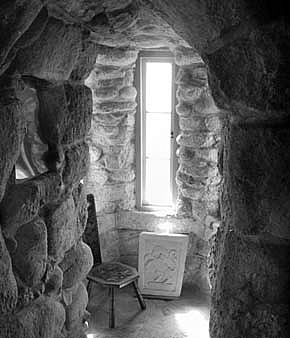
Inside one of Robinson Jeffer's Tor House towers. Photo, R. Whittaker
Keynote address, Robinson Jeffers Fall Festival
Monterey, CA, Oct 15, 2022.
After coming across a poem by Czesław Miłosz dedicated to Robinson Jeffers, I wanted to learn more and found Roan Stallion, Tamar, and Other Poems in the Berkeley library. In that first reading, the poems seemed out of reach. Their dramatic narratives, granite-like emotional sturdiness, and nature’s imposing presence were difficult to reconcile with my interest in exploring what is privately felt.
I was also wary of his retreat in Carmel. If I was an expert on anything as a 24-year-old exile, it was the tendency of the fire of a dream to use everyone and everything as fuel. A year later, I came across “Hurt Hawks,” and this poem became my re-entry into Jeffers. The emotional charge of the encounter with the wounded hawk reminded me of Federico García Lorca, but in Jeffers, pain acquired a stripped-down sincerity and power unlike anything I’d read.
I was also struck by how, in lines like “The broken pillar of the wing jags from the clotted shoulder,” Jeffers managed to bring together the epic revolutions of the world and the intimate rotations of the heart. Until then, I’d mainly engaged with artists and writers concerned with either the epic or the intimate—but not both.
The next Jeffers book I read was Be Angry at the Sun. It was the late eighties, and his visionary poetry helped me navigate this period of cynical trickle-down prosperity, empire-building, and cultural exhaustion. As I read more of his poetry, I became intrigued by and skeptical of his impassiveness about our role as spectators and participants in the dynamics between nature and a God-like presence. I couldn’t tell if Jeffers was Prometheus, the eagle who ate his liver, or the mountain that witnessed the spectacle. In time, I came to appreciate that he was all three, and I grew to admire his poetry for its capacity to speak to both my dying body and my eternal being.
It’s difficult to imagine reading Jeffers’s poetry without wanting to know more about the man who wrote it, particularly for someone like me, who was—and is—interested in the integrity and methods of the artists and writers I respected.
In 1990, I’d abandoned physics for art without knowing what this choice meant in practical terms, so I was searching for guidance on making sense of being an artist in the world. I wanted to learn from people whose work was faithful to the values of their lives and whose lives were loyal to the values of their work. And there he was, almost accidentally, as a black book with red lettering in my hand: Robinson Jeffers.
Jeffers’s studies of medicine and forestry and the incorporation of scientific knowledge into his poetry showed me an example of how science and art could serve each other. More importantly, his insistence that life, poetry, and nature ought to be responsive and responsible to one another resonated with me. The spirit I’d initially perceived as a remote stone temple in the sky became the aspiration of a poet and man who sought to balance dignity and humility, awe and unvarnished observations, geological time and the immediate moment, courage and surrender, and art and life.
The questions I wanted to answer were: Why attempt to create art? And: Of what use is it?
These questions were urgent and threatened most of those activities and works we usually describe as art. Of course, one can paint, write, or create installations without considering these questions, but when art is brought forth by these activities, It’s because they have, in some way, answered them.
These questions are easy to state but difficult to understand. Perhaps not at first. At first, they seem familiar and willing to accept almost any answer. But when we consider the variety and elusiveness of the forces we must account for, and the mysterious nature of purpose in the work of art, the apparent familiarity and tolerance of these questions vanish.
What does their disappearance leave in their place? Often a hole that we—sensing the abysmal quality of this absence—tend to cover with distractions, cynicism, or the replacement of purpose with preachy didacticism.
In those early days of my life as an artist, much of what I saw around me was opportunistic, superficial, trendy, and ultimately irrelevant to the pursuits that mattered in my life. I knew it was easy to lie to oneself about everything, especially one’s work, and one could always justify life-depleting compromises as “being realistic” or sophisticated. However, I wanted more than that, and Jeffers helped support my belief that there was an authentic way of working that promised not necessarily success but the possibility of meaning.
Here is a passage from his foreword to The Selected Poetry of Robinson Jeffers: “I decided not to tell lies in verse. Not to feign any emotion that I did not feel, not to pretend to believe in optimism or pessimism, or irreversible progress; not to say anything because it was popular, or generally accepted, or fashionable in intellectual circles, unless I myself believed it; and not to believe easily.”
Who would disagree these are words worth living by? But how many of us do it, especially when our reputation or livelihood depends on being appreciated?
It’s easier to dismiss popularity when we don’t have skin in the game. It’s even harder not to crave popularity and accolades when our flame has been extinguished, and all we have left as artists is the approval of others or the benefits of money. We give ourselves too much credit—and also not enough. We can all be tempted, but It’s possible to resist temptation. Our judgments and opinions often stem from envy, fear, and weakness rather than strength and honesty. Yet, we can strive for more. In the effort to try to do better, I find it helpful to seek clarity in aims that are not merely socially defined. In this, Jeffers is a powerful guide.
One hundred years before the birth of Robinson Jeffers, the artist and art critic John Ruskin wrote:
“All true art is praise. Fix, then, this in your mind as the guiding principle of all right practical labour, and source of all healthful life energy,—that your art is to be the praise of something that you love. It may be only the praise of a shell or a stone; it may be the praise of a hero; it may be the praise of God:—your rank as a living creature is determined by the height and breadth of your love; but, be you small or great, what healthy art is possible to you must be the expression of your true delight in a real thing, better than the art.”
But before we can speak of the height and breadth of our love, we need to find what we love, which is not always easy in our cynical and confusing age.
So, how do we find what we love?
In his 1934 letter to Sister Mary James Power for her book Poets at Prayer, Jeffers wrote: “I think that one may contribute (ever so slightly) to the beauty of things by making one’s own life and environment beautiful, so far as one’s power reaches. This includes moral beauty, one of the qualities of humanity, though it seems not to appear elsewhere in the universe. But I would have each person realize that his contribution is not important, its success not really a matter for exultation nor its failure for mourning; the beauty of things is sufficient without him.”
Then, in his 1937 poem, “The Answer,” he wrote:
Then what is the answer?—Not to be deluded by dreams.
To know that great civilizations have broken down into violence, and their tyrants come, many times before.
When open violence appears, to avoid it with honor or choose the least ugly faction; these evils are essential.
To keep one’s own integrity, be merciful and uncorrupted and not wish for evil; and not be duped by dreams of universal justice or happiness. These dreams will not be fulfilled.
To know this, and know that however ugly the parts appear, the whole remains beautiful. A severed hand is an ugly thing and man dissevered from the earth and stars and his history... for contemplation or in fact...often appears atrociously ugly. Integrity is wholeness, the greatest beauty is
organic wholeness, the wholeness of life and things, the
divine beauty of the universe.
Love that, not man apart from that, or else you will share man’s pitiful confusions, or drown in despair when his days darken.”
These two writings by Jeffers point to what I understood early in my encounter with the poet from Tor House. Namely, discovering what one loves is assisted by looking with attention and respect at all that is great and small, remaining engaged in the act of living, and recognizing our connection to all there is. The art that emerges from this love is not praise, as Ruskin wrote, but revelation, as Jeffers suggests.
Despite his influence on my artistic and personal development, my wariness of that fire of genius that consumes everyone around it remained. I admired Jeffers’s rejection of many trappings that appear unavoidable in our contemporary life and his ambition to build a home that could shelter his family and the values that kept them together and guided his poetry. But there was a denial of the human world and a pursuit of utopia in his granite cottage without electricity that struck me as a warning.
Does one need to move, literally and figuratively, to an isolated strip of land by the sea to maintain one’s integrity and quality of work?
Frequently, the biographical references we recognize as warnings say more about us than about their source, and this was the case for me with some of Jeffers’s choices. As an exile, I was—and am—familiar with estrangement, distance, and a notion of home that is more like a unicorn than a real possibility. I thought I recognized in his basket of rejections and his claim of a promontory by the sea some of my hopes and fears.
I explored this warning for many years. Sometimes, it took physical form, as in the painting of a melting ice version of Hawk Tower or of Jeffers with the twins walking into the blackness—a painting that some of you might have seen at the Monterey Museum of Art’s exhibition. Other times, my concerns stirred inside me as I watched one of my children paint in my studio, as I saw my work at an art fair or auction, or in those moments late at night when I wondered whether I’d bet the house on a losing unicorn.
Eventually, my concern with that ominous fire led me to Tor House. For me, it represented Jeffers’s philosophy made into a place, with all the risk and possibility the embodiment entails. What could I learn from his choices, I wondered? As I meditated on Jeffers’s stonework and its influence on his life and poetry, I also asked what masonry work had helped shape the quality of my own. These wonderings acquired even more urgency during the isolation brought about by the pandemic, so I decided to reach out to the Tor House Foundation in the hope they would let me work there for a week.
I realized this seemed like an unlikely possibility. How could a typically messy painter convince the Foundation to let me bring oil paints into a raw-granite historic home? But after dozens of emails, phone conversations, and many questions and clarifications, they agreed to let me work at the house—and to let my daughter, Gabriela, film my visit.
We were there for five days. Elliot would let us in early in the morning, and we worked until sunset. I painted inside and outside the house, and Gabriela brought her camera to every corner of Jeffers’s household. We ate in their dining room, played their piano, sat quietly next to the bed by the window—one I’d read about years earlier in Robin’s poem—and admired the narwhal tusk over the fireplace. We also took walks on the beach, looked at Point Lobos in the distance, and tried to stay warm inside the frigid house.
I returned by myself a few months later to finish my novel, The Year of the Moth. Now that I have spent time at Tor House and written at Jeffers’s desk in Hawk Tower, his life still feels extreme, but that extremeness seems refreshingly sane and aware—the almost-fulfilled promise of an exilic imagination. Home for Jeffers was an actual place and a myth functioning as a bulkhead against the restless waves of time and memory. In his poem “To the House,” written while Tor House was being constructed, he writes: “to build us a hold against the host of the air.”
In my more-than-three-decade exploration of that hold, I have found areas in which Jeffers and I share concerns and areas in which he has revealed things and experiences I would have overlooked. Since my teens, I have strived to connect art and life, and Jeffers has taught me how he built and maintained that bond. His poetry has shown me how one might reconcile a nursery of stars with a passing glance and create meaning in the friction between words. These observations and transformations have led to individual paintings, sculptures, and photographs, as well as entire cycles, essays, and poems.
The Spanish poet and singer Joan Manuel Serrat wrote about Antonio Machado, a Spanish poet somewhat contemporary to Robinson Jeffers: “Neither prophet nor martyr Antonio wanted to be, and a bit of both he was unintentionally.”
We can also think of Jeffers as a prophet and martyr, though less unintentional than Machado. Jeffers understood he was after the discovery of our universe and our place in it. He trusted the force and freedom of poetry to help us accomplish this and was cognizant of the price it might cost him.
In the foreword to The Selected Poetry of Robinson Jeffers, which I mentioned earlier, Jeffers wrote: “Long ago, before anything included here was written, it became evident to me that poetry—if it was to survive at all—must reclaim some of the power and reality that it was so hastily surrendering to prose. The modern French poetry of that time, and the most ‘modern’ of the English poetry, seemed to me thoroughly defeatist, as if poetry were in terror of prose, and desperately trying to save its soul from the victor by giving up its body. It was becoming slight and fantastic, abstract, unreal, eccentric; and was not even saving its soul, for these are generally anti-poetic qualities. It must reclaim substance and sense, and physical and psychological reality. This feeling has been basic in my mind since then. It led me to write narrative poetry, and to draw subjects from contemporary life; to present aspects of life that modern poetry had generally avoided; and to attempt the expression of philosophic and scientific ideas in verse. It was not in my mind to open new fields for poetry, but only to reclaim old freedom.”
Robinson Jeffers is an intimidating example for anyone with artistic aspirations. His intelligence and prescience make him challenging to emulate. Most of our attempts at art seem small against the beauty and power of his verse, and the price he paid publicly for his integrity and beliefs was high.
And yet, we need him. We need his reach, vision, and power—not despite his imperfections but because of them.
We know too much about the possible and the small. Many forces try to convince us that petty intellectual and emotional ambitions, vulgarity, popularity, and personal benefit are the goals that matter—or the only ones we can attain.
So, we need the example of people and artists capable of hanging stones in the air against all the forces that say it cannot be done, and with hands that are necessarily too small and unprepared for the task.
We need Robinson Jeffers, and I’m grateful for his influence on my life and work.
Reflections
Be the first to share your reflection on this interview.