
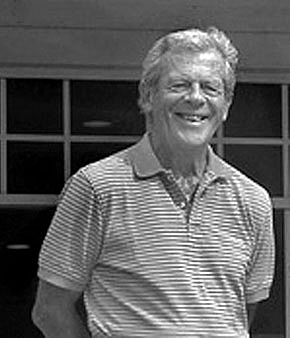
During a recent visit with San Francisco City College professor Steve Georgiou, I was being treated to one story after another as we looked through his intriguing cache of Lax memorabilia. (I’d met Georgiou after reading In the Beginning Was Love: the Contemplative Words of Robert Lax - one of his three books that came out of the time he’d spent with Lax on Patmos. It led to an interview (works & conversations #34) and the start of a long friendship.
Steve told me he’d sent an issue of w&c to his friend Jack Kelly. “He’s married to Lax’s neice, Marcia. I think you’d like him.” He handed me a copy of the The Merton Seasonal (Vol. 26, Spring 2001) from his scattered papers. “This features Kelly’s article about Lax’s return to his childhood home in Olean, NY where he spent his last days.”
Whatever else I might have learned from Georgiou in the past, somehow I hadn’t realized how deep his links really were to that remarkable man, Robert Lax. Kelly’s article was just another example of connections that continued to unfold, and I marvelled at my good fortune in being at the edge of this circle of profound spiritual goodness.
Not long afterwards, I got a warm email from Kelly himself, and I gave him a call. By the time we said goodbye, I knew I had a new friend. Then, a couple of weeks later, I received a large envelope from Kelly with several more things including a piece he’d written about his adventure of meeting Ernest Hemingway in 1955 in Cuba. Jack and his friend, Joe Barrett, were midshipmen on an NROTC cruise.
Jack wondered it there might be something in the package I might want to publish. On a follow up call, I thanked Kelly for the treasure trove, and told him I was sure I'd publish something. I told him I was swamped with material for the upcomng issue and struggling to fit it all together, but however I solved this puzzle, I looked forward to the further unfolding of our friendship. So the news of his death was not only a shock, but as the loss of a real friend, one I’d barely met along with all the unborn goodness I anticipated.
In its wake, his wife Marcia told me about some of Jack’s earlier writing from when he was a barge captain. He’d kept a journal of stories from those days. Would I like to see some of them? Indeed. As I read them, I could see why he was a Hemingway fan. Although we’re not including any of that work here, I plan to publish something of them in an upcoming issue of our newsletter. I just wish he could have had the pleasure of seeing his Cuban Interlude in print in our new issue.
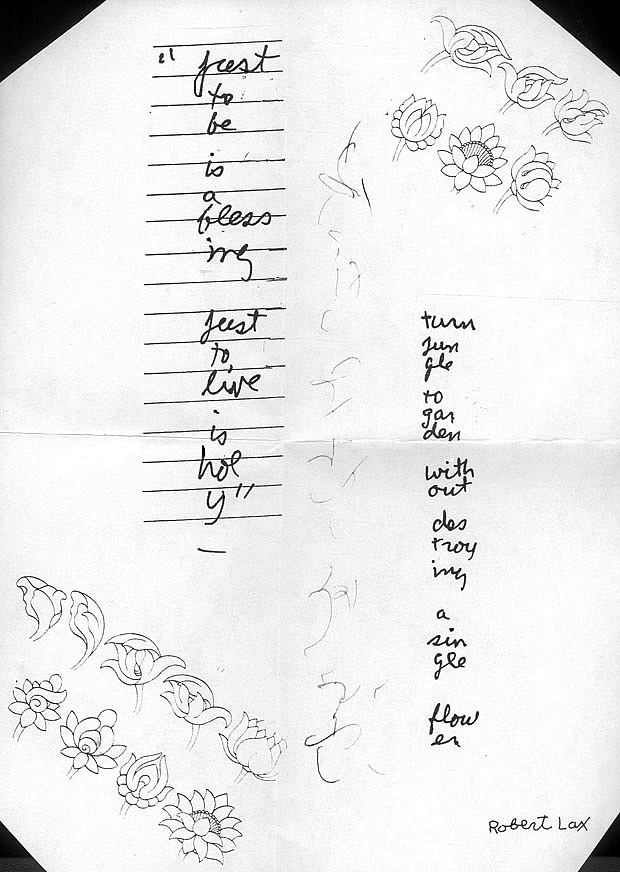
To round it out a bit, one of Jack's drawings (he was artist, too) is included, a photo of him with Robert Lax and one of Lax's poems— rw.
The bus driver let us off at a dusty road, directing up past small, white shacks, barefoot children running playfully. They watched us walk by, bright eyes in brown faces, looking surprised. Two young men in naval uniforms, “Americans” one whispered.
The road let up to a fenced property, large gate securely locked, the sign in English and Spanish: “Visitors by appointment only.” A small boy showed how to get through and we entered, continuing up the long drive to the large house at the top of the hill. Beyond the house, the land sloped down and away and we could see the city and the bay. We did not have an appointment, only the ineffable spirit of adventurous youth. We are trespassing at a private residence in a foreign land, with the attitude that nothing can go wrong, compelled to our mission. We have come to meet our literary hero whose stories we marvelled over, whose books we admired, whose life we envied.
The newspaper downtown announced his return from the U.S. and we set out to find him. We are at his front door and timidly knock. We could see through the screens dim outlines of furniture and a large figure unfolded from a chair, approached the door and opened it widely. “Hello boys, come on in.”
He smiled and shook our hands. He said he’d seen our ships come in yesterday and how did we like Havana? He gestured to chairs near his, around a large coffee table completely covered by bottles of scotch, rum, gin, vodka and tequila. He was sipping from a glass and offered us a drink.
When he was our age, he’d volunteered to drive ambulances in Europe during World War I. Severely wounded by an exploded shell, he spent months recuperating in an Italian hospital tended by an American nurse, his first true love. She was in his early stories and his classic For Whom the Bell Tolls. “Do not ask for whom, it tolls for thee.”
He enjoyed how we found him, taxi to ferry, bus to Cojimar where we thought he would be, just his sleek fishing craft bobbing in the water. “Si, Si... no comprendo... not here.” Then our angel, a retired American, told us to bus to San Francisco de Paula, wrote a note in Spanish describing us as relatives, and the bus driver let us off.
We operated as he would’ve, striking out to the unknown - somewhere between fearless and stupid, like driving an ambulance in a combat zone - picking up the wounded, then becoming one.
We are far from a battle zone here, this large commodious house. He took us from room to room. The dining alcove had a long table with a dozen chairs, greater kudus mounted on the wall, magnificent specimens from his African adventures, a room where a bed was covered with unopened letters and packages—“To be answered at once.” Then out back to the generous lawn, the stone building where he wrote, and an uninterrupted view of the harbor and Havana across the bay.
About the stone building: “Yes, that’s where I work. I used to think that one day when I had money, I would have a large slide made and when I finished work I would slide down from the building to the pool. But I never had the money.”
We settled on the back porch of his house, and he brought out a huge album filled with photos Life photographers had given him. We’d already seen at least a dozen in the magazine the past year. There were hundreds of photos and he carefully turned the pages for us, told stories about them—boxing with the natives, the tents they stayed in, the animals they took, tigers raiding livestock, elephants to be avoided, water buffalo to be avoided, gazelles and kudus in the distance grazing, then spooking, excellent photos of his return to the Green Hills, a country he loved. “I’d like to go back as a guide, set up groups—good money, and a helluva lot easier than writing.”
“Why have you settled here?” I asked.
“I wrote For Whom the Bell Tolls in this house and I’ve always done well here. Easy to like a place where you have had good luck.
“Never write too much at a time. Stop at a good place where you know what’s going to happen, then quit for the day. Don’t think about it. Let the subconscious work. The main thing is to know what to leave out. I rewrite a lot—re-did the first part of A Farewell to Arms many times. Your purpose is to convey to readers so they think it’s something that happened to them. Only compete with dead writers you know are good, like Tolstoy, Crane, Flaubert, James Joyce, Doestoevsky. Some will inspire you, others will bore you, some so beautifully written you’ll feel hopeless.”
“Writing is the most serious business there is—and imagination is the peak of art. Not what you are, but what you do that counts. Know places well and your characters too, then invent. As I say, stop writing that day when you know what’s coming next. The end will come.”
“Don’t slant your stories. Do it the way you see it. Good stuff always pays. Don’t do an outline. Endings change as you write. Start with journalism, then practice daily. Describe what you’ve seen. Make it alive, then get the emotion down. Write quiet stories and make them interesting. Learn how to see things as they are. You must see and hear, even reach out to smell the story. The best stories are invented. Reach for the fourth dimension. Reach for the soul. See things clearly so you write as they are. Never judge a man. See him as he is and let the reader judge. Understand him completely and present him without your own reactions mixed in.”
The afternoon sped by. He answered our questions thoughtfully, helpfully. He was charming and at ease, in no hurry in any way. He was enjoying our company and Joe and I relaxed with him in laughter and pleasure. He had friends coming but it seemed he wouldn’t care if we stayed. But we had the sense to take our leave. We walked on clouds down from the mountain top, our unforgettable experience with us— and his farewell: “Good luck to both of you.”
*************************
Rounding this out a bit, we include one of Kelly's drawings, a photo of Jack with Robert Lax, and an original of one of Lax's poems just as he wrote and drew them.
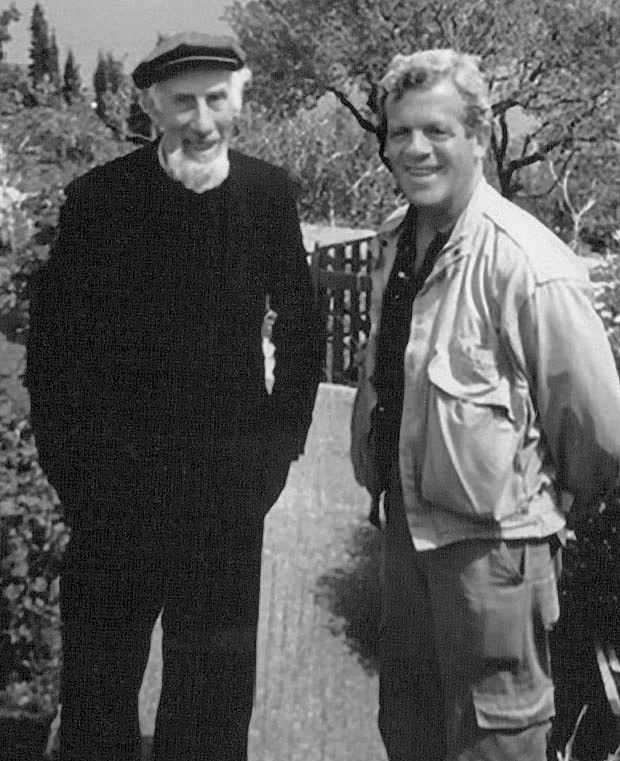
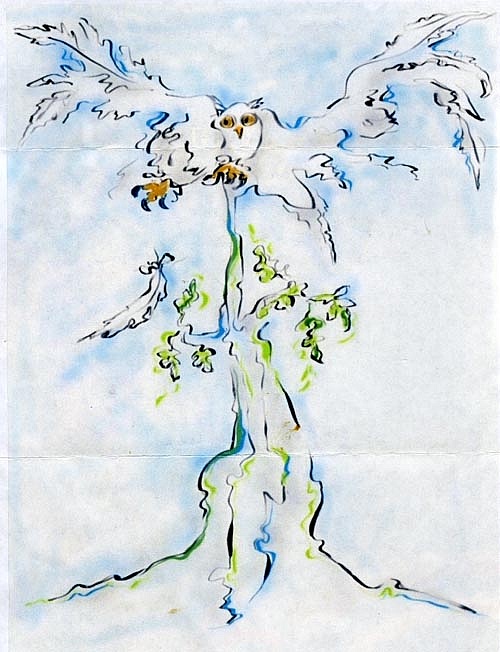
Jack Kelly, Owl, 8.5" x 11" on paper
Photographer, artist and writer Jack Kelly co-authored, Sanctuaries, a series of guides to monasteries, abbeys and retreats in the U.S. He studied at the Art Students League of New York and lived in Olean, NY.
Reflections
Be the first to share your reflection on this interview.