
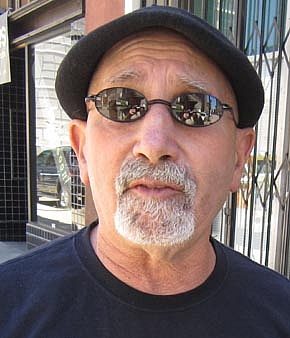
Photo - R. Whittaker, Joe Slusky - Franklin St., Oakland, 2010
Berkeley, CA, May 2024
This conversation took place in May, 2024 in Slusky’s home studio, surrounded by his sculptures and, most dramatically, his masterpiece, Ashby Odyssey, recently been restored by Russ McClure. (Mclure himself is a fascinating character -part avid art collector and part proprietor of a successful autobody shop in Berkeley. ) Ashby Odyssey has such a potent presence, it was hard not to start there...
Richard Whittaker: You’ve got Ashby Odyssey here, and it’s totally restored. Wow! So tell me, and this came up before, how did you start working with bondo with your pieces?
Joe Slusky: I was living in Sweden in ’67 and ’68 where I started to model with plastic filler. There was this L.A. thing – the bondo, autobody repair thing. That’s where this was coming from. See this one? It’s a little piece from around ’64. I was just making these pieces daily. I’d get excited, take one home, and by the next day, I wasn’t interested in it anymore.
This went on for a year, two years. So a question was forming “How do you make something that has visual longevity?” So somehow it led to where, when I’d usually think something was done, I’d just keep tearing it apart and changing it, changing it, and changing it. That’s why with a lot of those Bondo pieces - the positions of the pieces have nothing to do with the way they began. And somehow pieces were staying longer and longer working on them this way.
At that time, I felt like the metal was this intransigent material. But with this plastic filler, you can model it. I started to model the plastic filler over the metal in a way where I could develop the imagery of the thing. Like with clay. So that’s sort of what was happening. The welds are ground down and I was modeling with this stuff. So after ten years or more of working like that, I was getting tired of it. Also, the metal wasn’t so hard for me by then. You could grind it and everything and it became “soft” to me. And there were other things. In some ways I was getting tired of the whole thing. People were coming to me and asking, “Hey, can you fix my car?”
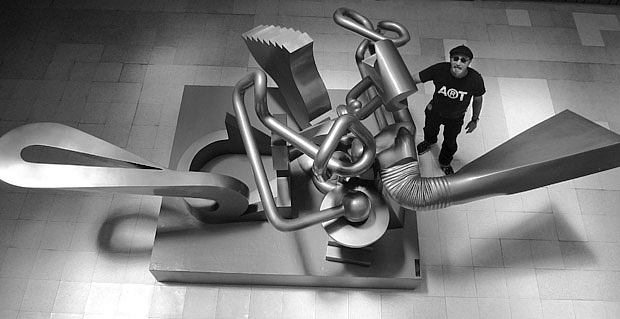
So Ashby Odyssey was built from 1969 to 1974 at my Ashby St. [Berkeley] studio. And after that it went into shows. I used to move that piece around—I don’t know how. And there are other things - see all those curving bends? [yes] I didn’t bend them. I collected pipe with bends in it - a whole reservoir of pieces I cut up with a torch - and I pieced them together. When I got the configuration I wanted, then I started using the Bondo.
Ashby Odyssey was in Richmond, then at Ohlone College, where I was part-time teaching, and it ended up in a building in Oakland on Franklin St.
RW: Right. I photographed it there.
JS: Do you know how many years ago that was?
RW: I'll have to check. [the photo is from 2010]
JS: Well, Russ McClure came into the picture. I swear, I want to say that for 27 years it was just in that building in Oakland, and the building went to seed. It was a beautiful building. I think’s where you took some shots. [yes]
When I was working on the piece at Ashby, I climbed up on the roof on the neighbor’s apartment in front and that’s where I was making decisions. So from that level, the piece is really super, and that’s how it could be seen in that building—from the mezzanine level.
Anyway, I had to get it out of there. The lobby looked terrible. The whole building went to seed. Some water had crept in, and that’s when I connected with Russ.
RW: Did you know Russ already?
JS: No. Somehow he knew me. I can’t remember the details of how we got together.
RW: Russ is a trip, isn’t he?
JS: He’s a major trip! He’s done work on your car. Right?
RW: Probably three times now. I mean he’s really good.
JS: Yeah. So, I ran into him at a 4th Street at a restaurant, or something. This piece was done ’69 to ’74. And it was maybe five, six years ago we connected - 2018. It became a thing of “How do we do this?” and there was an exchange. I had a number of Elmer Bischoff drawings, and he took some of my work, too. Then there was some payment. That’s how the deal went. Once it went over there, it stayed there for four years.
RW: Well, I walked in there one day and I couldn’t believe my eyes. Like, “Holy shit, Russ!”
JS: His master guy did it. It was a very elaborate thing—basically, stripping the Bondo down, re-Bondoing and painting it. And here it is, mint perfect.
So then I was getting to the Spring thing [photo needed], a transition piece - see? Originally, it was spray painted, done in ’73.
RW: And it has a relationship to Ashby Odyssey. I can see it.
JS: You got it, right. This piece was on the announcement of a show at the Berkeley Art Center in ’73. It’s all steel and has some Bondo it in, but nothing like Ashby Odyssey.
So, I had all this auto paint that was given to me - Sherman Williams. Pints and quarts of acrylic, lacquer paint. They didn’t need Mama Vermillion Blue, do you know what I mean? It was discontinued, but there was nothing wrong with the paint. I’m still using some of it.
I was familiar with the paint from spraying it, but I started brushing it on. And I don’t know exactly how I got into this idea, but I was just brushing on the acrylic lacquer. Then I covered it with black, acrylic primer and sanding through it. It was almost like I’d forgotten what the colors were. It was a little game I was playing. I put the black over it, and it was a discovery thing. At the same time I was smoothing the surface out, and the color was just emphasizing the form, this auto paint.
Then I stopped that and went back to direct welding and paint.
Thank God I didn’t start repainting all those old Bondo pieces like that one there! In a way it’s a female, but I wasn’t thinking that. What I was going to say is that a big part of the whole thing is memory retrieval. To me that’s really what is going on.
One, I don’t do any drawings. I don’t have any dreams. I don’t have any visions of what I want to be doing or entering. It’s all discovery. It’s all in the here and now. I mean, it’s being alive in the moment to the possibilities of what can happen. So what happens is stuff reveals itself.
But this is a very open-ended thing, as it turns out. There’s the more immediate thing. Afterwards, I see more stuff. Like in this little piece here. I mean this is typical. What is it? God, this is sort of like the cereal boxes' little prizes at the bottom - the Captain Marvel decoder ring. You were safe. No one is getting to you. I mean, that’s the kind of thing.
Then this piece here - we’re talking 1967, so the whole Minimalism thing was in the air - the Robert Smiths and whatnot at the Jewish Museum in New York. I’d had all this AE [Abstract Expressionism] indoctrination in school and now Minimalism. It’s like there’s a number of different levels. I never thought of the term “memory retrieval” then, but when this thing revealed itself, I knew where the source was coming from.
RW: With this piece, you’re talking about an experience of an injured knee?
JS: No. I ended up calling this thing Bruised Knee - but it's more about my wrenching falls into that zone, too, of how to come to grips with Minimalism versus the more Ab-Ex thing in the ‘60s.
RW: Well, I remember we talked at some length way back about how your experience as a college athlete, a gymnast, plays into this.
JS: Thank you, big time.
RW: That’s why I was thinking you might have some memory of physical issues.
JS: Well, no. I’ll show you pictures of me doing tricks on Ashby Odyssey [get photo]
RW: I mean, you were a varsity gymnast.
JS: All through college, yeah at UC Berkeley—and all through high school, too.
RW: You were like a pummel horse expert?
JS: Side horse. So this is what I’d be doing with my hands, practicing routines. [shows photo]
I’m doing these tricks, right? Well, think about sculpture, think about gymnastics. You’re doing visual tricks in three dimensional space. This is sculpture we’re talking about here. The thing with sculpture for me is you’re trying to solve the thing in the round.
So with the gymnastics you have the tricks, but then you have the choreography. It’s the sequencing of the tricks. So as you move around the piece, you’re hoping to "solve" it. That’s the root of it. And this is interesting. I’ll show you with the Ashby Odyssey.
And I should show you pictures of my Ashby studio, a short order grill right across from the BART station. I was there from 1966 to 1998—32 years. Bruce Beasley was there on the PG&E bill. I don’t know if you know these people: Doyle Foreman, a very good ceramicist, who was a student of Voulkos - he ended up teaching at Santa Cruz, and Michael Frimkess. They were on the mailbox for years.
RW: So all in this building on Ashy Ave...
JS: Yes, rrighton Ashby Ave. I was there from right out of school in 1966 to 1998. Since then, I’ve been in the Dome - It was one of Peter Voulkos' buildings. You haven’t seen my Dome studio?
RW: No. I’ve never been to your studio at the Dome, but I’ve been to Jody Gillerman’s studio.
JS: Right. Anyway, one day Paul Cotton came by and shot some pictures. I just jumped onto the sculpture, and I realized something... “Whoa, wait a minute!” It was the positioning of where things were. I mean, I could do tricks on this piece. Then it dawned on me again, this subconscious thing. When a gymnastic meet starts, they set up all the rings, the side horse, the parallel bars, et cetera, right? I was thinking, “Wait, excuse me. I’ve got an idea. What if this is the side horse event?"
RW: You mean on Ashby Odyssey?
JS: Yeah. When you see these pictures of me doing stuff on it? I’m yapping to you about the subconscious thing, memory retrieval. But let’s pull back a little more. What about our history? I mean, we were rats and lizards.
RW: I see. You’re going all the way - ontogeny recapitulates phylogeny.
JS: You got it.
RW: [laughs] Not sure where I pulled that one out from.
JS: And so whoa, whoa, whoa, whoa. Is that in there, too? I went through years and years of listening to poetry. I was kind of having a breakdown in London; maybe a better word is "disconnect."
RW: How old were you at this time in London?
JS: London came after Sweden and I was living there ’70-’71. I was going to the theatre in London. It was nothing, 90 cents. At the time my wife was teaching at a secondary school. We were married from ’67 to ’72. We’re still in touch. Anyway, I was going to the theatre where they did comprehensive things on authors - like Pacific Film Archives does in Berkeley - every night. And I was working at Central School - one of the art colleges - and had access to the facilities there.
RW: And you were teaching there, or what?
JS: No. I’d gotten some fellowship money and knew Brian Wall. He later came to Berkeley—a British sculptor. He was head of Sculpture at Central School.
RW: You took a graduate course in London?
JS: No, no, no. I was done with school. I basically went through Berkeley, and then I went through architecture. Here’s another thing - all architecture students had to take a year of sculpture. That’s how I got into sculpture. I mean, I was in doggy heaven. I got to Berkeley in 1960, right out of L.A. I was 17. It was intense; whoa. And I had this idea architecture. So we were required to take a sculpture class. I finished architecture; it took six years.
But then I went right into graduate school. By the time I finished the architecture degree, I had three degrees that included studio art, because I couldn’t quite get what was going on with architecture.
RW: So something pulled you into the art classes really strongly.
JS: Absolutely. Because it was all making. I love making stuff.
RW: So that connects also with your physicality.
JS: I didn’t think about gymnastics. But gymnastics really was the subliminal foundation of what was really going on
RW: That is so interesting.
JS: Yeah, look at it, man.
RW: Learning about your history, it all makes much more sense with the gymnastics, the physicality of it.
JS: It’s such a story, man! Where we lived, London…
RW: You said you were having a bit of a breakdown.
JS: Yeah. Here’s what it was. So I get to London and I’m taking all the experience. If you cut to the quick, it’s basically, look, we’re in this big miasma of mystery. Come on! If you’re not into traditional religion, I could just show you a picture from the Webb telescope. So it’s all mystery, and here we are in this thing. And we know we’re here for a nanosecond. We know about suns burning out. Richard. We’re celebrating today. We’re celebrating that we’re standing here talking!
RW: Absolutely.
JS: It’s just one, big, staggering - it’s beyond....
RW: I love this. I never quite thought of you, Joe, as having a feeling for the depth of the mystery.
JS: I feel bad that we never really have talked. I don’t know how we skipped it. It’s probably shyness.
RW: But these pieces are alive for me now in a new way.
JS: You got it! I mean there’s so many threads here. So I’m in London, and wait a minute, I’m going to theatre! We’re going to the movies every night, plus there are all the social people I was meeting who were at Central. As it turns out, Brian said, "Come. Come work. Use the facilities at the Central School." It’s one of the big art colleges in London, and there were tons of them at that time.
RW: This was before you got on the staff at Berkeley?
JS: No. I'd taught at Berkeley. After I graduated, they invited me to teach beginning sculpture classes at Cal. So in 1969 and ’70 I was teaching at Berkeley. Then Brian got an invitation to teach here [at UCB], and I met him.
RW: Okay.
JS: So, now I’m in London and I’m thinking what’s going on? All of reality is squeezed. Wait a minute: movies, drama, character development, theatre. I was getting a little bit confused, you know?
So, I get back to Berkeley and my friend Andy, a poet, had moved out to LA from Madison, and he was meeting people and suddenly, he's on this record album - Poetry For the Beat Generation with Jack Kerouac reading and Steve Allen playing the piano.
One thing led to another, so I ended up going to the Berkeley library and checking out every single record of dead poets reading. Because I was hearing things with the poetry. Poetry is about condensation. And then I realized, with the movie, you have to plug into the wall with the electricity. Here,[????] it’s real-time, and it all settled me down. Then I started listening more to my stepdad at that time. He was a sales guy and would send me buckets of old cassettes. I just went through everything. And I’d be talking to people on the phone.
Then, as I was welding and grinding the welds down, I was listening to all this poetry—Wallace Stevens, you name them.— And then I started painting. I didn’t want to stop listening.
So, it made me realize that sculpture is a lot like poetry, this condensation, compaction, and what not. It was really helpful, like “Yes. This is the right thing, doing the sculpture, as opposed to asking “Why aren’t I doing film?” Because I did do some filming - 8mm stuff.
RW: All right, you’re making sculpture, physical objects, putting them together—grinding, welding, painting. Meanwhile, you’re listening to poetry, going to plays, reading books, and you used the word “disconnect.” Like, is there a connection between these mute, physical objects you’re making and these narratives, poetry, and all this other stuff that gives language to experience? Is that the disconnect?
JS: Yeah.
RW: So, is there a bridge?
JS: The bridge became that I realized in poetry, it was this kind of condensation of experience, and that was basically what what was going on with the sculpture.
RW: I find that just fascinating, Joe.
JS: But look, we’re born, we die. It’s the journey. There are so many metaphors alone that go through my brain as I’m working, I can’t even begin to…
See how that rebar is painted? [yes] the increments of it? [yes] While I’m grinding the metal and making - doing all that and the welding - I’m not listening to poetry. But then when it’s done... The painting - at first I was just putting the paint all over. Then I started getting into these marks here [points]. They were like a capillary system activating the surface. So now, I’ve started with a little brush doing these marks, and I didn’t want to stop because I was hearing stuff in the poetry. So I kept thinking of more and more [What?]. That’s why the paintings started to take longer and longer, it’s like a shaggy dog story.
RW: Okay.
JS: I mean, nothing was planned. I didn’t want to stop listening to the poetry because it was meditative. You know, once you get the voice of the poet in your head, you can open the book and it comes alive. Totally vivid! I mean, I was reading then, too, like Ulysses. You’re going in and out of a person thinking thoughts - actual time -and it’s melded together. Virginia Woolf - that whole stream of consciousness thing. So that was one thread.
Basically, I started to realize the metal sculptures were essentially more in that realm of condensation like poetry. So what I was doing when I was doing this painting and then sanding down through it to get the surface = I was doing that with any of the metal.
I remember somebody coming by the studio and saying, “Hey, did you ever consider painting the increments of the rebar?”
I was polite, but go take a flying, leap, man!
But then, a few months later, I started doing it! And you know what? It was a complete revelation! It tied me in to so much stuff. For one thing, I realized there are different configurations going on in the rebar. And the other thing that blew me away is it’s a lot like those lanyards you make in camp—that box stitch. I loved that stuff with the vinyl, do you know what I mean?
RW: Yes, I remember those...
JS: To tell you the truth, it’s part of the thing I started off with, this question of how do you make something that has longevity? And I took this sort of vow: “I’m going to serve this work while it’s being made, and whatever it wants, I have to act on it.” That’s what led to the bondo filler and developing this thing more and more until it was Ashby Odyssey. So in other words, I kept working and working on the thing until it seemed done. Then that becomes, when is something done? You know about that.
RW: Well, yes.
JS: We can riff on this thought of completeness, of the whole idea, where in the 19th century Rodin is being inspired by broken statuary. You don’t need the whole figure to get the whole picture. It can be a part or a fraction—like a fractal, you know.
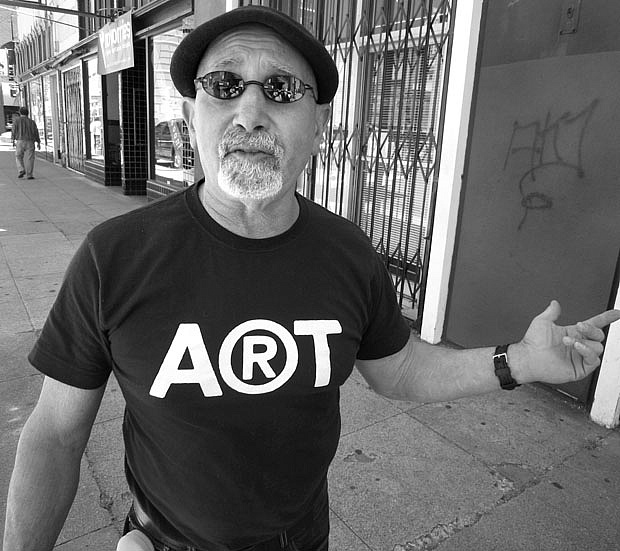
RW: [Franklin St. Oakland, 2010] So by the time you did Ashby Odyssey you’d taken this vow, right?
JS: Yes.
RW: So the Ashby Odyssey was made under the conditions of the vow.
JS: Totally. Basically I was living that day to day - not saying it every day, but that idea was planted.
RW: And then of course there’s this huge question. When is it done?
JS: That is a big one. And a lot of times the piece does get done. It was done. But then I’ll look at it - like that piece I showed you as you came in. It has a long story. It was done. I sold it, and years later got called back, “We’re downsizing.” It had been outside over 40 years. I started getting rid of the oxidation and blah, blah, blah. Then, I was painting on it more and more. So this thing of “doneness” is a bit of an open-ended thing.
RW: I have my own version of that with the magazine [works & conversations]. I’ll go back and look at my introduction from twenty years ago and I want to edit it - not to change anything fundamentally, but because a little more confidence has grown. We don’t even know how to talk about that. What does it mean “my being has grown?” And I'd get to the point more directly - something like that.
JS: But it is a little bit of that.
RW: Yes. I can see this in my own life. Something has gotten a little more confident and relaxed.
JS: It’s the same thing. The crafting of the work that you’re writing, the people that you’re dealing with, and the whole thing that comes out of the dialog and the fine tuning...
I started to make the analogy of work days being sort of like the weather. It starts off cloudy and miserable weather, and nothing is working. Then at noon, some light comes in. There are some decisions, and then it gets a bit weird again.
The process I got into with the Bondo— getting the piece to some point of resolution, and then applying the plastic filler—was a much slower thing. It was slower than the welding and piecing everything together.
Again, here’s what would happen sometimes with these pieces... So now you’ve got the metal and you’ve got this plastic filler that’s been sanded. Then you put the first coat of primer on that really defines all the forms - the undercoat of the primer - before you start the colors.
It was exhilarating to see, because there was a bit of camouflage going on between the metal and the Bondo. And now, it’s so clear. I mean, it was just a big high how it did. Everything kind of became…???
But another problem was, wait a minute! There’s something wrong with the color. But, No! I’m not going to change this thing! It’s like you went out and bought a car. You’ve got it home, and, “I don’t like that fin. It’s bothering me.” Am I going going to take a torch and cut it off?
RW: Right. No.
JS: But it’s sort of like you’re walking and feel great, but there’s a little pebble in my shoe, and that little, goddamn thing is starting to really bother me! And after a while, I’ve got to get rid of that thing and I cut into it, smash into the Bondo, and redo it. That happens with these things, too. But lurking in the back is our evolution. Again, there’s a lot of talk about legacy. I have trouble with all that. I like the making of stuff, and that’s the thing that happened.
With architecture, I loved it, but I lost the thread. I later learned how to talk because that’s how I paid the bills. Thank God that all architecture majors and pre-dental majors had to take a year of sculpture. That gets me into just how chance plays into everything, because in the '50s, sculpture was not part of art practice. It was part of architecture, going back to the cathedrals, Michelangelo, all of this.
I have a friend and he’s a really good stone sculptor. He went to Case Western and entered architecture, but he knew in a month, two months that “No, it’s not for me.” And it was a long, circuitous route, but he went to anthropology.
RW: Okay.
JS: I know we’re jumping. But just to finish on the thing of the mystery. So what is it? To me, the creating, the making—whatever media it is— how do you talk about the experience of being here?
I see it like a bird chirping. What is a bird celebrating? Celebrating this life. And the art is this thing of giving some inflection to this experience. That’s what this is.
RW: That’s beautiful.
JS: You’re continually recomposing the pines, if you will - of this taking in, giving your own inflection to it. Basically, crafting of this thing and sending it out into the world, and not worrying. What’s going to happen is out of your control.
RW: Let me stop you for a moment because I want to go back to an earlier part of the conversation. you were saying is that you were going to a lot of theatre. I’d never considered your pieces in the light of being perhaps a performance. In a way, iy could be a good metaphor.
JS: That’s right.
RW: It’s a long process, all the steps, decorative touches…
JS: Good point.
RW: It’s a drama, a poem.
JS: That’s right.
RW: It’s all of that.
JS: Totally. I sort of see these as the imagination fossilized. That’s what I was wondering when you did the article with Russ [McClure] and mentioned Ashby Odyssey. I said you should contact me. Anyways, this is the kind of thing that arises a lot, my leaping ahead with something to pick up later.
Another one of my metaphors is deep sea diving. That’s how the day starts as. I put on the belt and I'm down there doing the stuff. Then you’re pulled up. So you have this whole thing like an out-of-body experience. This can be dangerous stuff. So this ties into the importance of getting together, of having dinner, of having some kind of social framework. It’s not the idea that you go deep sea diving and there’s no boat to come back to. There as to be this balancing. Okay? I don’t have a license on everything that’s going on and can get sort of lost in seaching for this thing.
RW: I follow you there, and I also wonder—I’ve spent serious time with poetry myself and have an expanded idea of what poetry is - not just words on a page or spoken. I mean, there could be a performance on the side horse done with such perfection it moves you to tears, and that’s poetry. Poetry can be almost anything as long as it reaches this kind of magical alignment that cuts right through our habitual mindset, let's say.
JS: I call it catylytical. The minimalism thing, to me, basically had its roots in the Russian Constructivist thing of the early part of the 20th century.
RW: You know, that reminds me that Agnes Martin was thrown in with the Minimalists, but she had an incredible depth of spirituality that I don't think people received and wasn't just some Minimalist thing.
JS: That’s right. The Impressionists were all lumped together as one thing, but they all had these identities. Right? What really struck me about Stella was his emphaticness. I don’t cop to anything. I swear, I don’t own what, imagistically, is happening here. I made the thing. But I don’t feel like I have any ownership over that. I don’t want this thing to remain a triangle, a square, or a circle. I want it to do this kind of catalytic jump to something else that’s beyond words.
RW: What I find so intriguing talking with you this morning, is to get this interior picture about your work. It feels authentically right to me. Then to see something about your life, your experience, your questions, your search and the influences that were going on in your life—that all grows for me.
JS: Yeah. Some of these pieces go on for years - like with this piece. It evolved and it reached some conclusion. Then it needed something else. So this is sort of like a play within a play. That little sculpture [pointing] I’ve done it a number of times. But the point of it is, is that nothing? It’s definitely not the square thing. That’s from 1965. I was just putting different things together. I'm intrigued with this because, if you think about it historically, I’m talking about people like Malevich. These are real Minimalists.
RW: They had a very different view about what they were doing.
JS: Basically that stuff was a visual counterpart to the Soviet manifesto.
RW: I don’t understand what you mean.
JS: Think about it. What were they breaking apart? The whole hierarchical thing. Do you know what I mean?
RW: Well, this is another conversation, I think.
JS: Then let’s not. And in a way, this original thing had an organic thing. They were overthrowing the Czar, overthrowing a hierarchical thing.
RW: Who are they?
JS: The Communists, Lenin.
RW: All right.
JS: You’re looking at this narrative work that was a part of that era. Then you’re seeing a triangle, a square. What the hell is going on between these two things? There’s a schism. That work symbolized a breaking apart, supposedly of a hierarchy. Most everybody was very proletarian. This was the thinking in its pure form. Everybody could have a square and a rectangle. And then when Stalin comes into power, all those people were purged.
RW: But you were struggling, I guess, with Stella—a square is a square, a circle is a circle. That’s not what you were doing.
JS: No, it’s not. Underneath it, it has to do something where this whole confabulation of these things becomes something else.
RW: Well, if we look at Kandinsky and Concerning the Spiritual in Art, he is on fire with the spiritual possibilities of abstract art - this new avenue of promise for some kind of sublime, real potential in us, as humans.
JS: That’s what I grabbed onto. My dad’s Russian, he was born in Russia.
RW: So, I don’t know how Malevich fits in with Kandinsky except that they’re both making abstract art. But earlier you spoke of a moment where you, I guess, spray-painted something and saw it in its whole shape, and that was exhilarating. You used the word “exhilaration.”
JS: Exactly.
RW: So, I mean, this is in the realm of a higher feeling.
JS: That’s right, there’s a lot of that.
RW: Poetry is a condensation that can carry us us into what a lot of people call “magic.” This is what some art can do. But you can’t really convey it by describing it. Gertrude Stein said—and I think this quote is relevant here. It's from Four in America and goes like this: “Now listen, don’t you know that in the old times when a poet said ‘O, love,’ ‘O, sea,’ ‘O, moon,’ love was there, the sea was there, and the moon was there. But don’t you know that after thousands and thousands of literary poems had been written and the poet said, ‘O, love,’ ‘O, sea,’ ‘O moon,’ love was not there, the moon, was not there, and the sea was not there? Now, the poet has to work in the excitingness of pure being.”
Well, where are you going to find a sentence like that in art history? And what is "the excitingness of pure being?"
JS: Right. Well, an extension of that later is William Carlos Williams, which is a part of the Minimalist thing, with his The Red Wheelbarrow. The poetics of this thing not seemingly going beyond just the descriptive. In a way, it sounds like what you were just saying about Gertrude Stein is sort of Minimalist, but more than...
RW: Yes. There are poems that pull off the impossible, like journeys to inaccessible places. What that means is that my ordinary thinking and doing can't open that door.
JS: Well you know, Rimbaud’s thing was seeing the truth through derangement of the senses. Right?
RW: Like they take place in a non-verbal realm, you might say.
JS: Right, a non-verbal realm.
RW: Your sculpture takes place in your hands, in your seeing, your moving and what you’ve seen.
JS: There was a line, too, about Picasso talking about Cezanne’s paintings. He says the thing that’s compelling about them is the anxiety in every little mark. That’s the thing that’s driving me.
RW: That’s interesting. You relate to that?
JS: Yeah, in some ways. What I used to find interesting in class is you do some demonstration— this was the interesting thing about teaching—where it evolved into not repeating. I’m interested in how to interpret what I’ve just done? Where to take it? What does it mean? In a way, with each joint in the way things are put together, and how that changes as I'm modeling this thing around. Eventually, it becomes this whole. But to me, the excitement is happening all along the way.
With that piece there [pointing] “Whoa, that looks like a parfait glass.” I remember ice cream. L.A. I was always intrigued with the bike lanes and how they have these struts holding up the wings of the lanes. [pointing] That’s some kind of a PG&E cable. Then that jackhammer.
That’s the art. I find stuff like that.
It’s these connections—the jackhammer for tearing up the earth, that thing that’s coming out of the parfait glass. Right? It’s broken, and that intrigued me. That’s how it was at the yard, just fractured like that. It was thrown away, messed up. Then I added that top thing. And all of a sudden, it comes together like a crucifix.
I don’t know, what am I doing. What’s going on? And then I see this other piece, sort of like a female figure abstracted? So it’s on and on.
This is the realm of making that’s keeping it all alive, and part of this thing I can’t really explain. If I said it’s something about looking at our conscious/unconscious—an idea of transforming that, giving it an inflection— this is all part of the gravy, or the ingredients. It’s just this long story.
RW: Let me ask you this. So in this process, this making, the finding, the inflection that happens, and when it’s done… Actually, when is it done?
JS: It has its own life. And that’s what I want. The sociology. I can’t emphasize that enough—of being on Ashby Ave. for 32 years - people came there. That studio was a fixed thing, and the work grew out of that. I had stuff all around, and I meet you and you have a bookstore, “How’d you like to have a piece on display in your store?”
“Okay.” And that’s right off.
Maybe I had a part-time job, Anyway, I didn’t have to worry about the bills. I mean, it was important that something occasionally would sell, but it wasn’t desperation. I could spend as much time as I wanted on something without knowing that, “Hey, this is interesting!”
I could have been working on a piece for three months and it’s a mess, and someone tells me, “I really like this, but that part bothers me. Would you take that off?” I didn't have to do that. I did it on its own terms, and it stays like that.
I didn’t want a commission. I didn’t want any restraints. So I did big pieces. I’d run around and look at buildings. I’d approach the people, “Hey, this piece would work in your lobby.”
“Sorry, Charlie. We only do stuff for Christmas here.” Or “Okay, we’ll try it.” And there it goes.
I picked the space. It looked great there and who knows if it will sell? I’m just telling you how my brain worked.
RW: Okay
JS: So there’s an underlying sociology to these pieces. Look, I put a thing in the library at UC Berkeley and it’s been there for a long time. If it was offensive, people would get it out of there. So this is another part, another level of the work of its completion, of it existing in the world as opposed to the closet. I want it to be shared, I want it to be seen. That’s another factor.
RW: Of course.
JS: I love the idea, like Matisse’s thing—he has a friend who is sick, okay? “I’m going to loan you a painting; it’s going to help.” The idea it’s going to help. There’s a big hope there.
RW: Not only that they go out into society, but that they do some kind of good out there.
JS: Exactly. Exactly. That’s really big. That’s why the gallery thing is all sort of a bit broken.
RW: And I think another thing you’re saying is you had a job at Cal and some freedom there.
JS: Completely on its own terms.
RW: This is really good, like “G” Good’.
JS: Totally. And I get readings that this is coming through. There are some underlying issues, stuff going on in this, it’s not just a beautiful thing. It’s playing a little bit with an edge. But in the library you can’t put a bunch of dirty nylon stockings and razor blades in there.
But nothing I’m doing is that pre-meditated or conscious. I know I’ve thrown out a lot of thoughts here, but this thing about the metal and, Why do I keep the metal? Camus said it’s the act of living, of embracing, even maybe basically with no meaning, that you commit to doing something.
So what intrigues me about the metal, I think, is like, “Wait, what’s going on here?” You have music and the various medias, but what is the imagination? It’s an ephemeral thing in some way. But with the metal, it's like freezing in technicolor. That’s what it is.
******************
RW: That’s an interesting juxtaposition.
JS: This is the intriguing thing with sculpture. It’s coming out of us, and existing in our space. So then it becomes, wait, what’s the relationship between this and this, this organism? Now that to me, is an intriguing thing that I don’t go to.
I know that being a part of a particular moment in time historically, there’s a relation here. But then there are these other levels of memory. What is in these things? I do believe that that’s what the essence of these things is, and it does really interest me. That’s part of my love of it.
You see these little organisms on a mollusk. What’s the relationship between that organism and that shell, that structure? What is the genesis of those two things?
RW: I mean, we can give some sort of evolutionary, biological answer for that.
JS: A spider and a web. You know that whole line about “Aesthetics is to art as ornithology is to the birds.” I mean you could look at that. You’ve got a spider and you’ve got a web. God, the engineering in this web is totally startling.
Well, what is that to the spider? Do you know what I mean? Somehow, can I carry that thought of the existence of this thing to this organism that’s making it? What is that?
RW: Well, maybe you could extend that metaphor to “No web, no spider. No art, no humanity.”
JS: I’m not saying that. That’s kind of a frightening thing - sort of the analogy of deep sea diving and there’s no boat to come up to.
RW: Well, you used to hear the phrase “art, philosophy, and religion.” They'd always be linked together - the three avenues for our deepest questions. But with Postmodernism, that phrase disappeared. That’s the territory we’re touching on here.
JS: Right. Well, you know, jazz is my religion. In a way, this is my belief system.
Reflections
Be the first to share your reflection on this interview.