
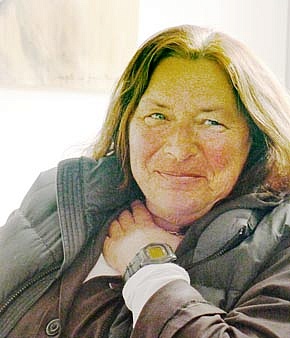
Jane in her studio, 2011 (all photos by R. Whittaker)
Meeting Jane Rosen was a gift of fate, one I couldn’t see coming. In fact, before I’d even met her, I wondered who this stranger was who’d appeared at our Sunday gatherings at the Gurdjieff Foundation of San Francisco. Her air of confidence radiated some position of authority. Or maybe it was just that she was, unmistakably, a New Yorker. I, on the other hand was shy, hid myself from others, and had an immediate reaction—who did she think she was?
Some weeks later, one Sunday morning after our general gathering, and before we went to our separate groups, I decided to approach her myself. I had no idea what to expect and was nervous. It could be awkward—or worse. But in spite of all that, I simply had to find out who this person was. “Hi. I’ve seen you around, but we haven’t met. I’m Richard Whittaker.”
“Oh. Are you the one who publishes that wonderful little art magazine!?” (The Secret Alameda and later works & conversations)
I was stunned. It the last thing I could have imagined and marked the beginning of one of the most important relationships in my life. Looking back now so many years later, I’m convinced there was something uncanny at work. The two of us, whose personalities could hardly have been more unlike, were aligned in ways that were profoundly productive and beneficial for each of us.
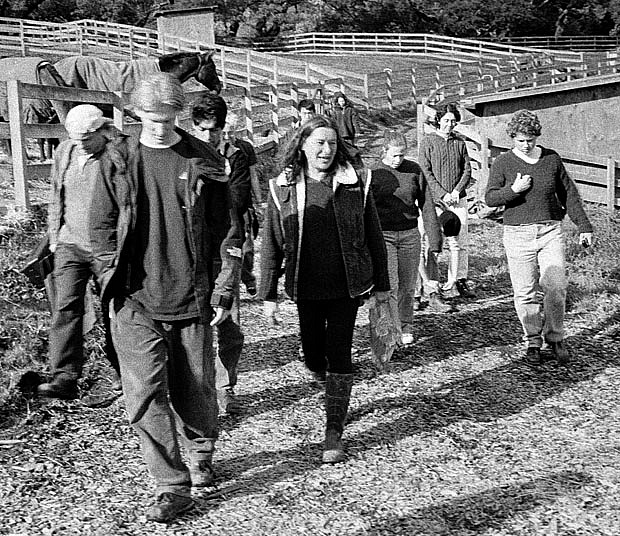
Jane loved teaching non-art majors as well as her art students. One of the most striking things now clear to me is the profound influence she had on her students, several of whom have gone on to important positions of influence outside of the artworld. In the photo below, several of Jane's students at UC Berkeley are visiting the horse ranch where she lived for her first few years in San Gregorio, CA circa 1996.
May the following excerpts from a few of the several conversations and articles that came out of our friendship stand as a testimony to the generative power of such good fortune. Our collaboration brought to light points of view, and the testimony of lived experience, that were otherwise greatly missing in the artworld in the wake of the Postmodern Critique.
I think I can do nothing better in memory, love and profound respect for this rare artist and human being than cite some passages from a few of our recorded conversations.
God Bless you Jane, wherever you are....
***************************************************
TSA: (1994) Who and what does your art address
Jane Rosen: I want to make work that you don’t have to have a Master’s degree in Art History to understand. When I lived in St. Martin there was something about the quiet and the water. I became interested in fishing and met an elegant old black man, Mr. Anstley Yarde, who was very tall and thin and had a great presence. He taught me how to fish. You use a can and string. He’d get me at six o’clock in the morning and we’d get these snails. We’d sit on a rock and drop soda-can lines and just sit there. I never caught a fish but he’d catch them. He’d hear them... and I thought, this man has knowledge. And one day, we’re sitting on the rock and he asked me what kind of art I made. I knew Mr. Anstley Yarde would not understand the art I was making at that time, and I realized I wanted him to understand it. It raised that question: who and what does my art address? Who did I want to talk to and what did I want to talk about?
TSA: There’s the academic dismissal of the value of the artist’s intention and the deconstruction of the simple idea of communication. What do you think?
Jane: If you say there is no possibility of communication, you still have to wake up the next morning, make your coffee, and function. Now what can guide you through that? A critical theorist who is very involved in deconstruction was at a dinner party with a friend of mine, a sculptor, and as they were leaving the theorist left in my sculptor friend’s coat. She didn’t notice until she got home and looked in the mirror and saw that her dress no longer hung out of the coat. Whereas the sculptor immediately knew that the remaining coat wasn’t hers. She didn’t even have to put it on to know it. I don’t know if this story is useful, but I know that people now—more than in many many years—desperately need something that’s a direction toward rather than nihilism.
My interest in art is not about telling us what the bad news is—we know what the bad news is. My question, and the question my art addresses, is “What is the possibility of the good news?” Not that the art has to be uplifting, but that it address questions about other possible states of awareness that could lead us toward that which could be a help.
Theorists will start talking and I’ll think, “God, I’m illiterate!” But in fact, I’m literate about another range of experience they’re not connected to. What I’m saying is, “You still have to get up in the morning and live life.” The moment you realize you’re mortal, that your body is a machine and it’s parts are going, one by one, the question becomes, “What is it?”
This is why I say, art is the language of the body and feeling trying to make a relationship between what the disconnected part of my mind is desperately trying to understand. And that, as a possibility, is what art does. It’s informing and transforming another part of myself and showing me what’s really going on. I think of this as my underwater life. It has to do with the difference between sitting in a boat on the surface of the water versus diving under the water and snorkeling, which is a much more three dimensional experience. My mind is sort of above the water. This underwater life constantly registers all of these impressions which aren’t being heard or received.
TSA: By your mind?
Jane: By a certain part of my mind. And right now there is so much talk about the mind-body connection. And although I’m interested in esoteric things and always interested in the question of philosophy or spirituality, I feel like some construction worker who’s seen God and didn’t want to!
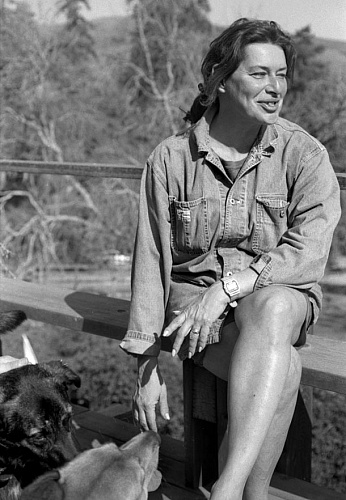
Jane at her first place in San Gregorio, a horse ranch, circa 1996 - photo R. Whittaker
I had the experience and then had to understand what the hell it was! This underwater life is going on all the time. Now art for me—when I see a shell, or a horse, when I see two weather systems meeting—
I don’t understand it with words. I feel something.
I experience something. I am aware of it, but I can’t say what it is. When I try to understand it with my hands, something in the alchemy—the process of working—engages a kind of listening. The underwater life connects. It registers something and begins to lead me. And I follow. For me that is the art process.
To make art about the bad news, or the negative aspects of our existence, of which there are many—and God knows, after living in New York for twenty years
I think I’ve hit most of them—is not my interest.
The question is, “What is my possibility? “ How can art direct us toward our possibilities? Toward a finer quality of existence so that the relationship between nature and the culture I find myself in can be reconciled. So a balance can be brought. So I can understand. That is what interests me.
The art world, in a way, is both a help and an obstacle because it exposes my ego and my inadequacy.
It asks for newness, a kind of brilliance, and fast food. It’s got to be quick. However, I’m slow and have a range of experience from the extraordinary to the mundane. How to reconcile those things is not something that can be easily digested by the art world. It’s a slow hit. My original dealer, Ed Thorpe, took on people who were slow like that..
TSA: You mention "the underwater life”—the experiences and processes that go on in the body, and being in touch with them—or one might say, with the intelligence of the body.
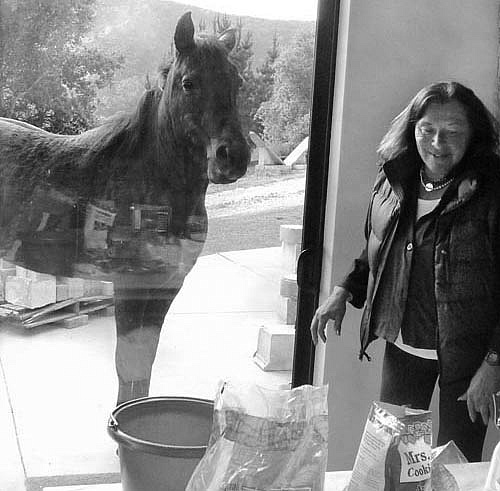
Negrita at Rosen's studio waiting for a treat.
Jane: Well, the Egyptians spoke about the intelligence of the heart and the the body. What I mean by that is —let’s talk about animals again. For me animal nature is a very important key to understanding our own nature. Watch a cat waiting for a mouse. There is an attention in his body that is extraordinary. There are no distractions, no thought about what he is going to do later or whether maybe there’s another mouse that might be bigger. The cat is completely there.
There are times when I’m working and I can hear my blood and my heartbeat in tune with the movement of the material. It’s about being in your body. I think athletes experience this, and people who are alone in nature for long periods of time—like farmers. They don’t say much, but there’s an intelligence, an instinct just like the cat. I think it’s the knowledge that American Indians have. For the Egyptians, art wasn’t a by-product. It was the product of an investigation.
When I’m working in the studio, I come up against these difficulties. I start. Something comes. I look at it. My ego says, “What a good girl am I!” And then this ego goes in and takes over. The beauty is that this mistake becomes visible, like the registration of a sewing line. You see where you were not paying attention. Your marks are a registration of the state you’re in. You see when you’ve just destroyed something that was given in a moment after really struggling through an obstacle.
That’s what I mean by an accumulation of different experiences that get registered on this wood, on this canvas, this paper, this stone. You become humble and go back and try to listen.
I think that my having synesthesia—if I look at a wing, I hear the sound. So, if I’m hearing this sound as a form, or movement, and following it, the wing appears. I don’t make the wing. If I try to make a picture of that wing I draw very badly.
It occurs to me that this act—this effort, that I openly engage in—holds the possibility of becoming more alive. You have to be more alive. You become more aware of what is going on. That awareness can be felt by the viewer and they can experience that in themselves. It is rare that this fortunate event occurs. Most of the time it doesn’t. That for me is a language that can be communicated.
TSA: The possibility of becoming more alive. Could you say anything more about that?
Jane: Most of the time we are not able in our ordinary state. For instance, I’m usually more interested in watching videos or talking, and I’m not really feeling fully alive. What I become very interested in—and this is why I speak about the relation between nature and culture —is how there could be a finer quality of awareness that’s given to me in nature, when I’m in the face of “human nature”? How to able to be in a room with people, or in the face of difficulties, and to be more alive? And some questions this brings are: How am I with students?
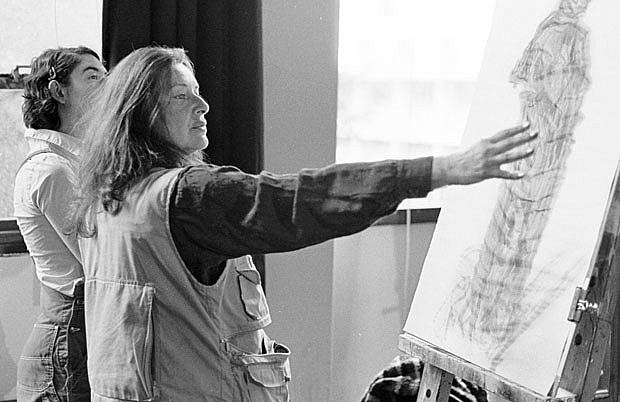
Rosen with student in her class "Art 12" (advanced drawing) at UC Berkeley circa 1998
What does it mean to be on the forward roll of the wave in a more aggressive state, or in the backward roll in a more passive state? What does it mean to be in a better or worse position in the art world? Or in society? Or in my own work? How is it possible to bring this intelligence to that?
When I look at students’ work and they are covering things with bees’ wax and brassieres—these images of fear about gender, and race, and inequalities— fear about the environment.… Well, I’m afraid of those things too, in a certain state. But in another state those things are simply not issues. This kind of fear and questioning, let’s say with feminism… I’ve lived the life of a feminist! And yet my art doesn’t address it directly. It doesn’t mean I’m not interested in that. It doesn’t mean that I don’t fight for every woman student and every other woman artist. I do. The contribution would be to struggle with relating the finer to the coarser, or the coarser to the finer. To make a relationship to these two things.
TSA: I was looking at a Rothko painting and remembered a quote to the effect that the Abstract Expressionists were the last painters who could believe that art was a noble calling. That’s not what I feel when talking with you and with many other artists. There’s often a feeling on this level somehow.
Jane: You know, and I don’t mean to put anybody down—but for something to be really art, not social commentary, it has to engage more of the viewer. It has to activate what can be felt, what can be sensed, and what can be thought. And when you look at a Rothko, here’s a man who prayed on canvas. Perhaps a question that takes many forms, but it speaks of what our better nature might be. For me, this is art...
In 2014 I met with Jane at her studio in San Gregorio, California to talk about seeing…
Jane: It’s a hard word for me, “seeing,” because I’m firmly convinced that seeing has nothing to do with the eyes in that way. I’m not saying it doesn’t include the eyes. An impression comes in. It may come in through the eyes. When I’m looking at a bird or an animal, especially when I’m drawing it, the key is the shift in cognition where—and I know when it happens, I can sense it.
works: Are you talking about drawing?
Jane: I’m talking about life. When we talk about taking in an impression, most of the time I’m not taking you in, I’m trying to make an impression on you. I’m going out. And there’s a shift that happens when I’m drawing or when I’m looking at the dog or a horse or looking at someone in my mind’s eye, there’s a shift where something in me listens, but not with my ears. There’s another kind of listening. It’s kind of like from the knees up to the shoulders is like a receiver or a satellite dish allowing something to come in almost through my middle. It could be seeing who someone is. It could be seeing the dog in the gallery when the owner said, my dog doesn’t need water.
works: Yes. I wanted to hear about that again. It’s an example of this kind of seeing you’re describing, right?
Jane: Yes. So, I’m standing in the gallery when a woman walks in with a dog and the dog is saying to me, I want water. It was a big Bernese mountain dog. I could see it in the dog’s posture, it’s presence—but it’s a double thing, seeing the dog and also a listening in yourself. So I asked the woman, Would you mind if I gave your dog a bowl of water? And she said, “Oh, my dog has had water and isn’t thirsty.” So I said to the girls at the gallery, do you have a bowl? They gave me this big stainless steel bowl and I went to the bathroom and filled it with water and came back. The woman says again, adamantly, “Trust me. It’s my dog and it’s not thirsty!” Well, as soon as I put the bowl down, the dog started drinking and practically drank the entire huge bowl of water. Then it licked my hand. [laughs]
works: That’s really seeing, but not what we think of.
Jane: Right. But seeing isn’t what we think it is. What we call seeing is “looking.” Looking is when you go out and you look at something. You have a number of facts about that thing and you put them together as a mental construct. Okay? When students in my class look at the model often they are not seeing it. Paul Klee said to his students, “Yes. I want to draw what I see, but first you must see what you draw.”
works: What is it when someone stops, but keeps on looking, and then starts to see more—literally?
Jane: That shifts what I would call cognitive gears. So there comes a new moment. The first look is a word, a name. To me anything that is attached to words and names is a mental looking. Then, I think there is a looking with your whole body as if there were tentacles that sense and touch the totality of the thing you’re looking at, so that the tree stops being leaves, branches, roots. It starts becoming a clustering, a gathering, a drooping, a lifting, a turning.
works: It reminds me how one day I was looking at a sky full of clouds and suddenly realized what an overwhelming amount of complexity I was seeing in what I was looking at... And how utterly impossible it would be to capture it in words.
Jane: What if the dialogue we’re having revolves around finding the right word so that we both know the experience attached to that word? As a teacher, there’s a huge difference, for example, between a sketch and a study. They can be called the same thing. A sketch is something that’s sketchy. Looking is sketchy. A study is where you’re studying with your body, let’s say the dog [pointing to her dog]. You’re observing the various movements and states and gesture, the presence of restfulness. You’re then translating what you see from this study to a piece of paper with the physical marks you’re making. And you’re also mentally using the laws you understand about drawing to create an illusion on that piece of paper. To me, seeing is having all of these things simultaneously in place, that open a feeling for the life of the thing you’re observing.
works: You say you’re “studying with your body.” Would you say more about that?
Jane: Okay. A simple way to talk about it is, I have something called synesthesia. I hear form. So when I’m looking at your shoulders, it could be a staccato note if you’re tense. It could be a rhythmic roll of a stone dropping into water and the rippling out. When I look at it, I hear it. I hear the pieces in the studio. Like yesterday, that big bird on the left. I could have done that carving with my eyes closed. I can see with my eyes closed.
works: Do you use your hands for that?
Jane: Yes. I use my hands to see. But I don’t have to physically touch you to touch you. Literally, if I was going to draw you, I’d [she starts moving her hand and making sounds that go with the different lines she’s tracing in the air] So I hear it. Which is probably why I became an artist.
works: Earlier you used the word listening. I mean this whole word “seeing” is—what is it?
Jane:: You say, “I see what you mean.” So that’s not a visual thing. It’s an understanding. To me, the act of seeing is coming into an understanding of the whole of what’s occurring. Like when I’m struggling with that drawing of the coyote I did. First, I saw a lone coyote on the hill next to a young deer and became very interested. The coyote is there day after day at about 2pm. So now, I’m looking until I can see what is happening.
The only way I can come to an understanding is by drawing it. I figured it out. I started to understand that he’s an older coyote. He’s more interested in eating gophers than the deer. And he’s been rejected from the pack. He’s quite beautiful and has more of the presence of a dog. Now I’m trying to do a drawing of the essence of that coyote. So learning to see is learning to put together my sight with my sensation, which can take in a much larger view.
works: So this is a seeing that is really coming into contact with what’s there, and “looking” isn’t.
Jane: No. And what’s there is never what you think is there. It just never is that. One of the things I find remarkable happened from that amber drawing I did of a hawk—the falcon is Horus in Egyptian art. The falcon was considered to be the highest energy because it’s what sees in and out simultaneously, the energy of the sun. So I thought, I’m going to learn about the hawk, and I’ve been drawing hawks a long time. So that amber drawing, Dave Nelson, the hay farmer…
works: Your neighbor, and not an artist?
Jane: Right. He grew up on this land. He picks up his mail at the post office where ther’s an announcement of my show with the hawk on it. Dave calls me up and says, “That’s a damn good drawing of a hawk! If you don’t mind, could I get me one of them announcements? I’m going to blow it up and make me a poster. I spend all day on my tractor and those hawks follow it to eat the mice that get pulled from the haying. I know hawks, and that’s a damn good hawk!”
I said, “Dave, I’ll give you a drawing of a hawk.”
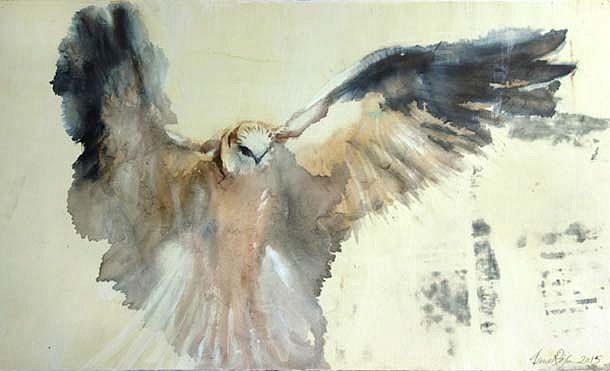
Jane Rosen, drawing, Hawk, 2015
He said, “I don’t have any money, Jane.”
I said, “Well, you’ve got hay. I’ve got horses. I’ll trade you a hawk for the hay.”
He said, “Okay. I’ll take that deal.”
works: [laughs]. Let’s go back to that bar of light in your studio that you mentioned.
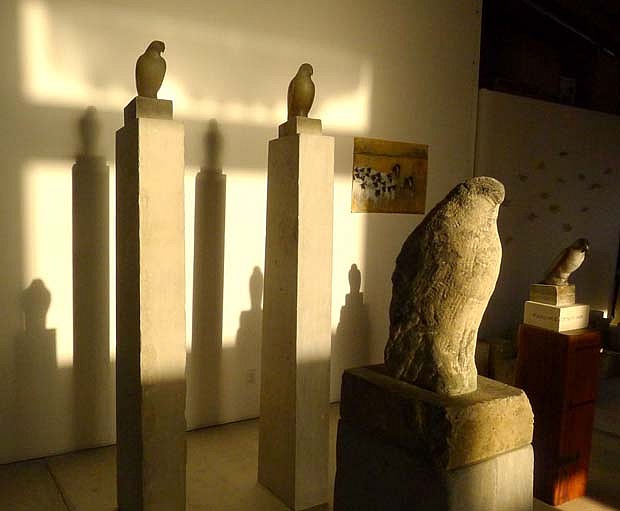
Jane's studio on her ranch in afternoon light
Jane: It changed my life. I always had studios where there were no bars of light coming in because that kind of light changes everything, completely washing out the pieces. And at first, I was very upset with the lighting.
works: Right. There’s a huge contrast between the shadow and the direct sunlight.
Jane: All day from dawn until dusk you get extremes of light bouncing all over and it was interfering. Then, just sitting in this chair week after week—I never did free-standing, vertical pieces like this before. But what started to happen was I started to listen to the light. I started to catch the light at various moments where the light would inform what the height of the piece needed to be, or the turn of the head. I started seeing the light as a help rather than trying to control it. Being in relation to the light was a big thing!
The other thing is that I’m very involved with vertical and horizontal movement—a movement in and out, and a movement up and down.
An inner emotional stance is an outer visual one. If you get nervous, for example, all the energy seems to go up. Your jaw tightens and your eyes scrunch and you hold your breath up high.
So there’s this movement of going out to the piece, like if you shot an arrow out to the piece. You’re looking at it, but there’s also a filtering back, so you’re also aware of yourself and the piece. So that’s a movement in and out. And with the movement up and down, I start to wonder, isn’t this a cross?
These pieces become representations of a seeing both in and out. And the light, which I resisted enormously, became the teacher.
works: Okay. Right off you said “seeing has nothing to do with the eyes.” So here we are, and what are the modalities of knowing, or receiving the world?
Jane: A couple of things. One is the word to attend, attendez, to wait. Attention is to wait.
works: ...and waiting with attention brings openness.
Jane: Right. So when you talk about seeing what’s real, to me, there is an invisible reality behind the visible reality. I have to let go of what I think it’s supposed to look like in order to see what it is. That demands attending to it—in other words, waiting—allowing the impression of the bird to come in, rather than going out to it. It’s a really subtle shift.
I was working yesterday on that big bird and seeing myself, literally, start chiseling away at something that “looked right” like it was supposed to be there. But I was listening and it’s as if the stone started to speak to me—even to a point under the chin where “Unhh, get this off!” Then “it just started chiseling” while I’m thinking, “What the hell are you doing, Rosen?”
I started using the tooth chisel because, with the beak, one mistake and it’s over. And sure enough, a piece of the beak came off. The Provencal limestone has fossils and shells in it. So you don’t know what part is attached to what part. So part of the beak came off and I looked at it. It was exactly what was needed! And I never would have figured it out.
works: Can we say there was a seeing there?
Jane: You’re serving something else. In fact, if I can be so bold—best case scenario—you’re an objective bystander. It’s moving through you, and you’re not in the way.
works: I’ve sometimes wondered, in terms of being in the world, what is the deepest way of being here? It has occurred to me that, when one has gotten down to the almost metaphysical place of our being here, that this is a place simply of witnessing.
Jane: Okay. The practice in the studio is a practice of seeing. If you are speaking of how to be in the world, I don’t know how to say it. We almost always have a vested interest in the outcome of a sculpture or an idea, or an idea about how we want the world to be or how we want ourselves to be and, as a result, we don’t see the sculpture, the coyote, the world or ourselves. So if you let go, which is what happened to me yesterday, and you follow it, there is a moment where this other kind of reality becomes visible. That’s what I think seeing is.
works: Beautifully put. Our thoughts and desires are always interfering—or almost always—because something can happen, an opening. I’m just sort of riffing on that because there’s another thing about the moment…
Jane: Great word, by the way. I don’t mean to interrupt, but when you said, “I’m just riffing on this,” I understood. It’s like jazz. You were looking for the chord of it. There’s an example of seeing what you were looking for—in a word.
works: [laughs] Yes! Language is another subject, language and seeing, that I thought we might touch on, but just to finish this thought, which is that in that moment when something really does quiet down, it’s a moment of silence.
Jane: But not always. Because here’s the most shocking thing. Often the largest silence I experience is in the midst of noise. All my ideas and the cacophony actually pulls something out of my belly because of the absurdity of it, and there’s a double experience. This is where the quote from the Mundaka Upanishads is appropriate: “Like two golden birds in the self-same tree, intimate friends, the ego and the Self dwell in the same body. While the former eats the sweet and bitter fruits of the tree of life, the latter looks on in detachment.”
It relates to this because sometimes—I’ve seen this with students. If I can keep them mentally occupied by giving them three conflicting directions of what to do with their drawing tools, their minds are so busy trying to figure it out, that something more essential can come out and it goes, “I’ll try.” It’s like our personalities can blow up so much, sometimes like a balloon, that they burst and the little impartial guy living in the belly, who hardly ever gets a chance to come out goes “I’ll draw that. I’ll try.”
works: [laughs] I wondered about seeing and presence. That’s not a word we’ve used yet, but I have a feeling there’s a connection between presence and seeing.
Jane: I agree. If you talk about being present, I would say that in order to see anything you have to be in play rather in fast forward or instant rewind. You have to be present.
works: I almost want to ask how can one see without being present?
Jane: You can—on the rare occasion, as I was saying. If there’s so much cacophony, it brings up something so fierce in terms of a desire be free, it can give rise to a presence to the cacophony. And the cacophony, like any good mouse, when you turn the light on, it disappears!
works: So here’s another big question. When are we simply dreaming, or in the grip of an illusion? This is tricky, because I can imagine something and maybe it is a kind of seeing, or I can imagine something and it’s just an illusion.
Jane: Right. So you’re up a creek, basically. There are rare moments in the studio where there’s an absolute authority. Something is really there. By the time you’re figuring out what it is, it’s over. You are then going to talk about it. But there are crystal clear moments. The rest of it is probably suspect.
works: I wanted to ask you something about the sensitivity of animals. I used to throw a ball for this dog who’d fetch all day long. One day I was reaching into my mailbox and he was watching me maybe a hundred feet away. My hand was in the mailbox. and I thought, I’ll start with the tiniest movement possible and slowly pull my hand out an start getting into the gesture of throwing a ball and see when recognizes that the game is on. So Kpoly’s watching me. And at my tiniest, first movement, he just jumped into a state of total preparation, “I’m ready!” It almost scared me. I couldn’t have imagined it.
Jane: Yes. Because he wasn’t reading your movement. He was reading your energy. So before you even made your first movement, he was listening to what you were conjuring up. If you watch animals here, you see an absolute awareness with their whole being.
works: In modern life, we have no idea of what that is.
Jane: Yes we do. I do. It’s called the instinctive life. When a mother runs out to grab her child without even seeing a car. Our instincts take over. Mostly we’re in our heads. If you get down in your body, you have a chance of hearing that.
works: Can we call that seeing?
Jane: Yes. That’s another form of seeing. It’s that more than one part of you needs to see. You can’t see with your head alone. You can’t see with your heart alone, because it’s very partial. You can’t see with your body alone because basically, I don’t want to put down the cigarette or the cake.
The day I met that raven you were asking about, this is what happened. I heard the dogs barking in the living room. Not a bark like “someone is here,” which is an announcement. Not a bark like “get away from my stuff.” That’s a territorial thing. Not a bark of fear like, “Oh, my God there’s a bobcat on the deck!” It was a bark I wasn’t used to, a kind of “What are you doing?”
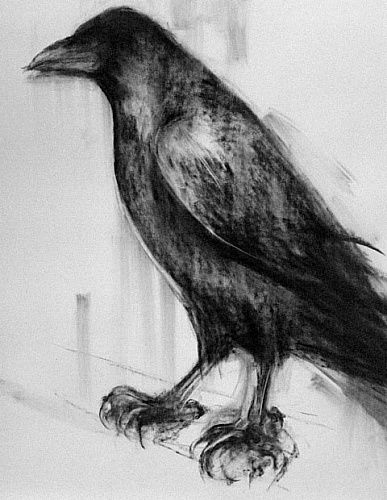
I walked into the living room and there was the raven underneath the chair at the dining room table. I looked at this big raven with huge claws and this huge Roman beak. The raven somehow had walked into the house before we had become friends and had gotten stuck underneath the chair. I believe it was a mom and she was coming in looking for food.
I looked at the raven and the raven looked at me. She had these beautiful eyes, and she blinked at me. It was clear she said to me, “I’m stuck. I don’t know how I got under this chair. I can’t get out and you’ve got two pretty big dogs. I’m in a situation.” So I looked at the raven and said, “Okay. Here’s the deal. You’re big. You have sharp claws and this beak. You could hurt me. I’m going to pet your back and if you don’t try to peck me or claw me, I will get you out from under the chair. If you try to peck me or claw me, you’re on your own.”
She looked at me, cocking her head like she was thinking about it. It wasn’t like she understood my words or I understood hers. There was something in my tone that was explaining to her. So I pet the back of the raven and not only does she not claw me, she pulls her claws into her belly and tucks her beak into her chest. I pick her up and I hold her like this [cradled in her arms] and she is perfectly still. I put her out on the picnic table figuring she would make a beeline out of there. She turned around, she looked at me and she nodded.
As Rosen envisioned, a foundation is being set up in her name. Artist residencies, classes, retreats and events will be take place at her ranch in San Gregoriio, California.” u
The following can be found on conversations.org
Interview: Toward the Intelligence of Life, 1994
Interview: The Importance of Questions, 2000
A Drawing Class at UCB with Jane Rosen: Art 12, 2005
East and West: The Work of Jane Rosen, 2007
Interview: Toward Inaccessible Places, 2008
Interview with Jane Rosen: On Paul Reynard, 2011
Interview with Jane Rosen: On Seeing, 2014
Interview: Tell My Story, 2018
Reflections
Be the first to share your reflection on this interview.