

©2026 Rue Harrison
drawings - R. Harrison / photos - R. Whittaker
Throughout the ages people have been fascinated by ancient Egypt, the civilization that emerged from Neolithic roots roughly 5000 years ago. The Romans and the Greeks thought the ancient Egyptians to possess a great and secret knowledge. The philosophers Pythagoras and Plato are known to have travelled there to learn from Egyptian priests. Today this fascination still exists, as evidenced by the tourists who visit Egypt in a constant stream. Yet the contemporary view of what the Egyptians knew is often either seen through a veil of unsubstantiated awe and fantasy or reduced by Egyptologists to a naïve and elaborate death and afterlife cult.
British author Jeremy Naydler, through his immersive study of the art, writings and temples of Egypt, has brought forward a fresh and comprehensive vision of ancient Egypt with important implications for us today.
In 2015 three friends and I signed up for one of the last tours of Egypt led by John Anthony West, author of The Serpent in the Sky.1 It did not disappoint. Day after day, as we studied the enigmatic friezes and statues, I became one of the awestruck; I felt that the knowledge of this civilization ran so deep and was so obscured by time that I would never decipher it.
Later I began studying the history of the mysteries of Egypt. I learned that Roman emperors transported obelisks and erected them–mostly in Rome—as a demonstration of their greatness, and that seven ancient Egyptian obelisks remain in Rome today.2
What I was learning in my studies became incorporated into my graphic narrative, Indigo Animal—an exploration related to, if not an example of, a path of entry to the unconscious mind that psychoanalyst C.G. Jung called “active imagination.” I’d been working in this way since the early 1990s: I begin drawing and let myself be led by both the drawing and my research to uncover a hidden thread.
Let’s pick up my story as my characters have gone on a summer session abroad in Rome. Soon they’re focusing on Bernini’s statue of an elephant with a real Egyptian obelisk atop it in the Piazza della Minerva behind the Pantheon. After learning about the seven obelisks, I knew this obelisk would become a focal point in my narrative as my characters, being animals, would naturally be attracted to it. Thus, following the circuitous path of the unconscious, I forged ahead, knowing only that the monument had been designed by the sculptor Bernini, who had won a commission in 1665 to display a small Egyptian obelisk that had been dug up from where it had been buried in a nearby monastery garden for over 1000 years.3
I knew nothing about the meaning of its hieroglyphs. But researching further, I found myself falling down a deep and intriguing rabbit hole. It’s where I was to meet Jeremy Naydler’s work.
What I discovered was that Bernini had been a close friend of Pope Alexander VII, and that both men had been part of the intellectual circles that included Jesuit scholar and polymath Athanasius Kircher.4 All were avid students of the Hermetic Philosophy that had surfaced in the 1400s with the help of Cosimo d’Medici, a powerful and influential figure who had sent scouts to obscure monasteries in the Balkans in search of old parchments. Monks had re-used them, writing Gospel texts right over the texts of ancient philosophers, such as Plato and Aristotle, thus inadvertently preserving them. In their searches scouts also procured and presented to d’Medici a copy of the Hermetica.5
Alexander VII was a learned man and, despite being Pope, had a deep interest in Hermetic philosophy. The Hermetica is a collection of compelling spiritual writings, and although attributed to Hermes Trimegistus, believed to be an ancient Egyptian sage, it was composed between the second and third centuries CE and reflects a blend of Greek, Egyptian and Gnostic thought.6 It caused a stir when it reappeared in Italy because, at that time, it was believed to date back to ancient Egypt. In reality, since these texts had been written after Christianity’s rise and seemed to reflect its influence, the Hermetica led to the impression that Christianity had existed at least back as far as the time of the ancient Egyptians.
So, beginning at that time, and under the influence of the Hermetica, the objects, writings, and art of ancient Egypt began to be rehabilitated—even attracting a benevolent gaze from the Church. The ancient obelisks were stood up again, one of them atop a wise elephant in the Piazza della Minerva, and another at the center of St Peter’s Square—all once again honored.7
As I continued my study, I learned that the first translations of the hieroglyphs (by Athanasius Kircher) on the obelisk sitting atop Bernini’s elephant, were not translations at all. It was more as if Kircher were channeling the Hermetic writers. Although a learned Jesuit scholar, Kircher didn’t really have a clue how to translate hieroglyphs.8 But no one else knew how, either. It wasn’t until 150 years later, when Champollion discovered a method of translation, that Kircher’s intuited translation (“a twofold spirit, the great Hemphta, whose generative powers infuse stars and sun to bring forth the bounties of life”) was discredited.9
By the 19th century hieroglyph study had become an academic subject. Even so, I was unable to find a translation of the hieroglyphs on this obelisk, identified by academics as the “Minervan Obelisk,” until I found (posted online) independent scholar Jeremy Steele’s “Piazza della Minerva Obelisk in Rome, a Tentative Translation,” (2014) as follows:
Golden Horus
Wahib, King of Upper and Lower Egypt
Two ladies Nebhepesh, Haa-ib-re
Beloved of Atum, great god, foremost
Of Sais, give life like Re forever.
Golden Horus
Sewadj tawy son of Re
His beloved father Neith, give
Life like Re forever.
Golden Horus
Wahib, King of Upper
and Lower Egypt
Two Ladies
Lord of Strength,
Haa-ib-re, Beloved of
Atum, great god
Foremost of Ta-Ankhet,
Give life like Re forever.
Sewadj tawy son of Re
His beloved Father Neith,
give life like Re forever.
The lines are poetic and mysterious, but don’t reveal much because we don’t know who Neith or Haa-ib-re or Sewadj tawy were. And due to our distance from the ancient Egyptians, we can’t feel the meaning of Golden Horus or the life-giving Re.
With the discrediting of Kircher’s work and the rise of the discipline of Egyptology, any desire to attribute to the ancient Egyptians an advanced spiritual knowledge waned. Nadler’s writing stands squarely here as a potent counterpoint to such views (see Shamanic Wisdom of the Pyramid Texts and The Future of the Ancient World).
Returning now to the Minvervan obelisk, the characters in my graphic narrative were quite let down when they read Steele’s translation. I was disappointed, too. All that repetition of, to me, insignificant names. It felt like the meaning behind these names could never be found again.
What would my animals do? How would they cope? The main character in my narrative is called “Indigo Animal.” In previous episodes, Indigo has become well known in the field of “Classical Lawn Statuary Research” by espousing a contemplative mode of art viewing. In fact, my book Indigo Animal —The Complete Trilogy ends with an art historical lecture delivered by Indigo Animal using this approach.
Reading further in Shamanic Wisdom of the Pyramid Texts I was encouraged when I encountered the “question of method.”11 It’s concerned with the development of phenomenology, or the study of structures of consciousness as experienced from the first-person point of view.12 In support of his line of thought, Naydler turns to the German poet, playwright and scientist Johann Wolfgang von Goethe (1749-1832) who developed its main principles in various essays on scientific method.13
He also writes that “Goethe repeatedly warned against the dangers of the theorizing mind losing touch with the phenomena it is theorizing about. What is required, he insisted, is “that we deepen our involvement with the phenomena.”
Although connecting an 18th century, world renowned philosopher to a 21st century cartoon animal may be a stretch, it nevertheless became evident to me that my character, Indigo Animal, was using a phenomenological approach to art viewing. But in my narrative, would it work with hieroglyphs?
No. That had already been tried by Athanasius Kircher. I needed to find another way.
Looking back on my process, it seems that I had begun my narrative by entering a realm of the unconscious as described by Jung and had discovered parts of myself personified by animal figures. In a Jungian, or shamanic way, I became Indigo Animal and saw the world through Indigo’s eyes.
However, as my characters encountered the works of ancient Egypt, they lacked the means to understand the images, just as I did, and just as the message of the hieroglyphs on the obelisk can’t be understood because the meaning behind the names is unknown. Some
illumination had to take place.
Let me take as an example the solar boat:
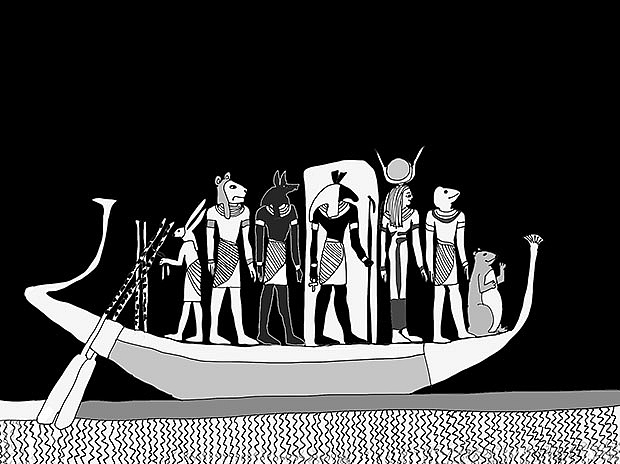
Images of it appear in many tombs in the Valley of the Kings and Egyptologists have worked out who is in the boat. Their findings can be easily found with a Google search: “The boat contains Ra, who ruled Egypt ‘for 30,000 years,’ Atum, the eternal fount of creation, Shu and Tefnut who succeeded Ra, Geb who became king after Shu and Tefnut, and finally Osiris and Isis, who ruled before the first human rulers of Egypt.”
“The solar boat travels across the sky during the day and through the underworld at night. It symbolizes the cyclical nature of life, death and rebirth and was critical to maintaining order in the cosmos. When Ra travels across the sky in the daytime he is bringing light and warmth to the world. At sunset, Ra and the boat descend into the underworld (the Duat) to begin the night journey. Each night the gods on the boat must battle the fearsome snake god Apophis (chaos), who attempts to swallow the boat. Each morning when the sun boat emerges, the cycle of life is reaffirmed. The journey of the boat symbolizes the constant struggle between order and chaos. Ra’s journey maintains the cosmic balance.”14
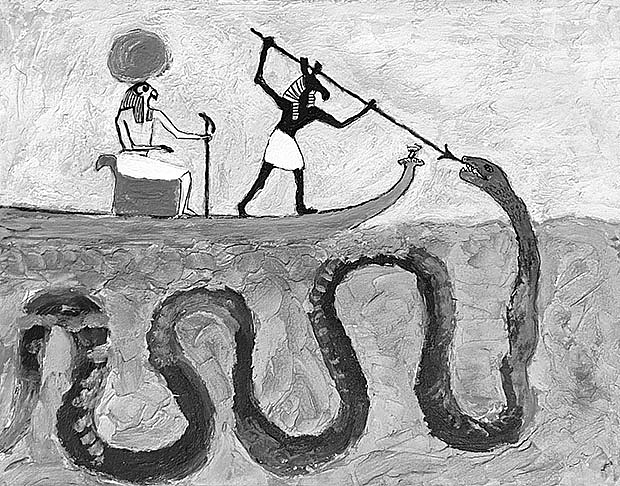
I didn’t even know this much when I introduced the solar boat into my narrative. I had just enjoyed the artistic representations of the boat in bas reliefs and books. I created a scene in which my characters convene in the Piazza della Minerva (the location of the Elephant and Obelisk statue) and somehow, I was called to draw a ghostly image of the solar boat above the obelisk. My characters all feel the beneficence of the boat, but then one of them becomes consumed with rage. Chaos ensues. The solar boat disappears, returning to its unknown mooring. Did something in me make the solar boat recede?
I have come to think that a part of me knew I did not have the depth of knowledge to do justice to the concept of the solar boat. I had spent some time drawing it and, just through the act of drawing, I began to feel more about it— even a sense of its grandeur. At the same time, I felt that I might be on the verge of making a joke out of it.
I had to rethink what I was doing, and it now seems to me that due to the inner exploration and self-questioning these acts of drawing initiated—my contemplation of the boat with mind and body connected—the solar Boat had to disappear at this time.
Now, let’s turn to Jeremy Naydler’s extensive study of Egypt as presented in his books Temple of the Cosmos—The Ancient Egyptian Experience of the Sacred and The Future of the Ancient World—Essays on the History of Consciousness and Shamanic Wisdom of the Pyramid Texts, The Mystical Tradition of Ancient Egypt. As I read them, I had the feeling of my eyes being opened.
Through his phenomenological studies of ancient Egyptian art along with his in-depth study of source texts such as The Egyptian Book of the Dead, The Book of What is in the Underworld, The Book of Gates, and other writings from ancient Egypt, Naydler gives us a persuasive account of ancient Egyptian consciousness as well as the misconceptions perpetrated in our era.
Take, for example, the many bas reliefs of battle scenes in the temples where an oversized pharaoh in a chariot lays waste to many much smaller enemies. Modern Egyptologists explain that these are simply representations of historical events such as the Battle of Kadesh (a battle which took place between the Egyptians and the Hittites in 1274 BCE) and that the oversized images of the pharaoh are an ancient example of “propaganda.”
Naydler offers a more symbolic view: that these scenes are representations of order conquering chaos. In Egyptian writings and temple art, the pharaoh embodies Maat, or the order of the mythological and divine realm.15 In the battle friezes he is conquering isfet, or disorder and falsehood, the antithesis of maat.16
For the ancient Egyptians, Naydler contends, the battle between these two forces was more important than any actual battle. The de-emphasis on the modern idea of progress, or narrative, from one documented event to another (the point of view from which many of us live our lives) is related to the difference in how we and they, the ancient Egyptians, conceive of time.
The presentation of the crew of the solar boat served up by my Google search, which includes Ra’s “30,000-year” reign, seems quaint to us—the beliefs of “primitives.” Could we entertain the possibility that the mythological perspective of the Egyptians and their many gods and rituals were not merely fictions? What if they were a means of holding in place a vision that described existence, ordered time and the universe such that they existed within something living? Perhaps they did not suffer as we do in our scientific, materialistic culture from what writer Graham Greene, in The Power and the Glory, has one of his characters describe as “a vacant universe and a cooling world”17 as if such a contemporary understanding were a comfort.
Notwithstanding all its benefits, this empty vision also follows from our scientific perspective.
True, we have our religions, but many are losing their adherents to the delights of TikTok, Netflix and the endless blandishments of our consumer culture. Naydler refers to all this as “the drive to solidify the world…the peculiar project of the West.”18
Space, in the ancient Egyptian concept as described by Naydler, is filled with spirits and gods that are more than merely concepts of certain attributes. Something in the ancient consciousness allowed them to achieve a kind of dimensionality, to live. In his essay, “The Reality that is Not There,”19 Naydler explores the idea of “nonlocational space,” where things in it no longer have an external, perceptible location, but are nevertheless still real. They have being, but no location. They are ‘nowhere.’20
An example is perennial plants. They disappear in winter yet reappear in the spring. Where were they? Or when we are asleep and we dream, where are we? In a state of dreamless sleep, are we ‘nowhere’?
This is a terribly difficult idea for us moderns to give any credence to at all. However, a feeling for an invisible reality was accepted by people up through the 17th century, as shown in cosmological diagrams,21 for instance, while today we feel unequivocally correct in our scientific views. Could it be that we are cut off from perceptions that human beings once had?
Naydler goes on to state, “We, all of us, stand between two worlds: an outer world of objects in locational space, and an inner world that we become aware of within our own consciousness, in nonlocational space…. It is not literally within us. If anything, it surrounds us—encompasses us on all sides—for it is the great ‘sea of soul’ that Plotinus describes: ‘The universe lies in soul, which bears it up…like a net thrown into the sea… The universe extends as far as the soul goes, but no further.’”22
Let’s return to the example of the solar boat. For the ancient Egyptian, every evening at sunset the solar boat, containing Ra and his court, descends below the horizon. In the night they battle the cosmic forces of chaos wrought by the python Apophis.
When we say, “The sun goes down,” how is that for us? Sometimes we’re amazed by a sunset’s beauty. Some of us may say a prayer of gratitude for another day. Speaking for myself, as the sunset transitions to night—buffered by the distraction of my thoughts and worries—I’m not in touch with the reality of this cosmic event within which I have my being. Thanks to Science, I am not worried about the sun coming back up on schedule. But how do I feel about my being, which scientific materialism explains as being nothing more than a vulnerable speck? In this state, would I be able to face the darkness with equanimity?
The ancient Egyptians, in what we consider to be their odd and disturbing myths, were able to travel with the sun and imagine an epic battle taking place which connected the day to the night, of which they were a part because they lived within a belief system that allowed them to stay with the sun’s journey, as Ra—unseen, but still existing—battled and subdued the python Apophis.
Another noted figure whom Naydler has studied, and is relevant here, is Henry Corbin. In his writings Corbin expresses a concern that the word “imaginary” is not apt for the realm he wants to describe because “it is equated with the unreal, with something that is outside the framework of being and existing.” Corbin’s (and Naydler’s) wish is to awaken his reader to another order of things for which he proposes the word “imaginal.”23 He approached the territory of the imaginal through Persian literature. With this word we enter a realm like the one Naydler describes in his writing on ancient Egypt.
Corbin also relates the imaginal with the world of the unconscious explored by Jung in active imagination, a method of writing or drawing that leads the practitioner into contact, and dialog with, materials existing in the unconscious.
Could it be that the imaginal realm—the unconscious realm—whispers to us in various ways, and through different thinkers, attempting to break through the scientific materialism in which we live?
Could it be that my own narrative— begun as a fantasy to while away the time and to keep my own inner demons at bay—has been its own means of travel, permitting me to enter the realm of the unconscious, or the imaginal realm of non-locational space?
Not only did my characters multiply to better describe my inner world, but in recent stories, they have shown the way on a journey of discovery through research and history that I could never have imagined— or had the will to follow—without them.
Some of them have embarked on healing journeys; some have become healers. As a group they, among other things, have led me to study obscure works of art and pore over centuries-old texts. And I’m not a scholar! I would never have done any of this without the urgings of my imaginal friends.
To some, these musings may seem unhinged. But what is this inner world that supplies such richness? Why are people called to make art—to follow the mysterious flow of a watercolor, the inner space created while writing a haiku, or even while making a macramé owl? Maybe these types of activities could be points of entry into whatever of “the reality that is not there” is still available to us.
Near Oxford
Fast forward to May of 2025. I am on vacation in the UK with my husband Richard, publisher of this magazine. Thanks to my discovery that we have a friend in common, I was able to contact Naydler to see if there might be a possibility of visiting him while we were in England. He graciously invited us to lunch.
On the appointed day, getting off the bus, we find ourselves on a country road not far from Oxford. It’s peaceful, and no one is around, which is unfortunate, since (of our two choices) we’ve gotten off at the wrong stop. We try unsuccessfully to text him and are wondering what to do next, when there in the distance, we see a man walking briskly along the narrow road coming our way. Could it be? Indeed, it is!
Jeremy Naydler is a gardener and a philosopher/writer/scholar and we encounter him in his gardener aspect, wearing a sturdy hat with a wide brim and practical clothes.
Jeremy and his partner Louanne Richard’s house is nestled among other modest brick cottages, but stands out for its wild garden. It’s a visual introduction to Jeremy’s teaching and life aesthetic of embracing one’s relationship with nature—accepting being part of nature, as Goethe reminded us 200 years ago. Beside the entry door a beautiful bas relief of St Francis transmits calm. Once inside, Jeremy and Louanne lead us out to the even wilder garden behind their house that might, to a conventional eye, seem to be merely overgrown.
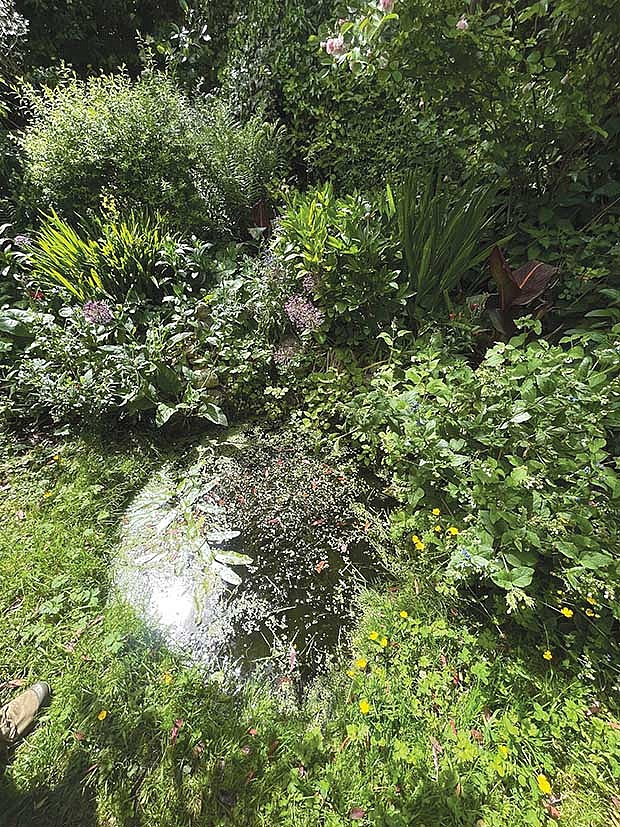
Not to us. Standing in the greenery in the first moments of getting to know Louanne and Jeremy, the sense of being enclosed by, and part of, nature is very strong. There’s a tiny pond, completely natural, with tiny plant-life floating on its surface. Jeremy calls our attention to some kind of native grass growing near its edge in unedited profusion. The plants are so high and thick that it’s not possible to see outside the garden; the order of the village can’t touch us here. It’s such a small space, but seeing it as if through Jeremy’s eyes, the richness it contains springs forward.
One has but to turn around in place to see their unusual beehive situated a little above eye level. Asked about it in an email after our visit Jeremy explains that it was a gift. “I built the large wooden pagoda. The skep (round upturned basket inside) is handmade of rushes, but not by us. The wooden box it sits on has a large hole in the top so the bees have more space, plus a window in the side so one can look in and see what’s going on.” Perfect.
We all go back inside and sit in their sunroom—glass on three sides, decorated with plants and glass beads—just big enough to seat the four of us for lunch. It was daunting for me, as someone who generally shies away from celebrities, to move from hero worship to meeting the hero in person. Luckily, Richard has interviewed many accomplished people and dove right in.
We learned that Jeremy had been disappointed with philosophy as taught at Oxford when he attended as an undergraduate. He found that it was not possible to study the Existentialists and Heidegger, for instance, as only a canon of British philosophers was on offer. The disappointment must have been significant as he left Oxford and took his Doctorate at the University of Kent to continue on his path as an independent scholar, philosopher, writer and gardener.
Over lunch, our conversation leads in many directions and as we’re talking, the solar boat is much on my mind. I’m thinking, “my characters’ attempt to ride in the solar boat—I must ask about it! I must learn from this learned man!” I’m hoping that my characters and I will have a chance to fly, to grow, to have our questions answered, rather than wandering along once again rebuffed by the mysteries. I’m also hoping to find a really good ending for my story. Finally, with an avidity I do my best to conceal, I say to Jeremy something like, “I’m fascinated with the solar boat. How would you describe what takes place when it disappears and begins its night journey?”
Jeremy looks down at this plate. Some time passes. Then he replies in a humble tone, “Well, I haven’t been thinking about Egypt for many years now….”
His books I’m referring to were published 20 years ago. And sitting there, I come down a bit in myself. A little anxiety is in the way, but I feel that I must live with it and let the solar boat disappear once again. After all, Jeremy can’t help my characters have a successful journey on the solar boat in my imaginal realm. It’s up to my own growth and self-knowledge to attract the boat and ensure its safe passage.
It so happens that Jeremy has been writing and speaking in recent years about the advent of logic, mathematics, the discovery of electricity, the development of computers, Scientism and their effects on human consciousness.24 Various philosophical perspectives on this problem became a topic of lively exchange between Jeremy and Richard, who at one point began speaking about “emptiness.”
I could feel that Jeremy was bridling at the introduction of the word, and suggested, “Perhaps it would be better to use the word ‘unknown’? How can I face the unknown?”
It was an interesting moment, as Jeremy responded, with some force, “But I want to know it!”
Postscript
After thinking about the contents of this essay, I asked Richard about his use of the word “emptiness.” He told me that in a way, it was the most interesting thing for him. “Do you remember when I went down to L A to interview psychology professor Lobsang Rapgay, the Tibetan Buddhist? I wanted him to explain what he’d meant when I’d heard him talk about ‘aesthetic thought’ and how, in the West, we were too exhausted to practice that. He said that when it reaches a certain level, ‘aesthetic thought can bring the numinous down into circulation and, without that, a culture cannot survive.’ He also spoke about Wilfred Bion’s ideal for the psychoanalyist, of seeing patients in a state “without memory or desire.” And that “healing begins by embracing the state of not knowing in the spaciousness of the mind so that in the darkness a flicker of light can be seen.” I’ve come to think of ‘emptiness’ as an inner silence with the ego completely quiet where something finer can enter one’s awareness.
For Jeremy, perhaps the effort is more to inhabit imaginal space through consciousness. Is there a conflict there? It’s hard to think there could be. But the time had passed quickly—heading for three hours—and had included our getting to know a little about Louanne—her Tai Chi practice and her perspective on some problematic current events. After such a richly layered feast, to ask for more was unthinkable
So this last question seemed best left for a possible second visit. And certainly there’s much more. In Naydler’s latest work he shows how in the past 2,500 years, the central development of consciousness has been our individuality. Among those who have noted the price we’re paying for the purchase of this license, Jeremy Naydler’s voice is a singular and compelling one. It needs to be heard.
***************************************
1. West, John Anthony, The Serpent in the Sky, The High Wisdom of Ancient Egypt (Three Rivers Press, 1979)
2. Tompkins, Peter, The Magic of Obelisks (Harper & Row Publishers, 1981) Chapter 1 Historical Background pp. 1-15.
3. Ibid., p. 99
4. Ibid., p. 86-98.
5. Ibid., p. 50
6. Internet AI search for “What is the actual date of The Hermetica?”
7.Tompkins, Peter, The Magic of Obelisks, Chapter 2 The Resurrection of the Obelisks pp.17-45.
8. Ibid., pp. 87-97.
9. Ibid., p. 88.
10. Naydler, Jeremy, Shamanic Wisdom of the Pyramid Texts, The Mystical Tradition of Ancient Egypt (Inner Traditions, 2005) Chapter 2 The Death and Rebirth of Mysticism in Ancient Egypt pp. 20-47 and Chapter 3 The Mystical Versus the Funerary Interpretation of Ancient Egyptian Religion pp. 48-81.
11. Ibid., Chapter 5 A Question of Method pp. 123-145.
12. Stanford Encyclopedia of Philosophy
13. Naydler, Jeremy, Shamanic Wisdom of the Pyramid Texts, The Mystical Tradition of Ancient Egypt (Inner Traditions, 2005) p. 125.
14. Internet: AI search for “solar boat”.
15. Naydler, Jeremy, Temple of the Cosmos, The Ancient Egyptian Experience of the Sacred (Inner Traditions, 1996) p. 93.
16. Ibid., pp. 112-120.
17. Greene, Graham, The Power and the Glory (Random House, 1940)
18. Naydler, Jeremy, The Future of the Ancient World, Essays on the History of Consciousness (Inner Traditions, 2009) p. 88.
19. Ibid., pp. 66-82.
20. Ibid., p. 71.
21. Ibid., pp. 72-76.
22. Ibid., pp. 71-72.
23. Corbin, Henri, “Mundis Imaginalis, or the Imaginary and the Imaginal” (1964)
24. Naydler, Jeremy, In The Shadow Of The Machine, The Prehistory of the Computer and the Evolution of Consciousness (Temple Lodge, 2018)


Reflections
Be the first to share your reflection on this interview.