
[Author's Note: This Fifth Monk parable is adapted from the original Story of The Fifth Monk by Tom Callanan.]
Once upon a time, there were four young monks who, seeking to end animal suffering, meditated and contemplated on how to create a compassionate world. Years passed in quiet determination. One day, they witnessed a truck full of animals headed to slaughter that crashed. The monks rushed to rescue as many animals as they could, creating sanctuaries where these beings could live free from harm. Over time, more transport trucks crashed, and the advocates were overwhelmed with rescue efforts. Suddenly, three of the monks walked away, leaving a single advocate to continue the direct rescue work.
Months later, the flow of trucks slowed, and the second monk returned. She explained that she'd gone upstream to where the animals were being raised, exposing the conditions through investigations and campaigns, helping consumers understand the reality behind their food choices. Many people changed their diets, and fewer animals were sent to slaughter. The problem appeared solved, and the two monks returned to their contemplation.
But soon the investigations were dismissed as "activist propaganda," and consumption returned to previous levels. Years later, the problem mysteriously stopped again, and the third monk returned. He explained that he'd gone further upstream to work on institutional change - corporate campaigns, food service reforms, and policy work that removed animal products from entire institutions. Convinced the problem was now solved systemically, the three monks returned to their practice.
Unfortunately, economic pressures and political backlash eventually reversed many of these institutional gains. Many years later, after much struggle, the problem stopped again, and the fourth monk returned. She explained that the institutional work was just one piece of a complex web. She'd been building coalitions across environmental, health, and social justice movements, creating political power for comprehensive food system transformation. Meanwhile, the third monk had been supporting innovators who were creating remarkable alternatives - plant-based meats that satisfied even devoted carnivores, and new technologies that could produce real meat without animals. The movement elected officials who began implementing supportive policies while these innovations made compassionate choices easier and more delicious than ever. The problem appeared to be finally solved.
Tragically, the next election cycle brought opponents who dismantled some programs. But something had fundamentally shifted - the innovation and cultural momentum had created irreversible change. Still, the monks, now older and wearier from decades of effort, realized they needed something even deeper - a transformation of consciousness itself.
In deep contemplation, the monks began gathering with others in circles of practice and dialogue. Over time, a special quality of presence and collective wisdom emerged that they called "the fifth monk." With her guidance, these circles began glimpsing what a truly compassionate food system could look like - one where the question of harming animals for food seemed as foreign as many past forms of exploitation seem to us today. New forms of healing emerged that helped society release old patterns of disconnection from our food sources. This catalyzed a spirit of innovation and hope that, step by step, helped build a fundamentally different relationship with food.
The transformation was remarkable: the alternative proteins that had been developed as transition foods naturally gave way to a culture celebrating whole plant foods as the new fine dining. Farmers who had once raised animals now grew heirloom vegetables and ancient grains. Children grew up thinking it was perfectly normal to have chickens as backyard friends rather than dinner. What had once required fierce advocacy became simple cultural common sense.
The four monks, now very old and gray, sat again by the riverside where they had begun their journey so many decades before. No longer needing to rescue anyone from anything, they opened a picnic basket filled with the most delicious plant-based feast they had ever tasted, raised a toast to the fifth monk with sparkling elderflower water, and spent the afternoon telling stories and laughing until their bellies hurt - not from suffering, but from pure joy.
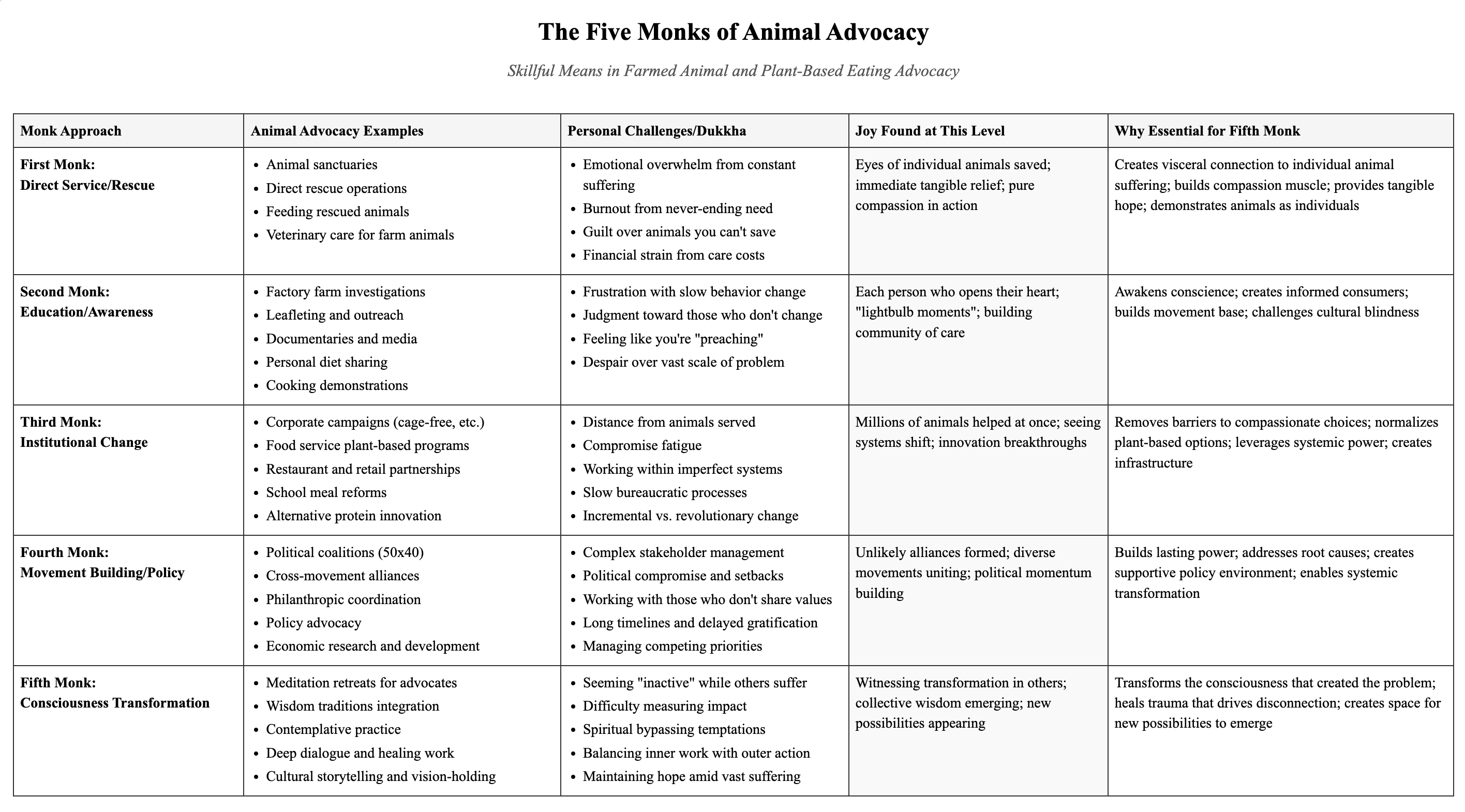
[Zoom in]
My Journey Through All the Monks
In 1987, when I first encountered an animal rights activist at Venice Beach, with nothing but a few posters showing the cruelty of factory farming, I didn't know I had choices around what / who I ate. Eight years later, when his message finally clicked, I thought I had two tools: angry protests and leafleting. I did them both, but they felt like self-flagellation. I didn't enjoy the work, but I thought these were my only options to help the world's billions of farmed animals.
My First Monk phase was necessary but painful. Standing with signs, chanting slogans - it felt like I was performing suffering rather than alleviating it. Passing out leaflets felt like penance, my cross to bear. But this phase built something crucial: it connected me viscerally to the urgency of animal suffering.
As my business became more successful, I moved into Second Monk territory - the "earn to give" model. I spent 99% of my time making money and 1% writing checks. This felt more efficient but less integrated. I was funding others' compassion while staying removed from the work itself.
The Pollination Project marked my entry into Third Monk work. Suddenly I wasn't just writing checks - I was empowering individuals worldwide to find their own unique ways to create compassion. During this time, I also began investing in alternative protein companies, recognizing that innovation could make compassionate choices easier and more delicious.
Food Solutions Action, 50x40 and Farmed Animal Funders represented my Fourth Monk phase - building coalitions and engagement across animal, environmental, health, political and economic development groups. Here I learned the hard truth about working upstream: the further you go from direct animal contact, the more complex it becomes. Coalition work meant managing different motivations, theories of change, and values.
But then, nine years ago, something shifted. We started hosting weekly meditation at my house. A year later, we began hosting meditation retreats for animal advocates (with a real monk!). This was my introduction to Fifth Monk work - not replacing the other approaches, but creating the conditions where they could emerge from wisdom rather than reactive urgency.
Here's what's important: I haven't moved away from the earlier levels - I still engage at all levels. I still fund direct relief through Pollination Project grants. I still do education through sharing my story, advisory work with media groups, and other forms of funding. I still invest in food tech companies and support institutional change. I still work on coalition building and policy. And I host meditation circles.
The progression isn't about leaving approaches behind - it's about adding new dimensions while staying connected to all levels. Each monk lives within us, and each has their season of prominence while the others continue their quiet work.
The Upstream Paradox
One of the greatest challenges in this work is what my teacher Tashi Nyima calls "the upstream paradox." The further upstream you go, the more leverage you potentially have, but the more distant you become from the animals you're trying to help.
Working at a sanctuary, you see eyes looking back at you - individual beings whose lives you've directly saved. Working on policy, you're dealing with statistics and legislative language. Both are necessary, but they require different spiritual practices to remain heart-centered.
The dukkha - the suffering we experience - at each level is different:
-
First Monk dukkha: Emotional overwhelm, burnout, heartbreak of never being able to save them all
-
Second Monk dukkha: Frustration with how slowly people change, judgment toward those who resist
-
Third Monk dukkha: The compromises required, working within imperfect systems
-
Fourth Monk dukkha: Complex stakeholder management, political setbacks, long timelines
-
Fifth Monk dukkha: The temptation toward spiritual bypassing, the challenge of seeming "inactive" while animals suffer
What I've learned is that trying to be perfect at any one level is a recipe for suffering. The wisdom tradition teaches us something crucial: each approach is a skillful means when it emerges from the union of compassion and wisdom.
Skillful Means: The Union of Compassion and Wisdom
“Skillful means” is the implementation of compassion through wisdom. This isn't just a nice phrase - it's a practical instruction for how to work at any level without losing our center.
Compassion without wisdom too often is merely sentimental and fails to actually reduce suffering. It leads to burnout, reactive anger, and ineffective action. We've all seen advocates who are so angry or distraught they can't connect with anyone outside their own echo chamber.
Wisdom without compassion leads to cold analysis, spiritual bypassing, and paralysis. We've all met people who understand the problems intellectually but remain disconnected from the urgency of suffering.
But when we unite them-when our actions arise from both clear seeing and an open heart-we become "skillful." We can work at any level while remaining centered, joyful, and effective.
The Three Wheels and Animal Advocacy
My teacher's Dharma Handbook speaks of three progressive levels of understanding, which map beautifully onto our journey:
First Wheel (Direct Cause and Effect): This is First and Second Monk work - seeing clearly that our food choices cause suffering, that inveself-graspingveal truth, that individual actions matter. This level is absolutely necessary.
Second Wheel (Systems Thinking): This is Third and Fourth Monk work - understanding that individual choices alone aren't enough, that we need systemic change, that the whole web of institutions must shift.
Third Wheel (Consciousness Transformation): This is Fifth Monk work - recognizing that the consciousness that created the problem cannot solve it, that we need a fundamental shift in how humans relate to other beings.
Each wheel is necessary. Each builds on the previous. And paradoxically, each returns us to the same truth: the interconnectedness of all life.
Why Each Level Matters for Manifesting the Fifth Monk
Here's what I've come to understand: the Fifth Monk cannot emerge without the first four. They're not competing approaches - they're complementary expressions of the same awakened nature, the same compassionate impulse.
First Monk work keeps us connected to why we're doing this. Without sanctuary workers and rescue operations, we lose touch with the individual faces of suffering. We need people willing to look into the eyes of a rescued pig and remember why policy work matters.
Second Monk work builds the base. Without investigations, education and outreach, we have no movement. Every person who stops eating animals because they watched a documentary or were taught the harms of animal agriculture creates space for institutional change.
Third Monk work creates infrastructure. Without corporate campaigns and institutional reforms, individual choices remain marginalized. Someone has to make plant-based or more technologically advanced options available and affordable.
Fourth Monk work builds lasting power. Without policy change and movement building, all our gains remain vulnerable to backlash. Someone has to create the political, economic and cultural conditions for transformation.
And Fifth Monk work transforms the consciousness that enables all the rest. Without contemplative practice, wisdom traditions, and deep dialogue, we remain trapped in reactive patterns that ultimately recreate the same problems in new forms.
Finding Joy at Each Level
One of the most important teachings my practice has given me is this: we can find joy at every level when we stop trying to be perfect in an imperfect world.
The First Monk finds joy in each individual animal saved, not in eliminating all suffering.
The Second Monk finds joy in each person who opens their heart, not in converting everyone.
The Third Monk finds joy in each institutional step forward, not in perfect policies.
The Fourth Monk finds joy in building relationships across differences, not in winning every battle.
The Fifth Monk finds joy in the very possibility of transformation, not in a perfect outcome.
When we try to be perfect - to save every animal, convince every person, win every campaign - we create our own suffering. But when we understand our work as one thread in a vast web of awakening, we can act with a "relaxed urgency."
The Emergence of the Fifth Monk
What I've witnessed in our retreat gatherings is something remarkable: when advocates from different levels come together in contemplative practice, something new emerges. The sanctuary worker's direct compassion meets the policy advocate's strategic thinking, the educator's communication skills meets the contemplative's wisdom-holding.
In these spaces, we stop competing over whose approach is "most effective." Instead, we start recognizing how each approach feeds the others. The Fifth Monk isn't another person - it's the collective wisdom that emerges when we stop defending our positions and start serving the larger awakening.
This is what gives me hope for our movement: not that any one approach will solve everything, but that together, we're midwifing a new consciousness where the question of harming animals for food becomes as foreign to future humans as slavery seems to most of us today.
Heartivism: The Path Forward
I call this approach "Heartivism" - activism that emerges from the marriage of compassion and wisdom rather than from reactive anger or cold strategy alone. Heartivism recognizes that:
-
Every level of intervention matters
-
No approach is superior to others when rooted in wisdom
-
The consciousness that creates suffering must be transformed, not just managed
-
Joy and effectiveness are compatible
-
Individual healing and collective transformation are inseparable
Heartivism asks not "What's the most effective approach?" but "What wants to emerge through me right now in service of this awakening?"
The Light in Each Approach
Whether you're cleaning out sanctuary stalls or crafting policy language, whether you're offering cooking demos or facilitating board meetings, whether you're sitting in meditation or standing with protest signs - if done coming from a place of equanimity, you are manifesting the same awakened nature.
The light in the First Monk honors the light in the Second Monk honors the light in the Third Monk honors the light in the Fourth Monk honors the light in the Fifth Monk.
When we truly understand this, our work becomes not a burden we carry but a gift we offer. Not a problem we solve but a love we express. May all our efforts serve the awakening of compassion. And may we find joy in being exactly where we are called to serve on this beautiful, difficult path.
May all beings be free from suffering and the causes of suffering. May all embrace happiness and the causes of happiness. May all abide in peace, free from self grasping. May all attain the union of wisdom and compassion.
COMMUNITY REFLECTIONS
SHARE YOUR REFLECTION
2 PAST RESPONSES
Appreciate this multi-faceted, deep, transformative gem of an article that has emerged through you for our awakening in the movement and beyond, Ariel.