A Mess of Paint and Possibility
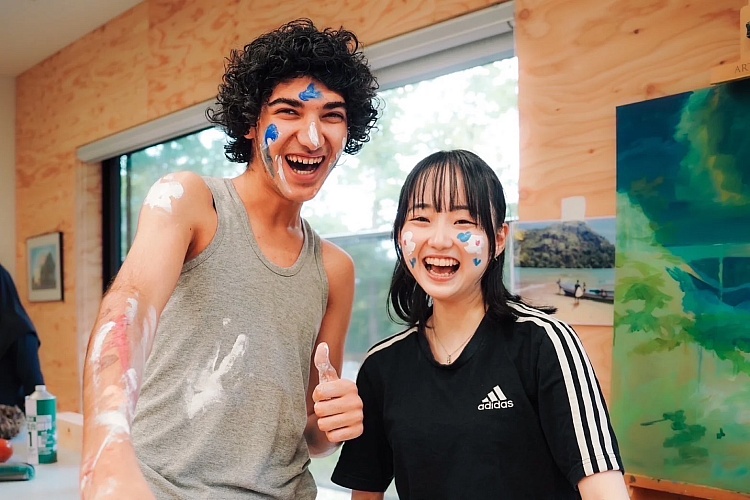
 The art room was a mess. Paint on hands, paint on shirts, laughter bouncing off the walls. Students from more than 90 countries were gathered at our school in Japan, writing the word "peace" in their own languages, layering these offerings into a Peace Pole outside our school building at UWC ISAK Japan. In the middle of that joyful, colorful chaos, something shifted. It felt like a collective exhale — a spirit in the room I could sense but not yet name.
What made the moment extraordinary was what had come before it.
A few weeks earlier, two students from completely different political backgrounds had clashed with each other. I watched their conflict unfold — the frustration, the hardened faces — and it made me sad in a way I hadn't expected. Our school's mission at UWC ISAK Japan is "to be a catalyst for positive change," yet here we were, in one of the most intentionally diverse environments on Earth, still hurting each other. It struck me that no matter how good our intentions are, we can still cause harm. Goodness alone isn't enough.
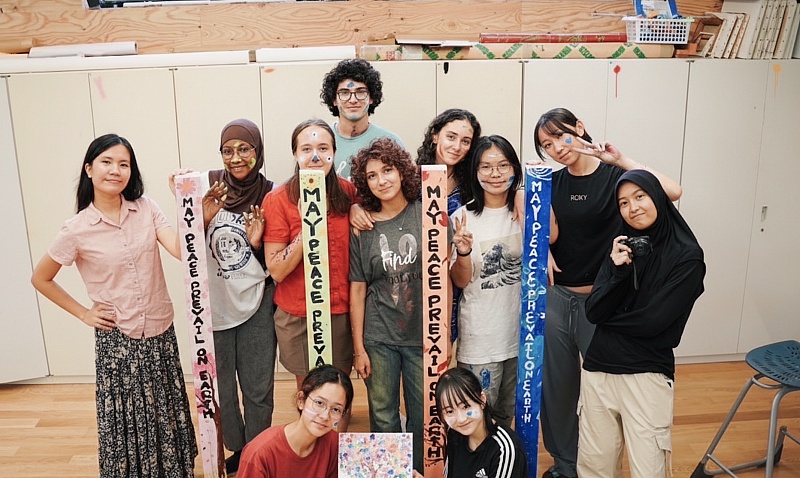
But then something shifted. On the International Day of Peace, the art room was loud with laughter. We were covered in paint, building a peace pole together — students from completely different histories, religions, and political beliefs. For a few hours, no one was trying to win. No one was trying to prove why they were right. It was that everyone was connected with the vision for peace. And I remember how peaceful it felt in the classroom.
It wasn’t that our differences disappeared. It was that they didn’t feel like weapons.
When the day ended, and I walked back toward my dorm, I saw those same two students sitting side by side.
Thats when I understood:
Peace is not simply resolving conflict.
It is the intention we choose before it begins.
And that's what changed the classroom that day.
That was the moment I understood something that has shaped everything I've done since: our differences may sometimes divide us, but a shared desire for peace has the power to bring us back.
The Peace We Assume and the Peace We Lack
When I talk about peace, people often assume I mean the absence of war. But in Japan, where I grew up, we have no war. We have something that looks like peace on the surface. And yet the leading cause of death among young people in my country is suicide.
This cannot be called true peace.
I've come to think of peace as having two dimensions — the outer and the inner. Outer peace is the physical safety we all deserve: no violence, no harm. But inner peace is what gives that safety its depth. I believe the world we see is, in many ways, a reflection of what's happening inside us. If someone is full of competition and anxiety, that's the lens through which they interpret everything. But if their heart carries love and gratitude, even the same world begins to look different.
A peaceful world, then, doesn't begin with policy. It begins inside each person. When peace becomes a shared intention — not just a slogan, but something we actually orient our lives around — then even our conflicts change character. Arguments still happen. Disagreements don't vanish. But they are no longer the destination. They become part of the path toward something, rather than the end of the road.
I don't want to be someone who simply talks about peace. I want to be someone who lives peace. To me, living peace means becoming the kind of person who makes others think: If a peaceful world existed, the people living in it would look like this.
1,200 Voices in Fourteen Days
After ISAK, I carried that lesson with me into larger circles. I kept thinking about what I had seen in that classroom — how peace began not with agreement, but with a shared orientation. So I founded the Youth Peace Ambassadors, a growing network of young people from more than 100 countries, connected not by politics, but by the same desire for peace.
As our first milestone, we asked young people around the world a simple yet profound question:
“What does peace mean to you?”
When we launched a global video collection campaign for Expo 2025 in Osaka, we gave ourselves just two weeks. In fourteen days, we received 1,200 video messages from 70 countries.
Now, we are organizing a youth peace education platform called the Peace Journey, where young people are invited to discover their own path to peace — exploring how they can contribute to peace by pursuing their passions, dreams, and areas of expertise. This time, more than 1,600 young people from over 100 countries applied, resulting in an acceptance rate of just 3%!
But what struck me wasn’t the numbers. It was the hunger. Young people everywhere were waiting to be connected.
They already carried passion. They already carried the seeds of peace within them.
They just hadn’t been given the kind of space where those seeds could grow.
Alongside this, I've been part of a project called Yumi's Universe, a peace education initiative inspired by Japanese tea ceremony wisdom. Through animations, music, and stories, children follow Yumi and her animal friends as they travel the world learning about compassion, diversity, and mindfulness. What moves me most is watching children discover peace not through instruction, but through imagination and emotional connection — through story.
Conflict as a Doorway
People sometimes ask me about the challenges of this work — what holds me back. I struggle to answer. When your work aligns with your deepest conviction, challenges don’t stop you.
They shape you. I came to realize that difficulty is not something that blocks the path,
but something that guides it.
Every obstacle becomes an opportunity — to learn something I didn’t yet know about myself, about others, about how to create the conditions where harmony can emerge.
The real lesson ISAK gave me wasn't about diplomacy or conflict resolution. It was simpler and deeper: if conflict becomes the goal, relationships just break apart. But if peace becomes the goal, then conflict transforms into a doorway — a place of learning about ourselves, about each other, about what it takes to hold space for difference without losing the thread that connects us.
The Next Stone
This year, I will begin my studies at Minerva University. I don’t know what title I will hold in ten years — and I have learned to trust that uncertainty. What I do know is the direction. Whether my path leads to peace education, consciousness research, global youth movements, or something I cannot yet imagine, I trust that if I keep choosing what feels true, the next step will reveal itself.
When your purpose is clear, you don't need to see the whole road. You just need to see the next stone.
And wherever that stone leads, I will carry one message with me: May Peace Prevail on Earth.
Not as a slogan, but as a commitment —to keep creating spaces where people can meet,
build, and remember that coexistence is possible.
The way two people once sat side by side —not agreeing, but choosing to look forward together.
COMMUNITY REFLECTIONS
SHARE YOUR REFLECTION
6 PAST RESPONSES
So long as we working on finding agreement in the disagreement, it is a long and bumpy road that often leads us nowhere or even intensifies the disagreement.
However, if we choose to look forward together, if we can find something that is worth for all involved to focus or to vision on, we have found the bridge to cross the divide and to connect from deep inside our heart's longings.
Dear Miki, I send you my gratitude, appreciation, and lots of blessings, from one peace lover to another. May your work and vision bloom and spread from heart to heart all over the world!