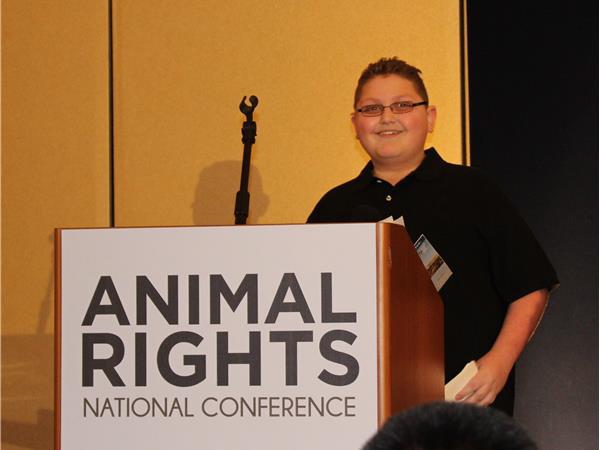
 Thomas Ponce Is a 16-year-old Animal Rights Ad

Thomas: You can try to research online. Pick an animal that you feel passionate about; pick a subject and research it online. Find a problem pertaining to that animal or subject and face it head-on. Take it. Find a way to get rid of that problem. Whether it be through the law, whether it be through raising awareness, try to get rid of the problem, be it shark finning, circus cruelty, whatever, vivisection. Any subject you want to tackle, learn about it, go for it, educate yourself. If you have children, educate your children. Whatever you can do, just go for it. Do something.
Birju: Hmm. Thank you so much, Thomas. Just to echo Alissa, it has been emotional listening to this for me. I appreciate the heart and the vulnerability with which you have been sharing. I am wondering if I can take the prerogative and ask a question on my behalf first. Is that all right, Alissa?
Alissa: It's all you, Birju.
Birju: Thomas, thank you again. It's been wonderful to listen to you thus far. I'm curious. One question that came to me as I was listening to you is about this concept of compassion capacity, where sometimes, you show people that are suffering, and they just shut down. Think of the commercials that are showing starving children in Africa, and people almost tune it out. And what I hear you describe is something that allows you to not shut down, something that allows you to not tune it out and close it off but quite the opposite. And it makes me wonder what it is that you have done in your life, knowingly or not, to grow your heart, to grow that compassion capacity so you can see things that are really painful for most people to see and to go toward it and to bring out your vulnerability as a result?
Thomas: I honestly don't know what makes me able to stand to see it. I don't know if it is because I was raised in a good household with love and compassion. I've known people to look up to. I've had this want to try to change things. I've seen a lot of videos of the slaughterhouses. I've seen a lot of the videos of the children in Africa. I've seen all of that. I don't really know what makes me able to stand it. I don't know if it is because I've seen them a lot or if I'm used to seeing it or if it is my desire to know what's going on in the world. I try to know what's happening and then to try to change that. In my opinion, ignorance is never bliss. Knowledge is the most powerful thing you can have.
Birju: Thanks for sharing that as the context for your journey, and I would love to turn it over to our first caller.
Wendy: Thomas, I so much appreciate the work you are doing, your compassion and your clarity and your purpose. You are a real teacher to all of us. I want to pick up a little bit about what Birju and Alissa just said, which is talking about the compassion issue and compassion fatigue. I spend most of my life really supporting animal welfare and animal rights; I give money to various organizations who do so. What I have found is that I don't have the capacity to look at the pictures, the horrible pictures. I have actively withdrawn my support to organizations who show that and have funneled my money to organizations such as Best Friends, which is enormously successful; they tell the story of what’s happened, so we know what’s happened, but they also show pictures of the rescue animal. I just wanted to say that for me, there is a balance between bringing forth the compassion, but without immobilizing the person who really wants to do good and support the cause. Just wanted to bring out my dilemma and how I have chosen to handle that. It's just another way to bring support for the cause that we all care so much about. Thank you so much.
Thomas: Thank you!
Birju: Thank you, Wendy.
Alicia: Before I ask my question, I just wanted to share a quick story. I actually experienced a similar thing with the shark. A friend of mine stepped on a hook, and when she pulled it out, there was a baby shark hanging from the hook. I took the shark from her and pulled the hook out. Just like you mentioned, looking at the shark's eyes in that moment, it's like it has an awareness of what's going on and putting it back in the water and watching it swim away made me feel the joy and the freedom of the shark being released. I just thought it was a pretty cool that we had similar experiences. My question, you mentioned on your WoW project for your school that you used the tigers as an example. It reminded me of the project that's going on in Russia that the Wildlife Conservation Society is doing. It's a rehabilitation project and what they do is take orphaned tiger cubs from the mothers who have been poached. They take the cubs and rehabilitate them with no human contact. They prepare them to hunt and be released back into the wild. The director of the project mentioned that one of the rehabilitated tigers attacked and killed a fisherman, so now there is whole controversy surrounding the project. So a lot of the people in Russia turned against him. But my thoughts on the matter are like, a lot of us think that we are more entitled to life than a tiger, that we are more entitled to life than any animal. I was wondering if you ever had a conversation with someone like that, something that you may have said that caused them to shift in the way they see things. Just wondering if you have ever had that conversation before. People tend to get defensive when you ask them to question the way they’ve always seen things.
Thomas: I tried to explain to them in the best way possible. Of course when the social norm is challenged, whatever, the status quo is challenged, people always get put on the defensive. If we approach it from a peaceful stance, it sort of nullifies that defensiveness that people can get into. And I also wanted to mention, as you said, a lot of people have a superiority effect to them, that they think, “Well, my life is more important than the tiger’s.” A life is a life. We should not value one life over another, be it tiger, insect, or whatever. No life is less valuable than anyone else’s. That shouldn't be thought of as correct, that anyone's life is more important than the other. That's one of the other issues that I see. If someone were to do that to a human, if someone were to say, "My life is more important than this person’s life,” it would be ridiculed as terrible. That person would be ridiculed. But if this were to happen to an animal, a lot of the people would just turn their heads and walk away. It's a terrible thing that happens. That’s one of the reasons why we have to keep doing what we do. Don't get frustrated; don't let it affect you. Don't get disgruntled about it. It's completely normal for people to do this. You have to keep going. You have to not let it affect you.
Alicia: I just hope that one day we get to the point where it is not seen as the norm, not seen as the status quo. One day the status quo will be that we are all equal. All animals on the planet are equal.
Thomas: Exactly. That's the correct paradigm to have.
Birju: Thank you. The next question that I am seeing here came from online. We have a question from Jackie in San Jose.
Jackie: Thank you for sharing that great poem. It had tremendous meaning for me and my friends who are listening. Do you keep a gratitude journal? It's a great way to track your progress and that of other animal rights advocates and to celebrate the good news of the people changing their ways and know that this movement is gaining ground.
Thomas: I think it's an excellent idea. I don't, at the moment, have a gratitude journal, but I will definitely look into getting one. I do write and that's sort of my way of keeping track of things. I also remember a lot of things that happen. I have signs up in my room. I have a ton of pictures and writings that remind me of the good and the bad. But the journal is a great idea.
Birju: I am sure that would have Jackie smiling. I am assuming she is listening. So, one question that comes up for me, Thomas, this word “compassion” and the way that you frame it and have been articulating it here, I am wondering how you have seen your compassion grow and be applied elsewhere in your life? Do you have thoughts on what direction you see your compassion response growing in as you go forward?
Thomas: When it comes to growing, my idea on what compassion is has grown since I was younger. It went from an idea that was in me and sort of transcended into sharing it. It's gone from something I keep to myself and share with only a couple of people to something that now I’m able to share with a ton of people. I want to let people know about the injustices in the world and how we can fix them. I am able to let people hear the message that I want out. I remember I woke up one morning and read an email that surprised me. Somebody from Spain had contacted me and told me about what was going on there, about the stray animals there and how he would like some help with it. He wanted to know how I could try to help or what he could do to help, how he could go vegan or how he could try to change the situation. So I worked with him for a couple of months, and he eventually ended up going vegan! And that was sort of a visual representation of what I was able to do. I was able to turn this person who needed help with this; I was able to help him. I saw what I was able to do. I saw that I was able to spread the message to another person, so he can spread to another person and another person. Eventually, soon everyone will have the same idea.
Birju: In this community we have a phrase for that called a ripple effect. Thank you for articulating that.
Jey: Hello, my name is Jey, and I am listening to the call with my mother. You are very inspiring and thank you for what you do for the animals. How do you work with other organizations that help animals to help more animals?
Thomas: Thank you for coming in to the call. When I was younger, I joined up with a bunch of organizations to try to raise awareness about animal rights and animal cruelty. After I had seen what was going on, I decided to spread awareness about it. If I see that an organization is doing a campaign or fundraiser or whatever, I post it on my Facebook or LinkedIn. I will do whatever I can to spread that message.
Question: Is it easy to work together? Because you have the same goal, is it easy to talk and raise awareness together with another organization?
Thomas: I think we all need to work together, and it's easy to work with an organization to try and raise awareness because you have the same common goal in mind. In the end, it is about the animals and the environment. We all have the same idea. We all want to try to stop this and protect our planet and animals. When we work together, we only come closer to the end goal. We are stronger. We can spread our message further. Two heads are better than one, and four hands are better than two.
Alissa: Thomas, I saw a question from the chat that I wanted to ask you. Somebody was asking what do you want to be when you grow up?
Thomas: One thing I definitely want to do is go around and speak in schools. One of my main beliefs is that if we can teach children at a young age about compassion and how to treat the animals and the environment, it's something that will stick with them when they grow older. If we can spread that message about compassion and life, we can definitely change the world with the new generation coming in. If we can teach and encourage our children to change the world when they are little, when they are young, then they will grow up to be much more compassionate people. They will grow up to be responsible, compassionate, loving. When they raise their kids, they will teach them the same values that they know. So the cycle of killing, of not feeling, of bullying, that cycle can be broken. We can start an entirely new cycle of compassion, love, life, healthiness.
For me personally, I want to start talking to them when they are young because I feel like it can be relatable. If a kid sees an adult going into their classroom to talk to them about it, some of them won't be able to relate because they think “Well, this person is an adult, and they probably reached this conclusion when they were older.” If they see it coming from someone close to their age or even at their age, they are like, "This is somebody who is almost like me. I can relate to this person. If this person can do it, why can't I?” I’ve heard a lot of kids say this. The main reason a lot of them don't want to try to make change, or try to change the issues that they see, like bullying, is because of their age. Because they are kids, they can't do anything. They think that, "Well, I am seven, so I can't change anything." You can. Age does not restrict what you can do. Your age doesn't dictate what you can say, what you can do, who you can talk to. It doesn't restrict what you can feel passionate about. If a seven-year-old wants to go around the world and try to change it, they can. They have every right to. That's the message I want to spread to them. That's one of the reasons why I want to talk in schools. I also want to work in the field of law. I want to maybe go into politics. I am not sure about politics, but I'm definitely sure about law and 100 percent sure about talking in schools. I have to mull it over a little bit. I definitely want to keep learning.
Thank you guys for everything that you all do each day individually. I have another poem; if it's okay can I read it out. It's called "I AM"
I am an animal activist
Standing up for what I believe
Speaking out for change to be achieved
Never being silent when the cause is right
Exposing the mass suffering and individual plights
Being a voice for those who have none
Working and educating until the deed is done
Raising awareness for those who are blind
Relentless persistence until the truth they find
Being an activist starts in the heart
Realizing the bigger picture that we all play a part
Saying no more will we accept the lies and secrets that for years have been kept
No longer will we turn a blind eye
And continue to watch you murder and lie
These innocent beings with a soul and heart
No longer will we allow you to rip their lives apart
This is what being an activist is to me
I will continue to fight until they are all free
I am a vegan.
Cruelty free is my life
And compassionate living with very little strife
To harm no living being is my mission you see
Love the animals always, but let them be
Not for food, clothing or entertainment or in labs
Their lives are worth more than shoes or a bag
Who are we to pick and choose?
Which living beings we can use and abuse
Being vegan is the choice for me
And for any true animal lover, it's the only way to be
I am a citizen lobbyist
This is our government at the time we knew
We have the power to change things and see them through
There is no reason to sit idly by
While the laws start to take effect, that make us want to cry
We as citizens need to find our voice
We need to realize and understand that we have a choice
If we don't speak up, how will they know?
Don't let the opposition be the only one who shows
A phone call, a letter, a meeting or two
By yourself, with a friend, hell, bring a crew
So take the initiative and make your opinions known
Our representatives won't act until they are shown
I am a good person
I do what's right no matter how tough
No one ever said it's easy, sometimes it's quite rough
But to know in my heart, I did the right thing
Warms my heart and put things on a positive swing
Hurt no one is my motto you see
Learn and grow and always happy you'll be
Treat everyone how you'd like to be treated
Your conscience will be clear and with happiness you’ll be greeted
COMMUNITY REFLECTIONS
SHARE YOUR REFLECTION
4 PAST RESPONSES
E
E
Great Job Thomas !! An inspiration and cause everyone can get behind... Keep it up no matter what...Fantastic!!
Here's to the passion and wisdom in people like Thomas who shares his belief and cause in a way we can hear, from his heart and with such a gentle manner. Way to go Thomas!
Wow. My life just improved knowing this young man lives among us. I'm going to forward this far and wide and visit his website, Lobby For Animals.
Thank you Thomas, you are a fine human being, an example for all.