When I was three years old, I cried to go to school.
Not because other children were going, but because something in me felt incomplete without learning. My father is a teacher, and every morning I watched him leave for the classroom. One day I refused to stop crying. A colleague finally said, “Let the boy come.” My father agreed.
That decision changed my life.
Within a week, I was solving simple algebraic equations such as 2^x = 8 and 2x + x = 3. By the end of that year, I sat for the Grade One examinations and ranked first in my class. I was three years old. In Zambia, most children begin Grade One at seven or eight.
Concerned that I was too young, my father withdrew me from school for two years. I officially restarted at five. But the hunger had already formed. It was not taught. It could not be removed.
From Grade One through Grade Seven, and again from Grade Ten through Grade Twelve, I ranked first in my class. On paper, that sounds effortless. It was not. Beneath the grades, I was wrestling with questions far beyond the syllabus. How did the universe begin? Can gravity alone explain reality? At ten or eleven, I questioned the Big Bang theory—not out of rebellion, but from a desire for deeper coherence.
That restlessness led me into research.
At fourteen, without mentorship or institutional support, I wrote my first research paper. I proposed two frameworks—harmonic mathematics and harmonic physics—to address forces often treated as negligible in dominant models. The ideas were not successful; they conflicted with established theories. I set them aside. What I did not abandon was the discipline of questioning.
My peers did not understand what I was doing. “Young researcher” was not praise; it was confusion. While others focused on examinations, I focused on problems without marking schemes.
The isolation was real.
I grew up as a book-oriented learner. My father would ask what materials I needed and provide them. My mother supported me consistently. They valued education, though they did not realize I was conducting independent research. My father discovered this only after seeing one of my published papers. He thought I was simply studying for school.
In truth, I was doing both.
I taught myself through university lectures from institutions such as MIT, Cambridge, Oxford, and Stanford. When I encountered a problem I could not solve, I wrote it down and tested every method I knew. If nothing worked, I closed the book and went for a walk. I kept thinking as I walked. Then I slept. Often I woke with a clearer solution.
The mind needs space before it recognizes structure.
After completing school in 2024, I applied to Northwestern Polytechnical University to study Aerospace Engineering. I missed the entrance examination date and was automatically rejected.
That moment nearly broke me. I had hoped university would provide mentorship and a research community. For the first time, I considered giving up.
I did not.
Instead, I intensified my efforts. By the end of 2025, at seventeen, I had earned eight diplomas and six certificates in areas including computer vision, aerodynamics, and electric mechanics. I continued publishing research. My Unified Position Equation, an attempt to connect general relativity, quantum mechanics, and electromagnetism, was accepted for publication in the Global Scientific Journal.
I was formally informed that I had received the Philippines Excellency Award from the Global Research Conference in recognition of my independent research contributions. In September 2025, I became the youngest member of the World Research Fellows of London. In December 2025, I was selected as the youngest member of the African Materials Research Society.
People often call me a genius or a prodigy. I intentionally drop those titles. I do not believe I am more talented than others. I believe in disciplined persistence. Consistency, not labels, determines outcomes.
I founded Genius Hub, a research organization for young people around the world, because I understand how isolating intellectual curiosity can feel. Research should not be limited by age. It begins with a question you refuse to ignore.
Today, my goal is clear. I intend to study Aerospace Engineering at Northwestern Polytechnical University and Electrical Engineering and Automation at Xi’an Jiaotong University. Aerospace gives direction to flight; electrical engineering gives it control and precision. Together, they form the foundation for the systems I hope to design in the future.
I see myself becoming a professor and researcher, contributing to global advancements in physics, aerospace engineering, and intelligent systems. I intend to earn a PhD, publish in leading international journals, and become the mentor I once needed at fourteen.
I study scientists such as Isaac Newton, Albert Einstein, and Nikola Tesla. What inspires me most is not their recognition, but their endurance.
The world does not always recognize significance while it is unfolding. That does not reduce its value.
Passion is not something you wait for. It is something you pursue the moment you recognize it.
One that taught me the most important thing I know:
You don't find your passion by waiting for it to find you. You find it by paying attention to what you are most exposed to, most drawn toward, most unable to leave alone. And then you follow it — not because everyone else is, but because something in you won't let you do anything else.
— as told by Prosper Chanda, founder of Genius Hub, on a Story Booth
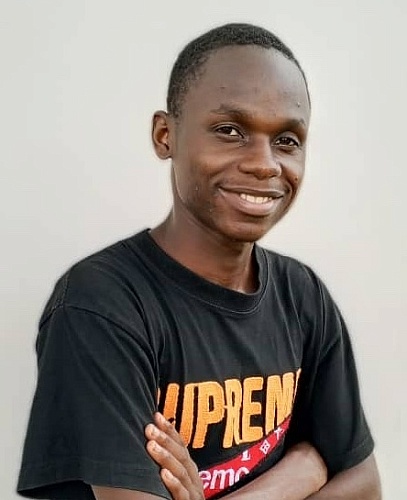 Prosper Chanda is a 17-year-old independent researcher from Zambia. He is the founder of the Genius Hub, a global research initiative for young people, and the author of published work on unified physics. He is currently awaiting admission to Northwestern Polytechnical University in China. The story above emered from a
COMMUNITY REFLECTIONS
SHARE YOUR REFLECTION
8 PAST RESPONSES
Well done Prosper