
In 1965, a graduate student at MIT walked into a talk he knew nothing about. He did not know the speaker. He did not know what Zen was. He went anyway.
“It so much blew the top of my head that I started meditating that night.”
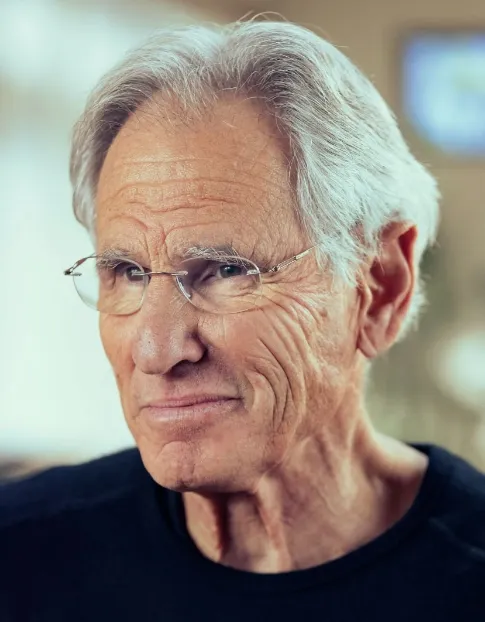 His name is Jon Kabat-Zinn.
What happened after that night is hard to overstate. One talk led to a small program in a hospital basement. That program became Mindfulness-Based Stress Reduction (MBSR). Today, tens of thousands of scientific papers include the word “mindfulness.” It’s one of the quiet revolutions in modern medicine.
The Hospital Basement
In 1979, Jon started MBSR in the basement of a medical facility at the University of Massachusetts. The patients referred to him were the ones nobody else knew what to do with. Chronic pain. Chronic anxiety. Chronic depression. They had an average of eight years of symptoms with no improvement.
Richie put it plainly:
“They gave you all the people that they didn’t know what to do with. And you actually developed something that was genuinely helpful.”
The chief of medicine told Jon he would be giving grand rounds in a year. He wanted results.
Jon knew what that meant.
“I knew that if I didn’t study it, I wouldn’t be there more than a year. I had to produce results if there were results to be produced. Either way, the results stand for themselves.”
When he began, there were only three scientific papers on meditation in the entire medical literature. Richie remembers them. One was conducted on three participants.
Jon held up a graph during our conversation. From 1980 through the late 1990s, the line barely moves.
“I sometimes think of it as like a fuse was lit here and it’s a very long fuse,” Jon said. “And then all of a sudden it ignites.”
That ignition looks like tens of thousands of peer-reviewed papers with mindfulness in the title, abstract, or keywords by 2024.
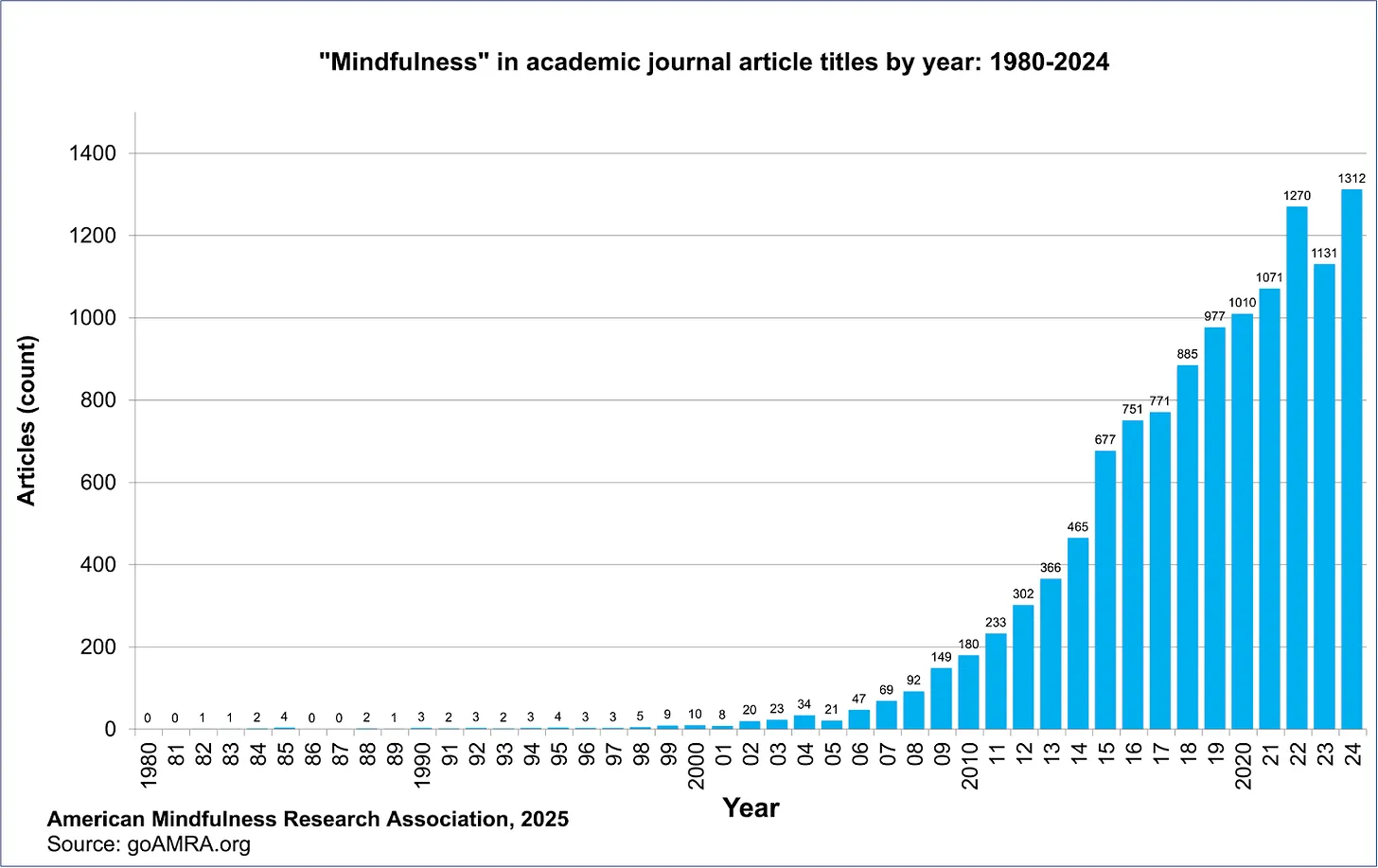
Figure 1. Count of journal publications by year with “mindfulness” in title, 1980–2024. Data obtained from an ISI Web of Science search and published by the American Mindfulness Research Association (AMRA)
At the inflection point was a 2003 randomized controlled trial Jon and Richie published together. It showed measurable changes in brain function and immune response after eight weeks of MBSR. Participants who received the training mounted a stronger antibody response to a flu vaccine than controls.
Richie reflected:
“It’s actually my most highly cited scientific paper. And it really ushered in the modern era of research on the scientific study of meditation.”
But he also made something else clear during our conversation. What Jon created was not just a clinical intervention. It was a bridge:
“I think you really invented something that I’ve benefited from enormously, which is a kind of hybrid science / Dharma integration, which is really what Dharma Lab is now trying to take out to the world.”
The Shift That Changes Everything
But the core of MBSR was never the data. It began with a question.
When patients arrived in that hospital basement carrying years of pain and frustration, Jon did not promise a cure. He did not offer to fix what medicine had failed to fix. Instead, he invited a shift in perspective.
“Are you your diagnosis,” he asked, “or are you more than your diagnosis?”
The orientation from the beginning was simple:
“As long as you’re breathing, there’s more right with you than wrong with you. And we’re going to pour our energy in the form of attention into what’s right with you and see what happens when we exercise that muscle.”
That goes beyond optimism. It changes how you see yourself.
“To a first approximation,” Jon said, “it’s many doors into one room.”
People enter through different doors: illness, burnout, anxiety, curiosity. But wherever they enter, they discover something shared.
And something else happens.
Awareness As Superpower
As Jon described it, when we practice — however we practice — we begin to feel part of something larger than ourselves. A community of intentionality. Of embodied caring. The word sangha points to this, but the experience does not require adopting a tradition. It is the simple recognition that we are not alone in the challenges we face, nor are we alone when we step onto the path of inner transformation, whatever that first step looks like for us.
At one point Jon drew an important distinction, highlighting the key role that awareness plays on this journey.
“Thinking’s the superpower, but thinking can get you into a lot of trouble. Awareness is liberative intrinsically and actually clarifying intrinsically. And so we cultivate access to it. We don’t have to acquire anything.”
What he’s pointing to is that the clarity and steadiness we keep searching for are not somewhere else. They’re already here, in this moment.
“If you’re missing this moment,” Jon asked, “what makes you think you won’t miss the next moment, and the next moment?”
Cort added a line that sharpened the point:
“If you’re not occasionally in awe, you’re probably not paying attention. There is always something to be in awe of.”
The research increasingly confirms what the practice reveals. These qualities are not rare gifts belonging to monks or mystics. They are trainable capacities of the human mind and brain.
Why This Matters Now
The conversation eventually widened beyond individual stress or illness.
“If mindfulness was important in 1979,” Jon said, “it’s infinitely more important now. In some sense, we need medicine for humanity.”
He spoke about political polarization, environmental strain, digital distraction, and the temptation toward despair. But he returned again and again to something more subtle:
“It’s really important to trust in your own deep goodness.”
Near the end, Richie said something we have repeated many times at Dharma Lab:
“We often say flourishing is contagious.”
Jon responded:
“The motivation to flourish is contagious. And then the training of the muscles to actually make it authentic and robust — that requires practice.”
Not Missing Your Life
Near the end of the conversation, Jon referenced Thoreau’s line from Walden about going to the woods so as not to discover, at the end of life, that he had not lived.
Jon called Walden “a rhapsody for paying attention.”
Seen that way, mindfulness extends far beyond stress reduction. It becomes a way of living deliberately.
Sources:
Davidson RJ, Kabat-Zinn J, Schumacher J, Rosenkranz M, Müller D, Santorelli SF, Urbanowski F, Harrington A, Bonus K, Sheridan JF. Alterations in Brain and Immune Function Produced by Mindfulness Meditation. Psychosomatic Medicine. 2003;65(4):564–570. doi:10.1097/01.psy.0000077505.67574.e3.
“Count of journal publications by year with ‘mindfulness’ in the title, 1980–2024,” American Mindfulness Research Association (data from ISI Web of Science).
COMMUNITY REFLECTIONS
SHARE YOUR REFLECTION
3 PAST RESPONSES