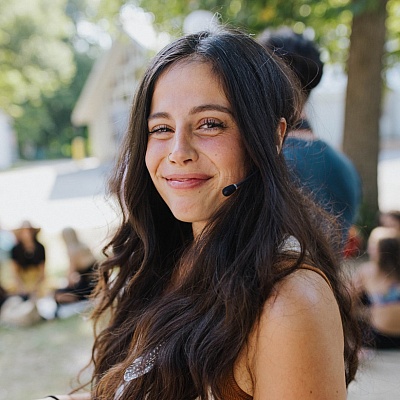
A writer named Leena sat down to write a letter after years of feeling too blocked, too uncertain, too changed by life to put words on a page. But something about writing to a stranger cracked her open again. She remembered her grandfather writing letters before sunrise, her father writing to her before she was even born, and her own book of letters to her daughter. Three generations of her family knew that some truths can only be found when you sit down and write them to someone you care about.
Leena's letter is really about something bigger than writing. It's about the story each of us is living — and the surprising fact that we have more power over that story than we think. She asks us to imagine our life like a book we're authoring. We can choose what kind of world our story takes place in. We can even recast the characters in our own minds — what if instead of fear or obligation playing the lead role, we gave that part to love, or curiosity, or generosity? The blank page isn't empty, she says. It's full of possibilities that just haven't been written yet.
One of the most beautiful ideas in her letter comes from a Mexican novel whose title means the recollection of things to come — a memory of the future. Leena believes our stories work this way for each other. When we live bravely and share what we've learned, we give other people a glimpse of what might be possible for them, before they've even lived it. Every choice we make today, she reminds us, becomes tomorrow's story.
Let's Talk About It
1. If your life were a book, what would the title be right now — and is that the title you'd want it to have? What title would you give it if you could choose anything?
2. Leena says most of us let fear, obligation, or our inner critic play the biggest roles in our lives without ever choosing them. If you could recast one of those roles with something better — like curiosity, kindness, or joy — what would you choose and why?
3. Think about a story someone else told you — a grandparent's memory, a parent's experience, even a character in a book — that made you feel like something was possible for you. What was it, and why did it stick?
4. Leena writes that the parts of us we've outgrown — the mistakes, the old versions of ourselves — aren't the villain of the story. They are the story. Do you agree? Can you think of a time when a hard or embarrassing moment turned out to be an important part of who you became?
After-Dinner Experiment
Tonight, give everyone at the table a piece of paper and a pen. Ask each person to write the opening sentence of their own story — not the story of their whole life, just the story of who they are right now, in this season. It can be one sentence or a short paragraph. No wrong answers, no grades, no sharing required unless someone wants to. When everyone is done, ask: was it hard or easy to start? What word did you almost use but didn't? Then, if your family is up for it, fold the papers and save them somewhere safe. Open them together in one year and see how the story has changed.
COMMUNITY REFLECTIONS
SHARE YOUR REFLECTION
8 PAST RESPONSES