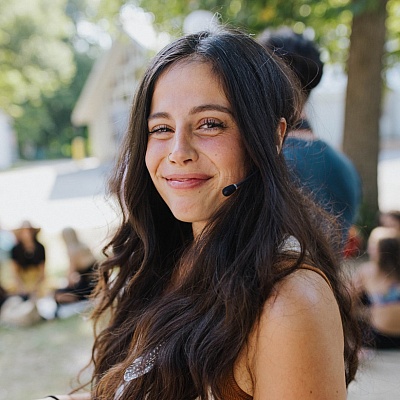
Here's something most adults won't admit to you: even the people who seem to have it all figured out hit walls where they can't find the words. Writer Leena Wilde Ryan went years without writing anything she felt proud of. She calls it existential writer's block — that frozen feeling when life has changed so much that the old version of you doesn't fit anymore, and the new version hasn't fully arrived yet. Sound familiar?
What broke through her silence was an invitation to write a letter. And that made sense, because letters run in her family like a kind of inheritance. Her grandfather was up before dawn every morning — birds fed, clocks wound, coffee going — writing to his friends like it was the most important thing a day could hold. Her father wrote her a letter before she was even born, talking about the world, the Yankees, and what he hoped to teach her. She found it just before her eighteenth birthday. Later, she published a whole book of letters to her own daughter. Three generations who understood that some things can only be said in this form.
When Leena left her first marriage, she walked away with almost nothing — just her clothes, her plants, and her books. Starting over from scratch forced her to ask a real question: who actually gets to decide what story I'm living? Her answer surprised her. She realized most of us inherit the main characters of our inner world without ever auditioning them. Fear gets the lead role. Obligation keeps showing up in every scene. The inner critic somehow always gets the last line. But here's what she figured out: you were always allowed to recast.
What if the protagonist of your story was love instead of fear? What if curiosity and generosity got top billing over anxiety and self-doubt? This isn't toxic positivity — it's a genuine choice about which voices you let drive. You don't erase the hard parts. You don't pretend the difficult chapters didn't happen. As Leena writes, the versions of yourself you've outgrown, the choices you'd make differently — they aren't the villain of your story. They ARE the story. The wisdom is always in the hindsight.
She references Mexican novelist Elena Garro, who titled a book Los Recuerdos del Porvenir — which translates to something almost impossible: a memory of the future. A recollection of something that hasn't happened yet. Leena thinks that's exactly what stories do for each other. When you share your story honestly — the messy, unfinished, still-figuring-it-out version — it becomes someone else's proof of what's possible before they've even lived it. Your story doesn't just inspire. It awakens something in someone else.
There's a punctuation metaphor in her letter that's worth sitting with. She talks about the semicolon — two complete truths held together without one erasing the other. The person you were; the person you're becoming. Both real. Both yours. And then the question mark — the only punctuation, she says, that's comfortable with not knowing. The only one that leans forward into the unknown instead of away from it.
So here's your moment to pause: Leena asks what she calls the big question — when all your chapters are written and the final page is turned, what will your story reflect about the life you chose to live? What will you leave behind in the hearts of people you found along the way?
What would YOU do? Think about the cast of characters running your inner world right now. What feeling or voice has the lead role in your daily decisions — fear, comparison, the need to fit in, someone else's expectations? If you could recast just one role starting today, what would you replace it with — and what would actually change? You don't need the whole story mapped out. You just need the next sentence.
The cursor blinks like a heartbeat. Patient. Present. Asking: are you ready?
COMMUNITY REFLECTIONS
SHARE YOUR REFLECTION
8 PAST RESPONSES