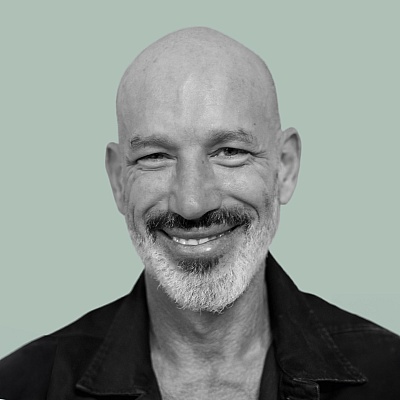
I was flying down a hill in Toronto on a Wednesday morning, on my way to the clinic. A woman had rolled down her window at a stop sign to warn me — you're going to get yourself killed riding like that. I remember the exact thought in my head: I got this. A few minutes later I was tumbling over the hood of a car, my head hitting metal, then cement, traffic stopping all around me.
I lay there and checked in with my body. I was okay. It wasn't a near-death experience, but it felt like a moment where my life had been spared and handed back to me with a question attached. I had grown up in a house full of yelling — my parents fighting so loudly that I'd retreat into my room, into the television, into myself — and somewhere along the way I'd absorbed the idea that this was simply what love looked like. Not wrong. Just how people were. I carried that all the way into my own marriage, expressing my own stress the only way I'd ever seen stress expressed, and I carried it fast down that hill the morning I was almost killed. The collision was a wake-up call. Something in me finally said: maybe I don't got this. I have to clean myself up.
For decades, I was always trying to prove something. I was held back in grade two, and some part of me never stopped trying to show I wasn't dumb. I built my whole identity on doing. On achieving. On knowing.
But love isn't something you achieve. I had to learn it slowly. Painfully, at times. Joyfully, at others. Only then could I build a piece of technology meant to carry it. But my story is not a technology story, it's a love story.
Spirituality Entering Through Science
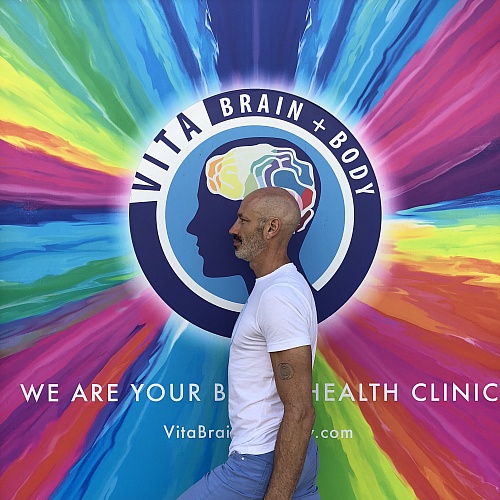 I was a chiropractor for years before I was creating technology. I was the kid who imagined portals in the bathroom and pictured his own body as a machine on the walk home from school. As an early adopter, I saved for the newest gadget, and brought that same hunger for how things work into my clinic, and eventually into something I created and called the system of the soul: a way of using my own body to feel the truth in someone else's. A progression in my training in Applied Kinesiology, it let me discover things about a person from a place beyond what the textbook would tell me to do.
It was that system, strangely, that cracked the door open. I'd ask a silent question and watch a stranger's body answer it. I started wondering how that was possible, and Nikola Tesla's insight was my best explanation: if you want to understand the universe, think in terms of frequency, vibration, and energy. Spirituality, for me, arrived through science, through the same curiosity that had always driven me.
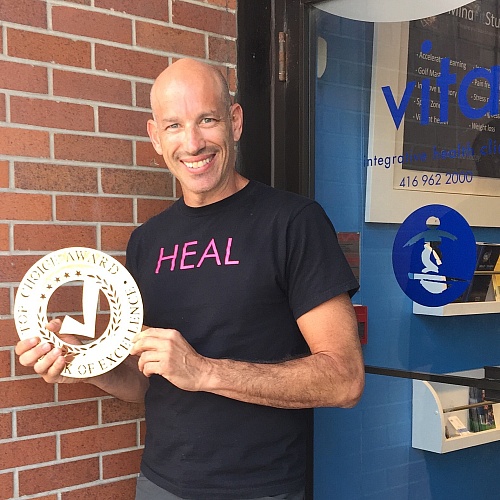 By 2016 I was at the height of my clinic and career— twenty-two years, seventeen associates, some of the biggest names in music walking through my doors and a regular corresponadant for a TV show called Toronto Living. I had been awarded International Chiropractor of the Year by associates and simultaneously at one of the lowest points of my life. I wasn't spiritual yet. I was still proving something. And the marriage I was in had become a mirror I didn't want to look into.
The Field in the Room
Not long after the accident, someone in my clinic mentioned Dr. Joe Dispenza was coming to Toronto. I signed up without knowing anything about his meditations. By the end of that first workshop I'd booked the next one. Within a year I'd been to six of his events, meditating over an hour a day, immersing myself completely.
At my second retreat, a woman I'd never met stopped across a pool, pointed at me, and began to cry. Later that night she told me, still channeling, still somewhere else: you're the bridge. My ego loved that, until she looked up again and said, just as certainly, and they tell me you're behind. I spent months wondering what exactly I was supposed to build.
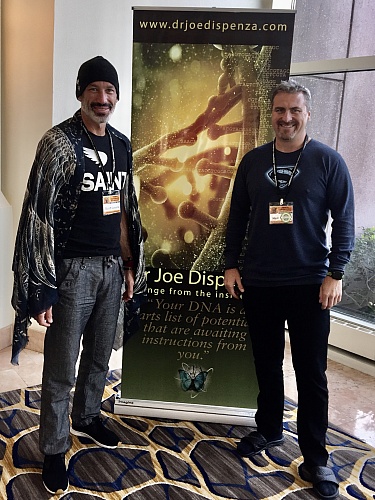 The answer came at the next Dr. Joe's event, in a room of seven hundred meditators. I had been meditating at home and I felt lonely. In that room — eyes closed, no one touching, no one speaking — I felt more connected than I had in years. I came out of that meditation and asked Neil the question that started everything: how do we use technology to create this feeling of connection, even when we're apart?
Days later, an app developer I'd met once, a year earlier, emailed out of nowhere asking if I had any ideas he could help build. We didn't fully know what we were making yet. We only knew it would be a meditation app, with one key difference: you'd meditate for someone else. We called it ZeroOne.
If I'd known it would take nine years to get here, I'm not sure I would have started. But Leena has a word for how I move through the world: pluck. I go for it, not knowing any of the answers. I never have. It's how a temporary tattoo became a global ritual, and how a meditation app became WishWell.
The Symbol and the Fire
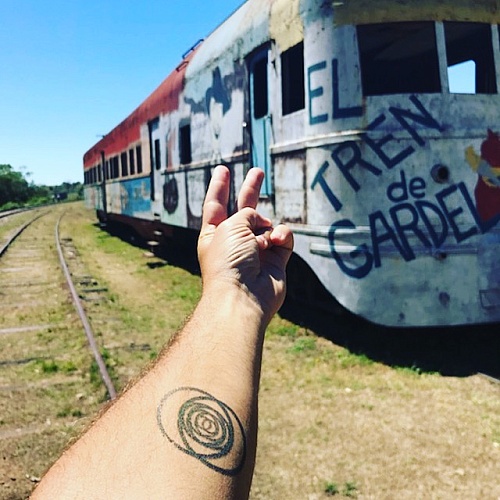 The logo was designed combining meditation and the system of the soul. We would ask questions around colors and design and get yes-or-no answers. The two O's come together to form a Vesica Pisces, wrapped in six circles in a Fibonacci sequence.
I printed a handful of temporary tattoos, thinking I wanted a permanent one and needed to see where I'd place it. Then a thousand for a Dr. Joe workshop of five hundred people, expecting to talk about the ZeroOne app. 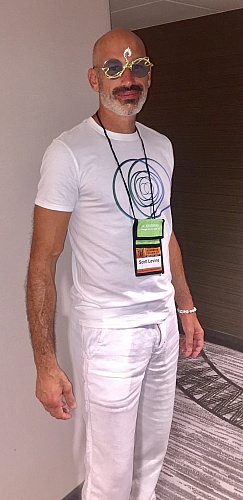 But nobody asked about the app. They talked about the symbol. It's a portal. It feels like love. Can I have an extra one for my tattoo artist? We've since gifted more than 280,000 of them around the world, always in person, always as a small ritual of gifting presence.
A year after starting ZeroOne, while I was at a festival in Costa Rica, my assistant texted me a photo of an eviction notice on the door of my clinic. Twenty-two years, gone — financially hemorrhaged out from under me.
It felt, at the time, like my worst nightmare — the same shame, the same sense of having failed, that I'd carried since I was held back in grade two and quietly decided I had to prove I wasn't dumb. I told almost no one. I cleaned out that clinic alone, night after night, and in the emptiness of losing every intake form and every system I'd ever leaned on, I found the deeper version of the practice.
Not long after, my marriage ended too. Naomi and I made one decision: no lawyers. We chose to protect what mattered — our daughters, and the relationship we'd still need to have as parents for the rest of our lives — and it's still holding today.
I moved into a new place, a home for my girls the weeks I had them, and started over as a single father, carrying the fear of building an entire life again from nothing.
Learning What Love Is
I won't pretend any of this was gentle. I've cried more in the years since than in my first decades of life combined.
For a long time, if you'd asked me what love was, I couldn't have told you. I knew what love looked like growing up: two people yelling, then opening the front door to guests as if nothing had happened, no one ever naming what had just occurred. I knew love as loyalty to my daughters, as the joy of a first marriage full of travel and parties and a version of myself I later outgrew. But love — the actual felt experience of being fully seen by another person — I didn't have that reference point. I was building an app for love and was on a quest to discover what I was building it out of.
It begins with Leena.
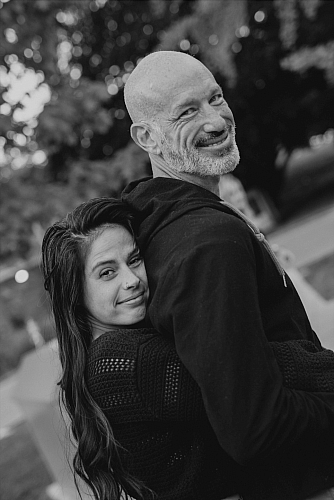 We were introduced during COVID by a mutual friend, both of us not looking for anything. We call ourselves wholemates, because it feels less like completing each other and more like recognizing something that was already whole.
We joke that we could watch paint dry together and call it a good day. We're also deeply intentional — about our attention, our energy, choosing moment to moment to be love, not just feel it. As Leena puts it: where the attention goes, our energy flows.
Leena is the one who taught me that being and doing are equal parts of a day. She showed me that presence is the work. WishWell was born out of the being before we ever sat down to the doing. Some of my darkest months came recently, this past spring, and what carried me through was learning to fully surrender and to trust that wishes come true — even when they don't arrive the way I imagined.
It All Started With a Wish
This is the mechanism at the center of our local currency for presence. When you gift someone a wish, you hold the tattoo on them and ask them to picture something they long for. You — the giver — see them in their joy, holding the vision as if it's already true. Presence is gifted as a witness to the wish, leaving them with a symbol on their skin, a reminder of the gift.
We have watched it land in ways we still can't fully explain. A waitress at a small hotel in Mexico came running down the sidewalk toward us three months after we gifted her a wish: her own restaurant, exactly as she'd pictured it.
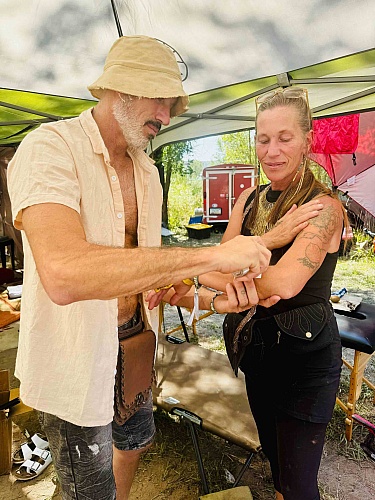 At a festival in Texas, when our setup fell through, we met Kathy whose nonprofit in Denver, is out of funds. We didn't ask what she wished for. We just saw her in her joy. Within hours, a stranger gifted her fifty thousand dollars — enough, she told us later, to feed two million more families. In the 9 years of travelling and gifting we have shared the tattoo with 280,000 people and over 50 permantely inking it.
During COVID, my former mother-in-law lay alone in a hospital going through chemo, and strangers on our earliest app began sending her notes. She never learned their names. She only knew, suddenly, that she wasn't alone.
The Most Valuable Thing We Own
We give our attention away all day, for free, and in doing so we've forgotten how sacred it is. WishWell exists to bring its value back: a place where you gift a minute of your presence to someone who needs it. Science shows that within about forty seconds of genuine giving, your body releases oxytocin and serotonin — feel-good, belonging hormones. Humans are hardwired to give.
Everyone has a minute. And after two launched versions, we learned that it's meaningful — that the instant you offer it, you feel better and the other person feels seen.
It took nine years to arrive at one answer. How do we use technology to bring us closer? The journey through it all was love.
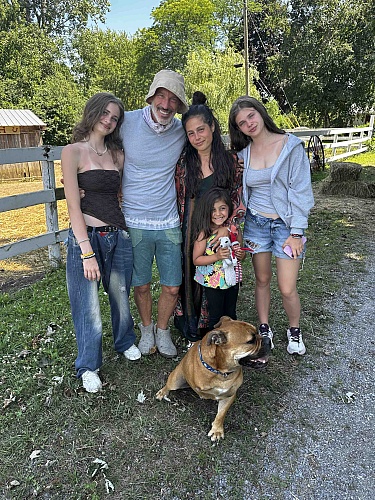 We devote ourselves to being love — for each other, for our family, and for this mission. Leena and I share a blended family now, twin teenage girls and Luna, who is seven. Our family nickname is the Blahhhss. Together as Stewards, we travel the world bringing our love and presence with us, opening Villages wherever we go.
WishWell is ready now. Ready for those who are ready to give.
The app carries something simple: human love, passed from one person to another, on purpose and made visible.
That's the journey. Love in a relationship. Love for self. And now, a technology built to carry it forward.
Underneath all of it — the chiropractor, the founder, the father, the husband — there is just this: I am here to love, and to live like that's the whole point.
— as told by Scott Levine on a Story Booth. View 9 video clips from his Story Booth.
COMMUNITY REFLECTIONS
SHARE YOUR REFLECTION
10 PAST RESPONSES
Intention, Attention, Connection, Presence, all making a difference! Gives me hope.
PS. My wish is to provide Kintsugi wrapped in Narrative Therapy workshops once again and in a way that sustains me and those participating 🙏