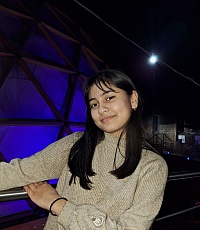
Shakhzoda Saidova is a young peacebuilder from Tajikistan, now in her first year at the University of Bucharest in Romania. A finalist for the Goi Peace Foundation's 2026 Youth Peace Ambassador Award, she is building SafeVoice, a phone resource and network of support for women facing domestic violence in her country. She shared this story in a Story Booth conversation; what follows is in her own words.
When I was fourteen, I left the table.
I was at a conference, sitting with the General Assembly of the United Nations, the representative of UNICEF in Tajikistan — I was representing the youth board of UNICEF Tajikistan. I was sitting at the table with the people I dreamed to be with, seeing them alive, talking to them. And I was so nervous that I decided to leave the table for two minutes, to come to my senses and to realize that this is all real; this is not a dream.
The head of our youth board came to find me. "Why are you here? You should be there, representing our work. What happened?"
And I said, "I'm so nervous. I don't know what to say. I don't really feel that I deserve to be at that table — there are more ambitious young people in our group, why did you choose me? I'm not prepared."
She told me that usually, when girls — especially young girls — have an opportunity to show up, to show their skills and who they are, they say, "Oh no, I didn't deserve it, I'm not good enough, I'm not an expert in that field." And in most cases these thoughts come from years and years of society persuading you that you're not good enough; you should study more; it's not your thing. She told me to never listen to these kinds of things from people who don't even know you. Try to stay true to yourself, and stay true to what you're actually hearing from you inside.
I know I'm not the cleverest one in the room. But what matters is that I am in the room with all those people — and it means something.
That was the realization she gave me. I said, "Thank you, Sis. I love you" — and I went back: "Hi, how are you?" I still remember that night, the dinner we had, the topics we discussed. And that line — what you're actually hearing from inside — has followed me into every room since.
Who Wrote Those Rules?
I should say something about where I came from. Tajikistan is a very good country. I love my culture and the environment I grew up in. A lot of people are confused, because when I say Tajikistan is a neighbor of Afghanistan, they think, Oh my gosh, is there guns and Sharia? And it's like — No, man! But it is a patriarchal country. I grew up being told to be a proper wife: a woman who can cook, who can clean, who will not disobey, who will always be quiet and not make a noise. And I was always wondering — why should I do that? Where are the rules? Who wrote those rules?
I watched my mom. She finished school with the red diploma — in my country that means only the highest marks, five out of five in everything. She wanted to be a doctor, but she was not allowed even to travel to another city for the biology competition that could have made it possible. She studied law instead, won a scholarship, and finished university with a little baby in her hands — somehow, with the highest GPA in her course. And then she was not allowed to work as a lawyer. It was the decision of her parents, of her elder brother, of her husband, of her husband's parents. She never had the option to choose what she actually wanted. She can still quote me things from our constitution, because she is a lawyer, and she remembers all of it.
When I was little, I was very dumb about this. I said to her: "Why, mom? You could have been a cool lawyer. I could have showed off at school that my mom is a lawyer, she's so cool. But you're not cool; you're a housewife!" It was super cruel, but I was a kid, and I didn't realize how horrible my words could sound in her head. She just said, "Yeah, that happens" — and that's all. Years later, when I understood how much ambition in her was ruined by others, it became a kind of warning for me: maybe I should depend on myself and try to listen to myself.
At twelve, I started volunteering — partly because it was very problematic to find friends at my school, where I was bullied, and I decided maybe my people were outside of school. And there I met women working in leadership positions.
I asked them, "Are you not afraid to be what you are? Are you not afraid to speak up?"
And they said: "No — why should I be?"
They literally opened my eyes. Before that, I didn't even realize that I can speak up, I can lead, I can be what I want to be, no matter what other people say.
Go, Girl, You Can Do That
At sixteen, I left the country for the first time in my life — to New York, to a program called Camp Rising Sun, founded by the Louis August Jonas Foundation, where young people from all over the world learn about ethical leadership. Everyone in my family was not okay with my decision to go abroad alone as a girl. My mom was the one cheering for me, persuading the others that I was able to do it. At that time, I was not even sure what I was doing, or where I was going, or if it was safe, or if they were going to kidnap me in the US, or whatever. I was so afraid. My mom was so scared — she didn't even want to let me go — but she said, "I know it's good for you. If I couldn't do this, you can do that. Go, girl."
The day of my school's graduation, I was on a plane to New York, so my mom went to get my diploma instead of me. The principal announced that Shakhzoda is right now on a plane to New York, representing our school and our country, and her mom will receive her diploma. And everyone looked at my mom like she was crazy: she's a girl, she's a child, she should stay at home — why didn't you prepare her for marriage instead of preparing her to go to the US? My mom sat there smiling at everyone: yes, I did that. Yes, she's my daughter — what do you want to say? And here is the thing: at the end of the graduation, a lot of those same parents came to my mom asking, "How did she get to the US? Can you tell my child how to do the same?"
I celebrated my seventeenth birthday at that camp. I saw the ocean for the first time there — you can't imagine how happy I was. Ninety-three percent of my country is mountains; we don't even have an artificial sea.
To Name Something
Why am I doing a project to transform domestic violence? The reason is very personal. I was raised in a kind of dysfunctional family where violence toward women — not necessarily physical, but emotional, financial, other types — was normalized. And I was wondering all the time as a kid: why does everyone treat this as a normal thing? Why are the neighbors, who listen to what happens next door, okay with it? Why are my relatives, my grandparents, okay with it? Why does nobody come to those who need help?
My mom once went searching for help, to a free psychologist. And that psychologist told her, "You know what, I think if you would not argue with your husband, maybe he would not beat you. This is good advice and you should follow it."
She only told me this when I was no longer a child — I'm thankful to her, it would have traumatized me more — and when I heard it, I was so angry at the professionals who work with these women.
Later, I worked with UNICEF Tajikistan on research about domestic violence. We asked parliamentarians, "Is it okay to beat your wife and kids?" I don't remember the exact numbers, but I think 70 percent said "Yes, why should it be a problem?" I was so embarrassed by my government. And just two days ago, a man in Dushanbe, the capital of my country, was beating a woman — and he was imprisoned for five days. I hope we can change it so that a woman's life does not cost thirty-six dollars, which is the fine for a physical assault on a woman in Tajikistan.
I realized something as a teenager: there is another Shakhzoda sitting in some other part of Tajikistan, wanting the same opportunities I had, and she is not allowed. One of my classmates — the eldest daughter, the second mom of her family — wanted to learn Korean, and she told me, "I really want to, but I don't know if my mom would allow it."
I told her, "Education is the only form of liberation you have right now in your life as a Tajik girl."
So — for my project, SafeVoice. I want to be clear: I'm not a magician, I can't make domestic violence disappear from the world. I'm not an expert, I'm not a psychologist, I'm not a lawyer. But almost every woman has a phone. SafeVoice is a super, super simple website: a list of lawyers who work with these situations, and the phone numbers for the crisis centers and shelters for women.
Because when I was young and searching for help, it was horrible — random websites, numbers that don't exist. Imagine a woman with three children in her hands who has one free minute to search for something — and even googling is dangerous, because your aggressor can check it — and she finds out there is no real help. She just starts to give up. No one should experience what I experienced as a child. And later, when we count the people who used the website, we can show the government the real numbers of those who need help, and try to work with them to create, actually, a law against domestic violence — because there is currently no law against it.
I like to read religious books sometimes, just as a researcher, and I heard from a professor of philosophy that the first skill God gave to Adam was to name something.
As soon as we name something, it becomes real. When you don't name something, everyone reacts like it doesn't happen.
Naming this problem out loud is the first step to changing it.
I am already criticized by a lot of people for speaking up. At school, I was criticized for wanting to go to university and get a PhD instead of getting married. How dare I live alone in Europe? How dare I, at nineteen, not be married? And all of this stuff. I'm prepared for that, and I don't really care. But I am scared for the others who want to speak up, because not everyone can handle the critics. If my project can change it a little bit in some people's minds, it's already a very big achievement.
It's better to do at least something than just do nothing and complain that the world is not a good place.
Try to Not Stay in One Place
I speak five languages — Tajik, Persian, Russian, English, a little German, and now Romanian. But honestly, the more languages I know, the less languages I know — you learn a new one and start to forget the previous one. The same happens with everything you think you know. So try to not stay in one place — not only physically, but mentally.
This October, my university courses began. In November, I travel to Lyon for a humanitarian aid training, and then to Tokyo, to the Goi Peace Forum, to present my project and to say thank you in person to the facilitators who mentored me — a good ending that is, at the same time, a start of something new. Personally, I was very nervous before my courses began, to be honest. I wondered how can I make friends? How can I talk with professors? And then I thought: girl, you survived more stuff in your life. You got it. I'm that same girl who left the table in fear at fourteen, heard her own voice from inside, and went back with an open heart.
Maybe there is a table you once stepped away from, too — and something inside you, waiting to be named, is now saying: go back, you can do that.
COMMUNITY REFLECTIONS
SHARE YOUR REFLECTION
2 PAST RESPONSES