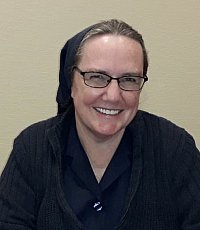
Sister Elizabeth Greim, DC, is a Daughter of Charity of St Vincent who has spent three decades building day centers for people who are unhoused and walking alongside refugee families finding their footing in a new country. Today she forms the youngest members of her congregation. But at thirty-three she was a divorced woman with four earrings in each ear and a pack of cigarettes on the passenger seat, certain a door had closed on her for good. In this Story Booth conversation with Charles Gibbs — the first time she has told this story quite this way — she traces the moment it cracked open, in her own words.
Why Can't You?
I wanted the pivot point of my life to be one of the dramatic moments. There were plenty to choose from. But what came was something very simple.
It was 1993, and I was thirty-three. Someone had introduced me to a community of sisters called the Daughters of Charity — a little more open than most, I was told. So I asked them if they would meet me. I wanted to help. That's all.
I should tell you what I looked like when I extended that invitation. This was the nineties, and I had the Annie Lennox thing going — shaved on the sides, a dress on the funky side, cigarette in hand. Four earrings in each ear. It did not once occur to me that I might be presenting a little on the odd side.
And then Sister Catherine walked in. Blue veil. Blue dress. Very sensible shoes.
She was the most beautiful vision. I thought, this woman is such grace — and immediately behind it, why on earth have I invited her into my space? She gave me a little hug and asked why I'd called. I told her I just wanted to help. And she looked at me and said:
Do you want to be a sister?
Well. Every little Catholic girl thinks she wants to be a sister at some point. I told her yes, I'd always thought about it. But I can't.
And she said, why can't you?
I said there were life situations. She said, what are the life situations? And that is when I had to explain who was actually standing in front of her — that behind all the weirdness, there was a whole other story that had brought me to that encounter. I kept saying no, it isn't possible, don't worry about it, I'm over that. All I want to do is help. She would not let it go. She said, tell me the story. I'd like to look into it.
And I knew, right there, that this was it — that whatever God had planned for me was about to come into fruition in that room, and if I was careful I wasn't going to screw it up. So I told her the story.
Peanut Butter and Jelly on a Bench
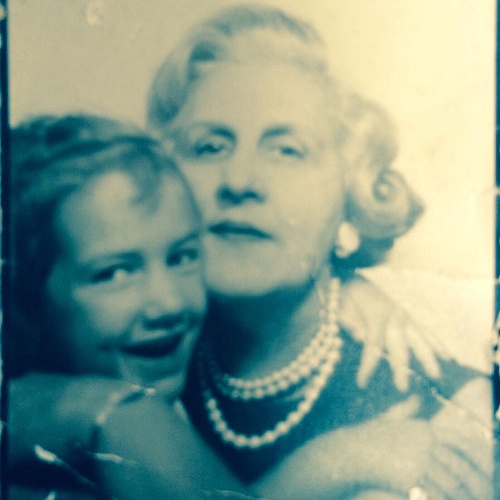 It starts with my grandmother, Teresa. She was very religious, and she used to take me into the Boston Common with peanut butter and jelly sandwiches. She would look around and say, that person looks hungry and lonely — and we would go sit down beside them and eat together. That was the water I swam in.
She's also the one who handled the other thing. I was a chunky kid, and all my girlfriends were skinny, and we couldn't share clothes, and I just didn't fit anywhere. She said to me:
Don't worry about those skinny girls. God loves you so much, He can't stop making you.
Then, when I was fourteen — this was the seventies, a Catholic high school in Boston — a missionary sister came to speak to us in a lovely brown habit. She told us about her work in Africa, about the simplicity of her life. She opened up the world. Sitting in that room, I was no longer just in Boston. I was everywhere, serving alongside her.
Afterward I found one of the sisters and said: I would really like to do that. I could join right out of high school. She said, it's not really for you. Why not? Well — your parents are divorced. Divorce is against the church. You can't come.
I could not fathom it. It was as though every Old Testament curse had landed on me at once.
Living My Life
So I lived my life. I did all the things women did in the seventies and eighties. I hung out with my friends. I drank and did drugs. I got married. I wasn't a Pollyanna about it — the way I saw it, I couldn't have the thing I actually wanted, so I might as well live.
The marriage was very difficult. It didn't work out, and I got very hurt in the process. I left, moved to Florida to help my mother, and needed a job. The only one available was at our church — which was strange, because I had walked away by then. Not from my faith, exactly; I should be careful how I say that. I didn't lose my faith. I lost the practice of it, the community of it. I thought I wasn't worthy: I can't be a nun, so I can't come to church, so I can't do any of this.
And then there I was inside a parish, visiting the sick, doing whatever was needed. And it felt like home. Everything about it was who I had been my whole life.
The Door Is Cracked Open
Sister Catherine came back a month later. I've often tried to imagine her standing before a council of sisters saying, well, I do have this one woman who's interested... and she's still married. I can hear them: What? What are we talking about?
What she said to me was: the door is cracked open.
I said — what does that mean? Am I supposed to sneak in through the crack?
No, she said. Three things. You're going to need to get rid of those earrings. Okay. I was starting to bristle. You are going to need to stop smoking. Dang. And you are going to need to get a divorce and an annulment.
Now we were into the big stuff — though I confess my mind was still stuck on the small. Do I really have to lose the earrings? If I'm wearing a veil, who's going to see them? I took them out anyway, slowly, a few at a time. One day I cleaned the whole house, threw out every ashtray, smoked every cigarette I could find, and at midnight said: that's it. I have never smoked since — and I am also forever a smoker. On long drives I still sometimes reach toward the passenger seat.
The divorce and annulment took nine months. Nine months — like a little birth. There was a period where I was being born into this.
But I had to come to grips with something harder: that the church sometimes crucifies its own members. If the tribunal had said no, that would have been the end of it. This institution, this family, this belonging that was everything to me — every part of it was telling me I wasn't quite enough.
Our foundress, St. Louise de Marillac, gave the community its tagline: the charity of Christ crucified impels us. When I first heard it I thought, that's quite a thing to put on a shirt. But I understood it. Jesus was rejected by his own people, his own church, his own apostles.
Rejection is not the end of the story. Sometimes it's the beginning of the story. Sometimes it's the place where you find your lineage.
And I saw what her perseverance had taught me: part of the service I would give would be the service of being connected to people rejected by their own communities. My compassion wasn't going to run on charity alone — people need socks, people need food, people need housing, I get all that. It was going to run on knowing that the things we love most can also be the things that hurt us.
The Edge of the Inside
I came into the community as a high school English teacher. That's how I saw myself. I assumed I'd serve by teaching — writing poetry with kids, reading books, talking about life's issues.
In thirty years I have not taught a single day of high school. Not one. There were schools I could have been sent to. I was never asked.
Instead I was sent to Richmond, Virginia, where two parishes were trying to start a joint ministry with people living on the streets. I thought: what am I supposed to do here? I'm an English teacher. Maybe they need to be taught something?
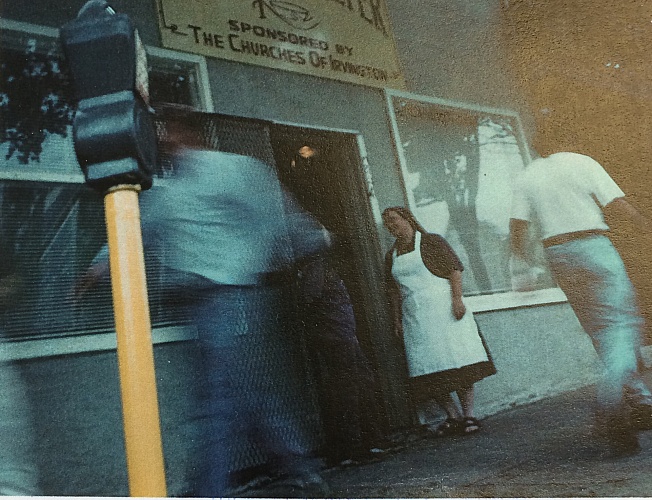
But the sisters had given me one instruction, and it turned out to be the whole thing: before you do anything, find where those who are most vulnerable dwell. It's the Gospel question — what are you looking for? Come and see. So I went and found them and asked, how can I be of service to you? Their answer was the program. We started an after-work program, for people who had jobs but were still living in a shelter and couldn't reach the city's GED classes.
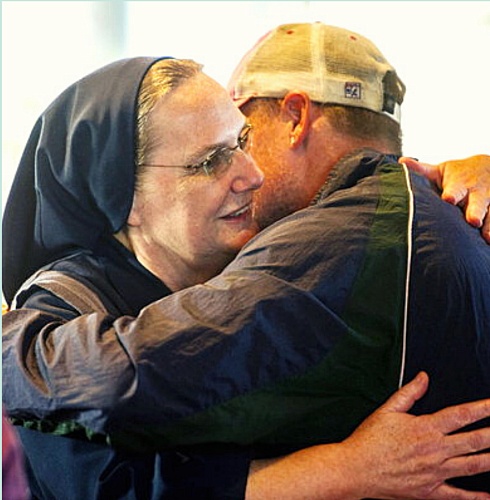 Every ministry since has been that same shape. I once heard Richard Rohr describe people who want to be on the edge of the inside — and I thought, that's it. Not radically outside. On the edge of something you love. That's where I've always been, and it's where the people I've served are too. The work is inviting them in, so all of us can love them.
The last three years, quite ironically, I've been the Seminary directress , forming the newest members of our congregation — even more unlikely than the rest of it. I share my stories and the stories of our community's founders with them and say: don't be afraid. It's okay. You will find the way where there seems not to be one.
Meseta
After I nearly died of sepsis working in a homeless center in Arkansas, my doctor told me I needed something less dangerous, so my community sent me to work with refugees in Utica, New York. (He had a desk job in mind, I'm fairly sure. I told him every job is dangerous — you're going to be around people breathing.)
Federal refugee resettlement lasts about ninety days. Then you're on your own. Nobody is ready in ninety days; it isn't possible. So we started a little program Day 91, now called The Bakhita Community.
The first woman I was asked to meet at the airport had come from a camp in Burundi, from the Congo before that — two children, one she'd carried out when her village burned, one born in the camp. She spoke no English. I spoke no Kiswahili. One day she walked past our house with her young son, and there was a statue of the Blessed Mother in our yard, and he called out: Ma, Ma, Maria, Maria! That was the moment of recognition. She knew this house was a safe place.
She called me Meseta. Someone told me it meant something like Big Mama, and I thought — well, that's about right. My whole life has been this bigness.
I'd take her to the doctor. The interpreter would ask something she didn't understand, and she'd look at me, and we'd gesture at each other. Then I'd turn to the doctor and say, she says her knee is hurting. And he'd say — how do you know that?
Because I know. I just know. What I thought were separations were not separations. It was an inner knowing that connected us.
A Sign, Not a Disguise
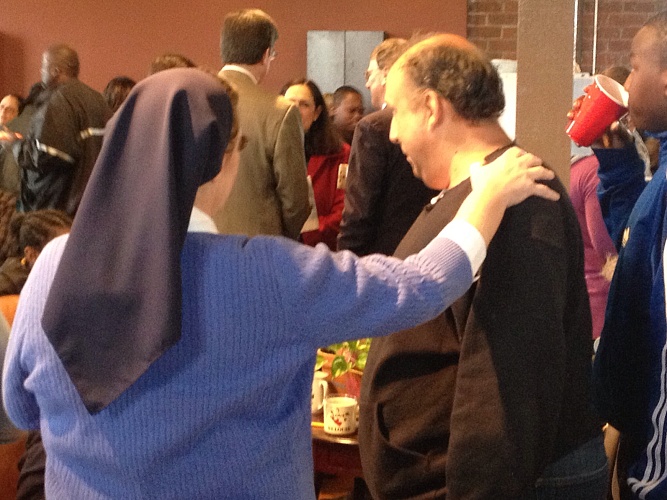 People ask why I wear the habit, when many religious women today don't. I understand the desire to blend in. But the world needs a sign of hope, a sign that somebody cares. If the uniform had been a sandwich board reading I want to be of service, I would have worn that.
I tell the young women I'm forming: if you wear the veil and the whole blue outfit, you will stand out, and people will talk to you — some of them not very nicely, because the church has hurt a lot of people. You come with wounds, and you will meet people who have been wounded. Our witness is to enter that woundedness without being afraid.
The cross was not a device of torture. It was a device of transformation. Crucifixion is a place of pain and suffering — and it became a place of resurrection. We should be willing to go there.
Both I and the church have grown up since 1974. We have grown to love and cherish each other. What we thought were immovable barriers turn out not to be immovable. They're moments for reconciliation, moments for compassion, moments to look behind what feel like rigid rules and find a very loving God reaching out.
I have never regretted a day of this. In the beginning, some of the sisters quietly hoped I wouldn't tell my story the way I'm telling it now — women who were widowed, ok; but divorce, that is another matter. But Sister Catherine's perseverance made everything before it make sense. I love my sisters and my community, and they love me back in very real and life-giving ways.
What Sister Catherine really did was see me. And that is the thing I have tried to do since: find where people dwell, sit down beside them, and see them. It's the peanut butter and jelly, all over again.
My grandmother was right. Even when the world tells you you're too much or not enough, you are enough. And when Sister Catherine stood in front of me in her simplicity and her blue outfit and asked why can't you — my whole big, beautiful, crazy self felt like it had come home.
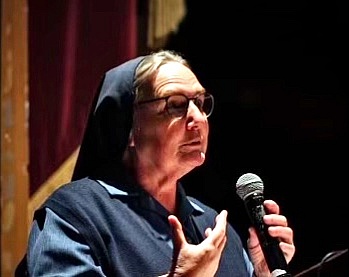 Sister Elizabeth Greim, DC, is a Daughter of Charity of St. Vincent de Paul and currently serves as novice director for her province. She co-hosts the podcast In the Company of Charity. This story emerged from a DailyGood Story Booth conversation in August 2026, hosted by Charles Gibbs.
COMMUNITY REFLECTIONS
SHARE YOUR REFLECTION