The way we look at the world matters: what we see is what we get...
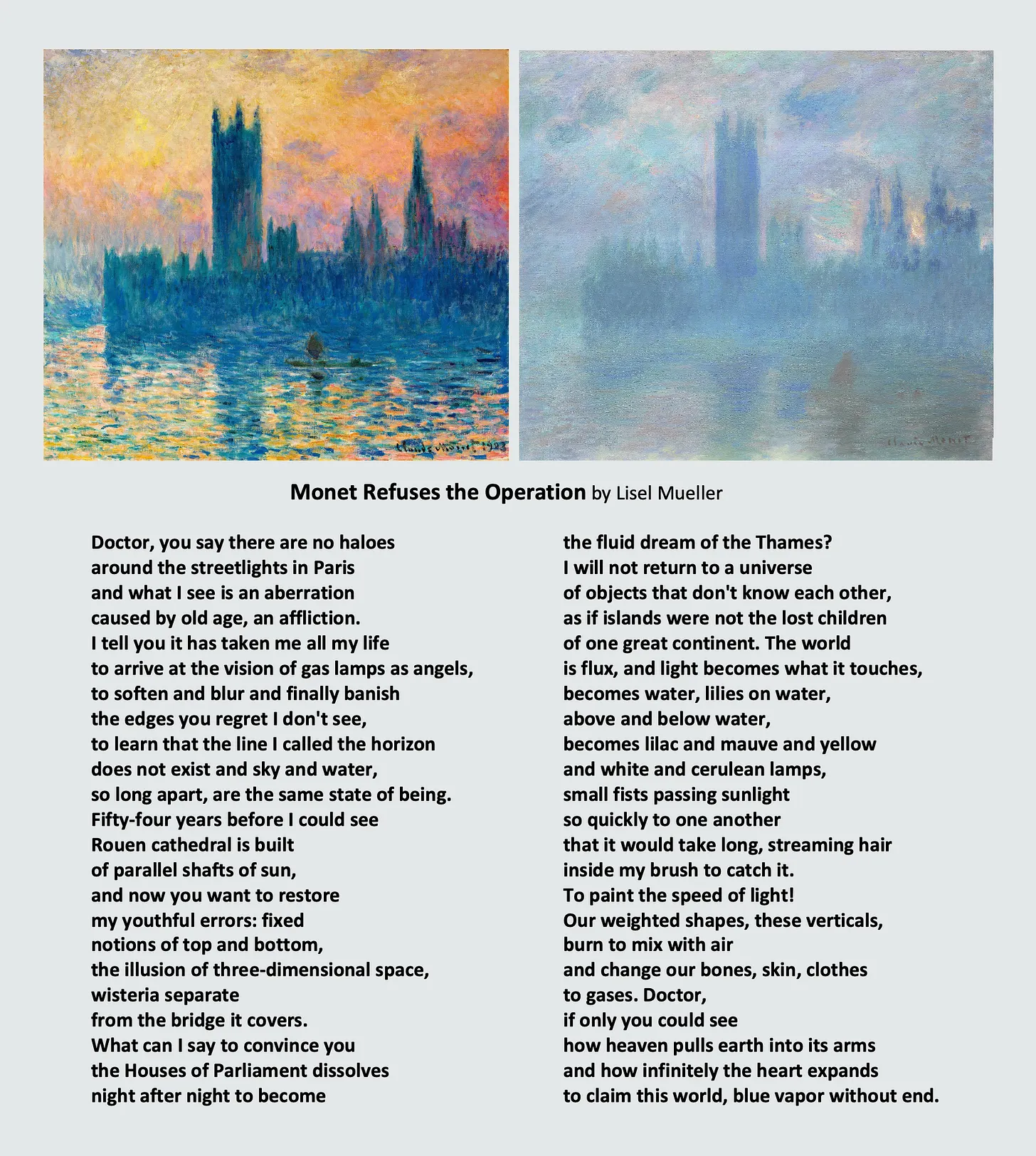
I. Here’s a poem that rewards a slow reading. It’s an eye-opener in which Lisel Mueller applies her poetic vision to a true story about the visual challenges faced by painter Claude Monet (1840-1926)—and makes it an even truer story about how much depends on the eyes through which we look at life.
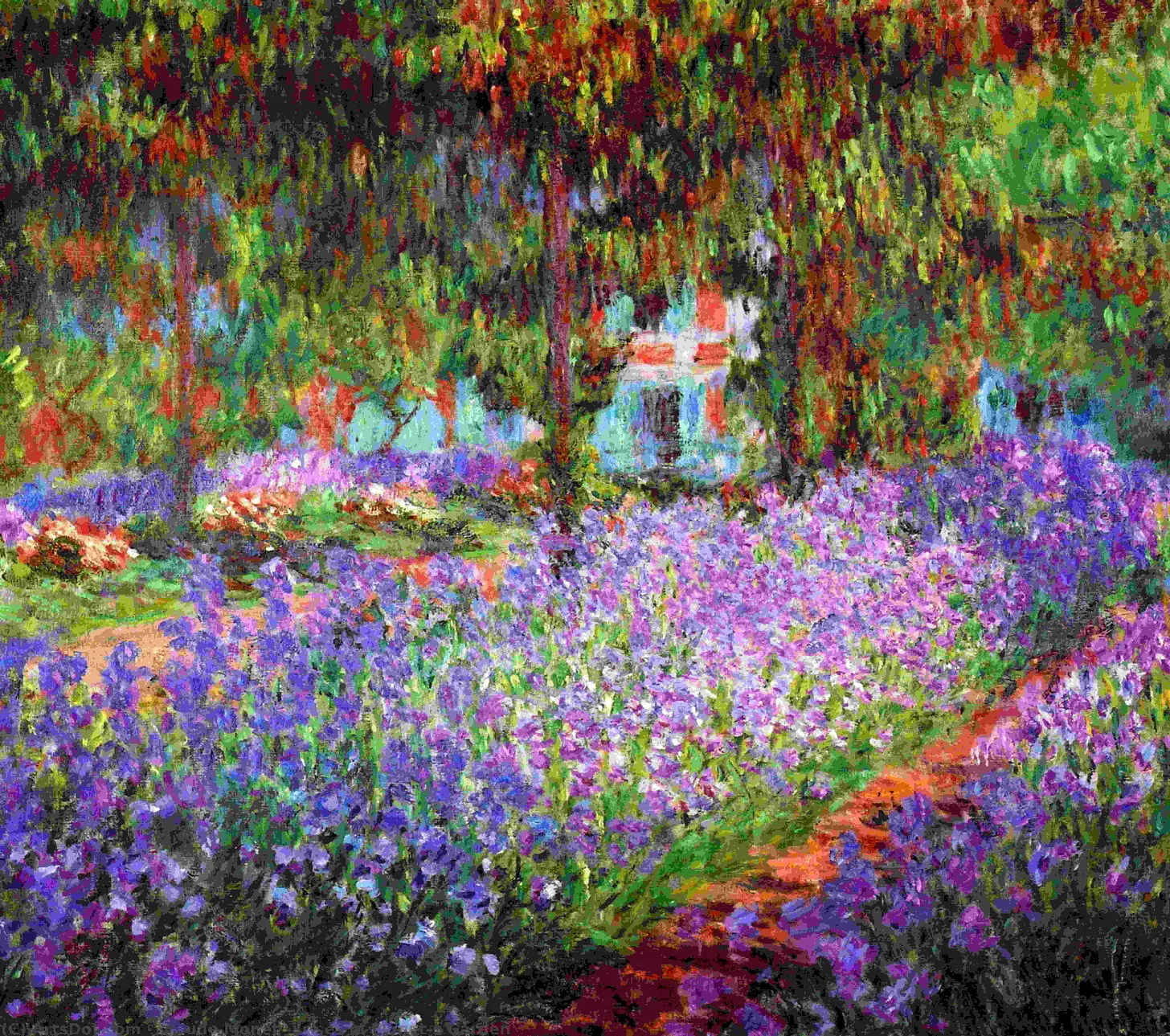
Monet—best-known for impressionistic paintings of the gardens at his home in Giverny in northern France—also made nearly one hundred paintings of the British Houses of Parliament along the Thames River in London.
For Lisel Mueller, Monet’s blended shapes and lines are not aberrations resulting from the blurred vision of his elder years. Instead, she sees them as a more faithful representation of the world’s “hidden wholeness” than normal vision can achieve. She reminds me that finding our way through the destructive times we’re in depends on looking at the world, each other and ourselves through “soft eyes.”
II. We are hardwired to look at life with “hard eyes,” the narrowed eyes that accompany the fight-or-flight response, eyes that focus laser-like on threats to our wellbeing. There are times when hard eyes serve us well. But they will never allow us to see the aquifer of beauty and grace that’s found beneath the broken surfaces of self and world.
For that, we need “soft eyes,” an open, fluid, diffuse way of looking at life that allows us to see the vulnerable potentials to be found under all those hard edges and sharp corners—a source of new life that can soften and humanize our world. Not that long ago on my patch of the planet, we were living on hard-frozen ground in which green and growing life seemed to have disappeared. It took soft eyes to see that beneath the ice and snow, nature was preparing for the rebirth called spring that today surrounds us so lavishly.
• It takes soft eyes to look at another person and see behind their armor to the shy soul that’s yearning to be seen and heard. Hard eyes will never reveal “what wars are going on / down there where the spirit meets the bone.” (Miller Williams) • It takes soft eyes to look at yourself and see beyond self-judgment to the solid ground that, if you yield to it, will accept and uphold you exactly as you are. • It takes soft eyes to look at a world packed with people scrambling to survive, and see beyond the frenzy to the way we keep reaching for relationships that reflect our interdependence, not only with each other but with what indigenous wisdom calls “all our relations” in the natural world.
III. Today we struggle to find signs of spring in this hard-frozen political midwinter of American democracy. Driven by manipulated fear of “the other”—and our failure to take our citizenship seriously—We the People handed political power to mercenaries who look at everything through hard eyes. Stephen Miller, POTUS’s central casting stand-in for Joseph Goebbels, said it this way: “We live in a world governed by strength, governed by force, governed by power. These are the iron laws of the world.”
It’s not easy to practice soft eyes at a time when we’re threatened by those who are supposed to be serving us. But soft eyes are a must if we are to preserve our spirits, avoid becoming what we oppose in the act of opposing it, and restore our democracy. To move beyond the MAGA calamity, we need the kind of vision that drew Martin Luther King, Jr. forward, one that depended on soft eyes. Without that kind of vision, how could King have seen the possibility of The Beloved Community under the rock-hard surface of the oppression he knew so well?
When I look with soft eyes on this hard-frozen winter in American history, what I see deep-down is a people preparing to rise again. Millions of us can still feel the new life we found by taking to the streets last summer, fall and early spring. We’ve been connecting as the trees do, underground, sending texts, emails, money and moral support, preparing to rise again to bring our misleaders down. The norms of love, truth and justice can be flouted only so long before a majority realize that we’re on the road to hell, led by people who already own property there.
IV. Poetry is the language we use to speak about what can be seen through soft eyes, the language of every wisdom tradition known to humankind. As I reread “Monet Refuses the Operation,” these words jump out at me: “I will not return to a universe / of objects that don’t know each other / as if islands were not the lost children / of one great continent.”
The cosmos, “the whole creation,” is not only groaning but screaming at us to wake up and recognize that our lives are interconnected with one another, and with the farthest reaches of the other-than-human world. When we let diseases ravage the poorest of the poor, we pay a public health price at home. When we declare war on countries that control access to energy, we pay a price in the cost of living. When we favor corporate profits over protecting the environment, we pay a price in natural disasters via climate change. Even more important, when we dismiss the value of other lives, we hollow out our hearts and live on the edge of a moral abyss that, sooner or later, will swallow us whole.
We have not always been blind to connections like these. As David Korten has written: “For most of the human experience, societies lived within cosmologies that understood the universe is alive, purposeful, participatory, and deeply interdependent. Humans are participants in, and dependent on, a larger community of life, embedded in reciprocal relationships with Earth and one another.” Might it just be true that we are, in fact, the keepers of our brothers and sisters, and that in caring for them we care for ourselves, too?
V. Lisel Mueller’s poem ends with Monet speaking these lines to his physician: “Doctor, / if only you could see / how heaven pulls earth into its arms / and how infinitely the heart expands / to claim this world, blue vapor without end.” This is the finest work of the human heart: to narrow the gap between heaven and earth by working endlessly to bind our wounds and reclaim the hidden wholeness.
Have we not had more than enough of pathological misleaders with hard eyes, pinched spirits, hearts full of fear and greed, who must deprive others of dignity and life’s bare necessities in order to assuage their own bottomless insecurities? Are we not overdue for a world in which “might makes right” is replaced by a renewed aspiration to live by the norms of love, truth and justice?
Is all of this “mere poetry?” Or might words like these be our marching orders for the “eye exam” Americans will have on November 3, when we will get yet another chance to look at the chart and say, “I see a path toward a more perfect union”? The answer to that question depends on what we do between now and then—and that in turn depends on more of us seeing through soft eyes that we really are in this together.
COMMUNITY REFLECTIONS
SHARE YOUR REFLECTION
6 PAST RESPONSES
I learned about 'soft eyes' from Sally Swift's writing about horsemanship. She taught the Centered Riding method beginning in 1975. I have since then 'soft eyes' to describe an approach to many other areas that I write about.