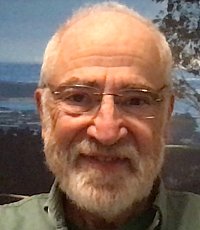
I was twelve years old, preparing for my bar mitzvah, when my grandfather sat me down to tell me where I came from. He wanted me to have the family history before I stood up in front of everyone and became, officially, a man. So he told me about his own father — my great-grandfather, Shmuel Klein.
Shmuel was a teenager in Eastern Europe, back when Jewish people there didn't have many options in life. The one thing he was good at was studying the sacred texts, so his family sent him wandering from village to village to teach. In one town, a relatively wealthy family with three daughters hired him. He was maybe fourteen.
The oldest daughter, Rose, was about his age. A young man and a young woman in that world were not supposed to be alone together, but they found ways to be alone anyway, and they began to have a relationship.
Meanwhile the Kaiser of Austria-Hungary was fighting a war against the Italians, and he needed soldiers. So he sent his men to the Jewish villages to grab young bodies for the army. They took Shmuel — this boy who knew nothing about war — and marched him to Italy. They couldn't find anything else to do with him, so they put him in charge of a prison full of Italian prisoners.
The prisoners were still there
What does a scholarly boy with his nose in the sacred books do with a prison? Here is what Shmuel did. He gathered the prisoners together and told them the truth.
"I can't run this prison," he said. "I want you to run it. I'll sit up front and make it look like I'm in charge. All I ask is that you keep it clean, get the meals served on time, and don't try to escape — because those guys out there with guns are waiting for you." The prisoners agreed. And so Shmuel sat studying his sacred books while the prisoners ran the prison.
When Passover came and he needed to be at a Seder, he unlocked the cells and said, "I'll be gone for about a week. Just keep pretending I'm here." The prisoners agreed.
He took the train back to the village, to the family where he had been teaching. While he was there, he and Rose decided they wanted to get married. Her father said it was impossible. Shmuel proposed a deal: I'll serve until I'm honorably discharged, and if Rose still wants me when I return, we marry. Her father agreed.
Then he got back on the train, walked into the prison — and there were all the prisoners, exactly where he'd left them! Every one of them still there.
He served out his time. He came home. Rose was waiting. They got married, and a year later my grandfather was born. And eventually there was me. It took me most of a lifetime to see that he had handed me more than a family history. He'd handed me a way of being: when you don't know how to run the thing you've been put in charge of, trust the people in the room with you. Open the doors, and see what holds.
A communist and a republican
I grew up in Leonia, New Jersey, a fairly conservative, white, Protestant town. My father was the kind of Republican they had in those days: keep the government out of business and out of people's lives, and keep the taxes low. So everyone who is willing to work hard and play by the rules can succeed on their own.
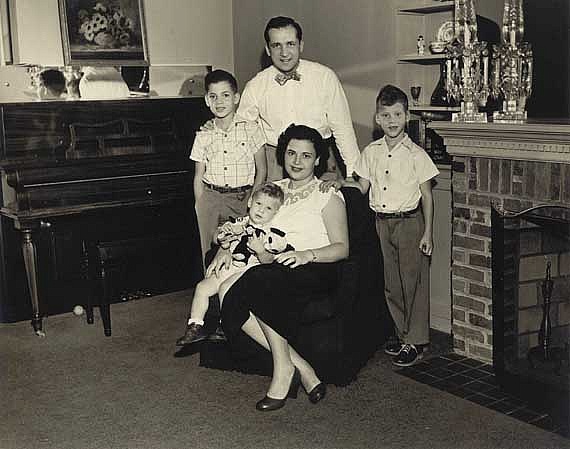
In the mean time, my best friend in high school was Tony. His father was editor of the Daily Worker, the communist newspaper. My father forbade me to go to their house. But Tony and I stayed close, and we got to thinking: if a communist and a Republican can be friends, maybe anybody can be friends.
So we started a group of high school friends — we just called it The Group — where anyone could say what they believed, as long as there was respect. We printed a little newspaper called the Echo Chamber. The principal threatened to throw us out of school if we didn't stop. A few of us had parents on the school board, so we asked them to cover us. We printed the next edition, and I walked into the principal's office, said hello, laid a copy on his desk, and walked out. He couldn't touch us. I didn't realize it then, but that became a direction in my life. I love getting people together who see the world differently, and finding ways for us all to learn from each other.
Stick out your thumb
I ended up at Wesleyan University, which back then was almost entirely white and Anglo-Protestant. I was the token Jew, and I wound up being best friends with the token Black student — Tunde Ojo, from Nigeria. Everyone else got invited into a frat house except Ojo and me, so we spent our time together, and I learned a great deal about being the person on the outside.
I also decided that America preparing for nuclear war was not a good thing. So I joined the New England Committee for Non-Violent Action, and participated in demonstrations where we sat on top of the nuclear submarines at the Polaris base.
My father, who was vehimently opposed to my anti-nuclear activities, demanded that I stop these activities and focus on my school work. When I refused, he cut off my college funding. With no way to support myself in an expensive private college, I put some clothes in a backpack, stood at the entrance to the New Jersey Turnpike, stuck out my thumb, and headed west. Weeks later, I was riding across the Bay Bridge into San Francisco, thinking, I'm not in Jersey anymore!
Where my Arm Ended
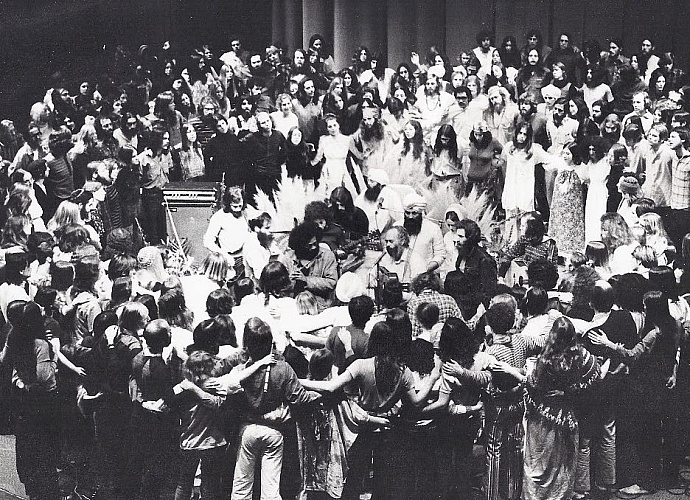
Two years after arriving in San Francisco, I was living in the Haight-Ashbury, driving a Yellow Cab at night, and going to class at San Francisco State College during the day. One day on campus, I saw a man with a guitar and a beard on the outdoor stage. "That's the Singing Rabbi," somebody said. I'd heard of the Singing Nun; I'd never heard of a singing rabbi. But he was singing, and hundreds of us from every background and race were dancing, arms around each other in a great circle. And at a certain point something strange happened.
I couldn't tell where my arm ended and the next person's shoulder began. It felt like we were just one big being.
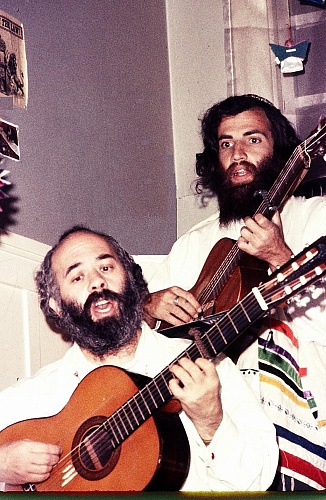
That was Rabbi Shlomo Carlebach. Up on the stage he was quoting the Baal Shem Tov, who founded the Hasidic movement: "If everyone in the world would hold hands, the hands would reach to heaven." When he said "heaven," he looked right at me. He became my teacher.
One day in August 1967, when Shlomo and I and a few friends were walking down Haight Street during the Summer of Love, Shlomo had an idea: let's start a house, and anyone looking for the great day of love and peace can join us.
"Do they have to be Jews?" I asked. "No," he said, "it can be anybody." If he'd said it had to be Jews, none of us would have come. Because he said anybody, we all did.
"We can call it the House of Love and Prayer," Shlomo said.
"What is a House of Love and Prayer?" I asked.
Shlomo answered, "When you walk in, someone loves you. And when you walk out someone misses you." That became our motto and guiding principle in the years ahead.
Shlomo was into travelling, singing, and teaching, not into making things happen. My friend John Seaman — studying to be a Presbyterian minister — said, "Maybe it's not Shlomo's job to start the House of Love and Prayer. Maybe it's yours!"
"How?" I said. "I don't have any money,"
So John, this Presbyterian seminary student, offered me his life savings: $400.
I walked into a realtor and described the kind of house I was looking to rent. He drove me across town to a three storey Georgian house that was exactly what I was hoping for: a beautiful location, a large living room that we could use as a prayer room, a large kitchen, and plenty of bedrooms and other places for people to hang out and study and sleep.
"What's the rent?" I said.
"$300 a month," he said. ""But we'll also need a $100 security deposit."
"Sold!" I said.
I told Shlomo, and he added the House of Love and Prayer to his business card. Within weeks, people from all backgrounds began pouring in from all over. It was the beginning of an adventure that lasted for many years. My life, and many other lives, were changed forever. And "The House" became part of the legend of 1960s San Francisco.
Get the right people in the room
Years later, I was earning a living as a part time community college instructor. My wife at the time was in graduate school. In 1980 we had our first child, and you couldn't raise a family on a community college instructor's salary.
So I answered an ad for a sales rep from Exxon, which was starting an office systems business in Silicon Valley. I sat down across from the sales manager, Diane. She looked at my resume. Had I ever been in sales? No. Ever worked in technology? No. Ever even worked for a corporation? No.
"So why should I hire you?" she said.
I reached into my wallet, pulled out a photo of my little daughter, and showed it her.
"When I was growing up," I said, "my dad worked hard so I could have every opportunity. I want to do the same for her."
Diane looked at the picture, looked back at me, and said, "You're hired!"
I didn't know a thing about office technology. But I knew how to get the right people into the same room.
While working on my master's degree on Humanistic Psychology in the 1970s, I had been greatly influenced by Virginia Satir, the family systems approach, and family therapy. For example, if someone in the family has been diagnosed as schizophrenic, you don't you don't try to just treat that person as an individual. You treat them as the identified patient in a dysfunctional family. And you treat the whloe family.
This approach formed the basis of my approach to corporate sales. The traditional viewpoint was: How do you persuade the buyer that your product is good? My approach was: How can my product help us bring the whole system together so your company can function better?
At one big phone company, the documents needed by the sales and technology departments were drafted by the legal department and typed by the women in the word processing department. And none of them were talking to each other. This was causing delays, errors, and lost sales. So I brought people from the various departments together to solve the problem. We discussed how the products I was selling -- word processors and electronic typewriters that could communicate with each other -- could help solve the problem by literally getting everyone on the same page at the same time. This company became our largest account, and I became Exxon Office System's number one sales rep on the West Coast.
Years later, when I was working in sales for a company that sold leadership training workshops, I started convening Silicon Valley's human resource leaders for free breakfasts. At that point for me, the "family system" was Silicon Valley's human resource community. They all had similar complex issues, but never talked to each other. So I convened them for conversations where they could learn from each other -- while promising to keep the conversations confidential.
It worked. And I founded my business, a membership organization for Silicon Valley's HR leaders, called the HR Forums. They hosted the breakfast meetings and learned from each other. I brought them all together, facilitated the conversations, and kept them all connected.
When I explained all this to my mother on the phone, she asked, "So when are you going to get a real job?"
Aryae gives a farewell speech to the HR Forums at it's closing in 2013.
Community of Global Citizens
Around 2013, by the time I was turning seventy, I invited futurist Bob Johansen to speak to the HR Forums. His institute, the Institute for the Future, had just finished a ten-year forecast, and he called it the most disturbing one of his career — and also the one that made him most optimistic.
Disturbing, because climate change and inequality would drive enormous instability, and soon pretty much everyone on earth would carry a mobile device. People who were hungry, angry, saw no real opportunities in their lives, and had no real committment to the established order, would be able to create chaos and disruption at an unprecedented scale.
Optimistic, for exactly the same reason: everyone who wanted to do what they could to support their communities, and link with other communities around the world to make this world better, would be able to do the same.
That set me thinking. What if I could help cultivate community among people everywhere who wanted to make this world a better place? A few friends and I started One World Lights — global citizens supporting a course change for humanity by supporting each other. Just this morning I sat in one of our virtual circles with friends from California, Georgia, Cameroon, Nigeria, the Ivory Coast, and Kenya, talking about how we can support each other.
Laughing lessons
But if you want to know who my real teachers were, I have to tell you about one of the most challenging times for me. My marriage had come apart, my wife and I had separated, and the kids were spending a week with their mother and a week with me. I was trying to do my sales job in Silicon Valley, pick the kids up from school in Half Moon Bay, make dinner, make sure they got their homework done, and make sure they were washed and clean and to bed on time and ready for school the next day.
One night at the dinner table I was anxious and trying to hurry them along. My daughter looked up at me and said, "Dad, you need laughing lessons!" Then she and her brother started clowning, jumping around, doing the most ridiculous things, until I couldn't help it and started to laugh!
They were teaching me how to shift gears — how to be here now. Two of the best teachers I've ever had!

Today is a gift
Someone asked me recently, what has stayed constant across so many chapters of my life? The anti-nuclear kid, the hippie, the founder of the House of Love and Prayer, the salesman, the CEO of the HR Forums, the elder convening global circles.
What's constant for me is, when I can sit in a circle with people who are so different in so many ways, and when we can speak deeply, and deeply listen to each other -- what's constant is the bigger picture that emerges for all of us. Or, said in another way, the circle is the teacher.
If I could tell my younger self one thing, it's this:
Today, right now, is a gift, for you, for each of us. Even when there also many struggles. Your whole opportunity is to accept that gift. Do what you have to do to deal with the challenges, yes. But really, really accept the gift.
Imagine knowing that for your entire life. It's not too late to begin now. Open the doors, and see what you find.
— as told by Aryae Coopersmith on a Story Booth. View 12 video clips from his Story Booth.
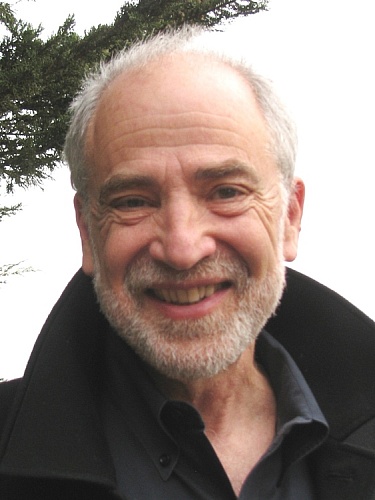 is a keeper of the incredible spirit of humanity, whose path has been propelled by the power of
COMMUNITY REFLECTIONS
SHARE YOUR REFLECTION
8 PAST RESPONSES
A most inspiring, humbling, touching narrative.
Hope to see you on my next visit to Cal.