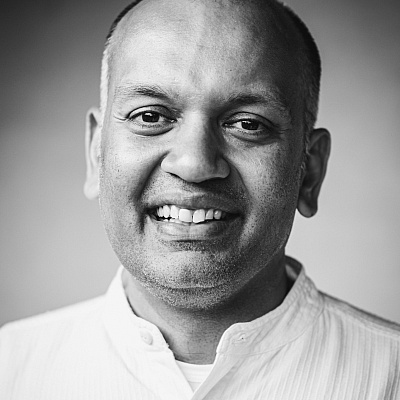
Dear Friend,
I came across something recently that I haven't been able to stop thinking about, and I wanted to share it with you. It's a graduation speech given by a man named Nipun Mehta to a group of high school seniors in Silicon Valley. What struck me first was that these teenagers—kids who supposedly belong to the "Me Me Me Generation"—actually chose him as their speaker. They chose someone who walked away from a lucrative tech career over a decade ago to explore how inner change connects to outer impact.
What moves me most is how he names the paradox we're all living in. He quotes Taylor Swift of all people, describing that feeling of being "happy, free, confused, and lonely, miserable and magical at the same time." Isn't that exactly where we are? He tells these kids the good news: the world is materially better than ever—people are better fed, living longer, healthier lives. Then comes the hard part: we're also profoundly disconnected. The average American adult reports having just one real friend they can count on. One! We have 150 billion Facebook "connections" and we're more isolated than ever.
But here's what surprised me—his answer isn't to fix anything externally. Instead, he offers three keys that feel almost radical in their simplicity: Give. Receive. Dance.
The giving part, I expected. But then he shares this story about six-year-old Ruby Bridges, the first Black girl to attend an all-white school in 1960. Every day she faced death threats and jeering crowds. And every day, she prayed for them: "Please, God, try to forgive these people. Because even if they say those bad things, they don't know what they're doing." A six-year-old! He says our capacity to love is a currency that never runs out, and suddenly I believe him.
The receiving part caught me off guard. He tells us that when we give, we receive many times over—not in some transactional way, but internally. There's actual science showing that when people feel connected, their heartbeats synchronize. Joy isn't zero-sum. The more you smile, the more you do smile. "To be truly selfish," he says, "you must be generous."
And then the dancing—oh, this is what I'm still sitting with. He says our biggest problem is that we try to track it all, and when we do, we lose the beat. He tells this story about his friend who anonymously pays for couples' meals at restaurants. One time, it turns out he paid for a couple who work at a nonprofit with disabled kids, celebrating their anniversary on money they'd saved all year. Everyone ends up in tears. And then he asks: who was the giver? Who was the receiver? Does it even matter?
The speech ends with Nipun buying ice cream for a homeless woman who then empties her pockets—finding just a nickel—and insists on buying him something too. They tip the cashier together. "No matter what you have, or don't have, we can all give," he says. "Generosity is not a luxury sport."
I thought of you reading this because I know you've been feeling that same paradox—the simultaneous beauty and brokenness of everything right now. And I wonder: what would it look like for us to stop keeping track and just dance? What small act of generosity might we practice this week, not to fix anything, but simply to reconnect?
With love and curiosity,
Your friend
COMMUNITY REFLECTIONS
SHARE YOUR REFLECTION
3 PAST RESPONSES
It is not easy to find this kind of attitude.
After the COVID it seems that Pandoras box, was opened again, and even hope isn't in the box,