
At fifteen, Ruth Brigandi lost her memory entirely for four months — and lived, for that time, without identity, language, or any sense of where she ended and the world began. When her memory returned, she remembered everything, including the emptiness. Today, Ruth directs Fundación Humanitas in Barcelona, home to a consciousness-research laboratory and the Festival of Consciousness. In this Story Booth conversation — the first time she has shared this experience in public — she traces the thread from that hospital bed to the work of her life, in her own words.
Waking Up Empty
When I was fifteen, I had an inflammation in my pituitary gland. It started with strange problems — in my cognition, in my body. And then one day, I fell. I woke up without anything. Completely empty. I couldn't move. I couldn't speak. I didn't understand the language of anyone around me — I didn't even understand the meaning of words.
I was a baby in a teenage body.
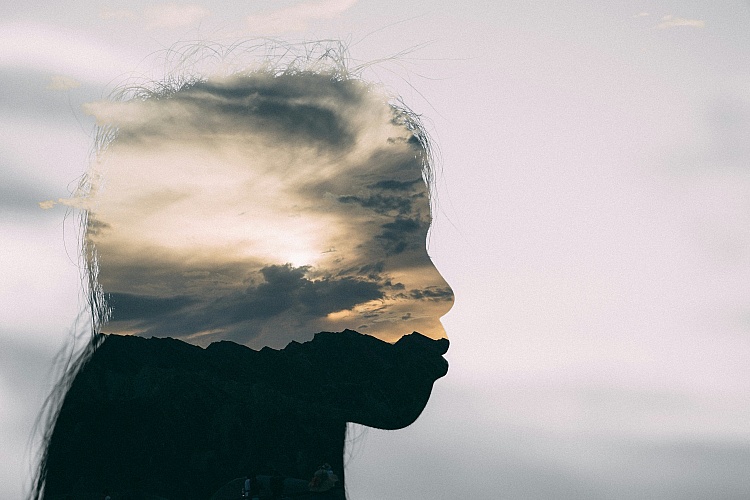 The boundary of my body didn't exist. There was a body, but I didn't know there was a body. I didn't feel that the objects in front of me were separate from me — it was just me, because I didn't know where my limits were. It was complete unity with everything.
I had no emotions — this is a very important part. I didn't feel sadness, or happiness, or anything. I just felt my body: when I was hungry, when I needed to pee. But little by little, I started to notice things. Like a magnetic field around me. When my mom or my dad walked away, I felt a hollow, something strange. I didn't understand anything, but I caught everything.
I had the feeling, in that stage, that the air is not empty. There is no empty space at all. It's all full. There are textures around us that we don't feel — but they are there.
And everything was good. It was just a peaceful stage. I remember it now — at the time it wasn't interesting, it wasn't anything. It was peace.
The Waterfall
People assume the illness was losing my memory. But I always said: the illness was recovering my memory.
I suppose when we grow up, little by little, we get used to being a human adult. But I went from zero to one hundred in a day. The first weeks were okay. Then my emotions arrived, and I didn't know where they came from. The sadness. The euphoria — that one was very high. And the thoughts — oh my God, the thoughts were horrible.
When you don't have any thoughts, and then you start to have all the thoughts — I always picture a waterfall. I was going down a waterfall. I didn't have the chance to catch anything, to hold myself anywhere. A lot of thoughts, a lot of emotions, and I was falling down, down, down at very high speed.
I fell into a depression, because I couldn't stop my mind. Everything came at once: I have a name? I have a body? I have a family? I have to go to school? I'm a human being — what is that thing? None of it made sense. I didn't want to be here. I just wanted to go back to that space of emptiness and peace. The only thing I thought about, all the time, was taking my own life. It took me three or four years to get out of that waterfall. I took medication, but the medication just made everything foggy — it didn't stop the water, it only meant I couldn't even see it.
Practical Things, and Love
At some point I arrived at a decision. I said to myself: I can do this for the rest of my life and end up in a psychiatric hospital. Or I can try something that doesn't make any sense to me.
I asked my family to let me stop the medication. After everything I had been through, I had become very, very sensitive to my body — I listened to it. And my body was telling me: you can't see what's on the other side of this fog. Maybe there's a monster there, maybe not. But you have to see it. I come from an Italian-Argentinian family, so you can imagine — this was a big thing. But my dad trusted me. He took all the responsibility in the family, and he said: okay, if you want to do this, it's your life, I want to respect that. But you have to promise me... and I said yes.
For two or three months I couldn't get out of bed. Then, with my dad, I started writing down the things that normal people do. Go back to school. Eat. Take a shower. Small goals, very practical. I had lost two years of school, and I made them up by studying for the exams in advance — and that helped enormously, because when I was studying, I was not thinking about myself. Sometimes I would collapse inside: I don't care who killed who in history, I don't care about mathematics. But I would tell myself: stick to the plan. We have to do it, we have to do it, we have to do it.
And underneath the practical things, one motivation carried me: the love I felt for my family. I saw my mom and dad suffering. It was like — it doesn't matter about me, but it matters about them. I would survive this for them.
In that moment, I felt that life doesn't have any sense — and the only sense is to live the life. It's existence. We are here for a reason. I don't know which reason. But we are here, no?
I made another decision, too, one the psychologists didn't like. I told my family: we have to pretend that everything I went through was a nightmare. It wasn't real. They said, Ruth, this is not the way, the trauma... And I said, okay, I will take care of the trauma — later. For now: practical things, practical things, practical things. Everything else: after, after, after.
The Intensity Years
Here is something I learned, and I say it with a smile: the intensity of life is good for depression. If you have a lot of goals and a lot of things to do, you don't have time to think. You don't have time to explore your existence, what is happening, good or bad. No, no, no — just do it.
So I built a very full life. I got married. I became a mom. I divorced after seven years. I did an MBA in Silicon Valley. I helped social-impact startups grow. I created my own company — yoga retreats, health coaching. A lot of things. And through all of it, always, this feeling: there is something missing here. I would arrive somewhere and think, this is it. And then: no. It's not.
I'm forty-two now, and I can be honest: I am still working with my addiction to intensity. I always want to do everything, one hundred percent, every day, because I learned that it saves lives — it saved mine. And I'm realizing it's not what I need anymore. Twenty-three years later, maybe I can learn to be in peace. To relax a little bit. Not long ago I heard Nipun speak about doing your 5% and letting life do the other 95%, and I had to recognize: I have been an exponential-growth manager of my own life. I was doing the 95%! So okay — maybe now I can try the 5%.
Making Peace With the Mystery
For twenty-two years, I didn't think of what happened to me as spiritual. When my memory came back, I was too preoccupied with the shock of it. It took me two decades to look at it another way.
And when I did, I realized: that feeling of love I felt when I was sick is something very important. It's something bigger than us. It's something we have, and we forgot that we have it — because we have it. Maybe it's intuition. Maybe it's resonance, frequency — we have more words for it now. But there is something there, and I experienced it.
 Even meditation came to me through that door. I don't struggle to quiet my mind. I just remember that moment of emptiness, and my whole system says: that's it. And I can stay there a long time.
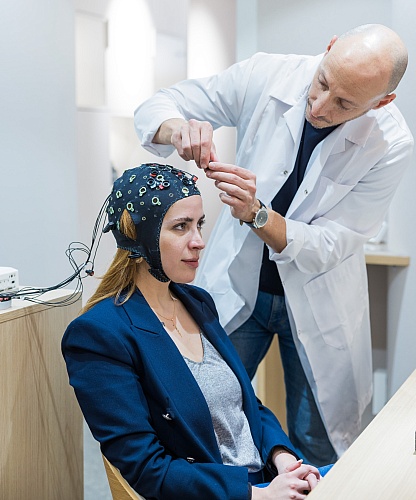
So I decided: okay, then I will put my talent and my energy — and I have a lot of energy — into investigating that. At the foundation, we have a neuroscience laboratory where we research consciousness, with twenty-five lines of investigation. We created the Festival of Consciousness. Every step I take now goes in the direction of that point in my life where I was able to see that there is something different. And I don't think it ends here — lately I feel a calling toward regenerative soil and community. Each step is a new direction of completeness for me.
Two Rhythms
People ask me about being human in the age of AI, because I once lived as consciousness without a character, without a culture, without a narrative, without a memory. And I think we are confused about our identity. We believe we are thinkers. We are not. Our system can think, can feel, can do a lot of stuff — but we are more than thinkers. Maybe these tools that are faster and more efficient than us allow us to come back to our creativity, our real being. It's painful, because our identity is stuck to us. But I think we are in a change of paradigm. A big one.
The other day, I was thinking: God is teasing us. Because look what has been put in front of us, like a mirror: nature. A tree takes four or five years to grow. Nature has a rhythm. And now, on the other side, AI — super fast, one question, a hundred answers. Two rhythms. We have to learn to switch between them, and find our own. Because we are life. We are part of nature. We are not our minds — I know that. I was a human being without a mind.
AI doesn't create — it makes what it already knows. That is efficiency. But we are very good at creating, and creation needs time. Imagine you have one more hour to prepare a pasta — I come from an Italian family — and you share that pasta with your neighbors, and they remember it for the rest of their lives.
This is the technology of generosity. A tree gives us a hundred apples, and a hundred apples give us a hundred trees. Superabundance! This is the law of nature — and we need time to live it. If we don't have the time, we don't create. It's as simple as that.
Everywhere now I see small communities popping up — regenerative, going back to the origins. Like a mycelium under the ground, working without being seen. Not one big thing; a lot of small things, connected. At some point, they emerge.
We Can Choose
I have teenagers now, and I tell them: we have a mind. It can be a weapon against you, or it can carry you somewhere glorious. It's difficult — the scientists I work with would say it more carefully — but we can choose what we think. We can decide: okay, I get fifteen minutes to complain. And then, done. I decided my illness was a nightmare, and I walked out of a depression. It took a long time, but I did it — noticing each thought, each feeling: okay, okay, I see you. Set it apart, and begin.
Maybe we believe that being aligned, being happy all the time, is the goal. It's not. The goal is just to be human — a lucid human. Sad things, good things, feelings, narratives — everything belongs. We are simply more than all of it.
After all these years, I think embodying life is the only purpose. There is no single way — every human being has their own way to explore it. And in that, I am very happy that I did not take my life when I was fifteen. Because now it's like — oh my goodness, I have this! My existence, and I have it!
When I was in the womb of my mother, and when I was in the unity of my illness — everything was good. Maybe we have to trust.
And that's it. It's very difficult — I built a life completely opposite to what I'm saying now. But I'm happy to realize it. We have time, if we take it. We have nature, showing us the rhythm. And we have each other.
— as told by Ruth Brigandi on a Story Booth. View 12 video clips from the live conversation.
COMMUNITY REFLECTIONS
SHARE YOUR REFLECTION
2 PAST RESPONSES