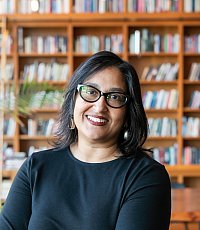
I was born in India and at the age of just three months old, my family moved to Lawrence, Kansas, where I grew up.
The contrast in my bicultural upbringing has been formative. Inside my childhood home, I was steeped in a Hindu cosmology that taught me the divine is in me, and in you, and in everything. The world outside my home seemed to beenveloped in what I'll call a pervasivebut unstated Midwestern American Christian sensibility that to my child self seemed to say, "God is perfect out there and man is a sinner in here."
I couldn't reconcile these two worldviews, but the contrast between them sharpened my curiosity about the deepest questions of my nature. I thought, we're rigged to want to know and to not know. So, we get to choose. I choose to believe the divine is in me, and in you, and in everything, because that makes me feel better about myself and about you and about the possibilities of life between and among us.
This fascination with the nature of consciousness has followed me my entire life. Early on, it showed up in a love of the arts, because the arts -- that same Hindu cosmology led me to understand that what we elevate to call art is the result of a human being manifesting the divinity in them sourcing from something deep within and far beyond themselves.
Later in life, this fascination with consciousness led me to AI because AI, too, is a product of human consciousness. And surely, in studying it, we will learn more about ourselves. My first job out of college was at the Psych project. This was a huge project in artificial intelligence to build a machine that has all of human common sense knowledge. I didn't know if that was possible, but I knew that in trying to replicate human intelligence, won't we learn an awful lot about our own capacities and limitations?
So, through following this curiosity, I've come to believe that the essence of the human condition can be defined by what we might call nonduality. This divided wholeness exquisitely captured in the yin-yang. It gets at the essential paradox of our existence -- that we are simultaneously emergent parts of one interdependent whole, and we're each distinctly consequential.
An infant comes into the world fresh out of the womb and she doesn't even know she's her and you're you. We have to teach her, "baby," "mommy," "nose," "your nose," "my nose". And we set about, as the Buddhists would say, naming the ten thousand things. Human cognition requires us to name things, categorize things, separate things -- to make sense of our world. Because if everything is everything, then nothing is anything.
Meanwhile, quantum science now shows what our wisdom traditions have known all along -- that these perceived delineations between things are illusory. We live in an entangled universe with an underlying unity. So we live in difference and wholeness. And this goes to the gorgeous complexity of wholeness in the human being. We are made to hold the "both-and".
When we soften the either or and really embrace the "both-and," we experience healing. The things that touch the deepest parts of us -- awe, wonder, truth, beauty, grace, love -- these arise from our wholeness. So, if the essence of the human condition is steeped in this non-duality, the divided wholeness, the essence of digital technology is by definition binary. It reduces to zeros and ones. And it's actually zeros or ones. That's a hard separator, an exclusive "or". There's no "and-or". No room for nuance, ambiguity. No contradiction. No paradox. No wholeness.
What are the implications in a digitally dominated era for the things we value most about the human experience? What of love, truth, and beauty -- all rife with nuance, contradiction, and paradox? Awe and wonder. These dance with mystery, with the unknowable.
How can the unknowable be reduced to zero or one? Grace can't be contained in an algorithm.
So, we better stay in charge, take responsibility, retain our agency, and bring the fullness of our humanity to all we make and do. Or else, we'll allow the zeros and ones to further compress us into becoming more binary.
Is it any wonder in a time when so much of our media is social media that we're more polarized? Binary in, binary out. We need to intentionally bring our full analog selves to the zeros and ones, and then we can metabolize what we receive, and that can help us guide what we transmit.
Even before AI, our modern technologies put more power in the palm of our hands than Genghis Khan could have imagined. And now, with AI, we all have access to a collective intellect, a super intellect. Add to that what's distinctive about AI -- that it has an exponential rate of development, and it has the capacity to further develop autonomously. So now, in designing/using/developing AI, we're approaching the power of gods. The divine is in me.
As Daniel Schmackenberger says, "If you're scaling towards the power of gods, then you must have the wisdom and the love of gods, or you'll self-destruct."
We talk a lot in AI about the alignment problem. How can we ensure that AI aligns with our goals and values and won't destroy us? I can't outsmart AI. It's an amalgam of our intellects and we will always be smarter than me. But the level of the solution isn't at the level of the problem. We won't do this through our intellects alone. This is where the "either-or" cognition of the mind must join forces with the "both-and" cognition of the heart.
For hundreds of years, since the Enlightenment, when we understandably cleaved off from the abuses of the church and we elevated reason, giving rise to the scientific method, the modern university, modern western culture has emphasized a particular way of knowing that's hyper secular, rooted in materialism, and increasingly individualistic.
Now, we've privileged the intellect above all other ways of knowing. Don't get me wrong, I love my brain. The intellect is profoundly powerful. It got us to the moon and back. But it's woefully insufficient by itself. The curiosity and desire to go to the moon -- that didn't come from the intellect. The transformational spiritual experience conveyed by some who've journeyed to the moon and back? That's not from the intellect. That's from the wholeness of human consciousness having a direct experience.
Wisdom and love don't come from the intellect. To cultivate wisdom and love, we need to engage other ways of knowing. The human being has many ways of knowing. Let's just take a minute right now and experience a few. Starting with the intellect. Just think to yourself -- how how do you spell the word star?
Thank you. S-t-a-r.
So, how do you know that?
Just think about where that lands for you. How do you feel it? How do you know "s-t-a-r"? For me, this is conceptual. It's abstract. It came from out there. I learned it at some point and I committed it to memory. Okay.
For something different, think about the last time you experienced physical pain. Maybe you had a headache. Maybe you skinned your knee, or fell off a bike. Maybe you burned your hand cooking dinner. Physical pain. How did you know it hurt? How did you know it hurt? See, for me, this is not conceptual or abstract. This is visceral, first-person, direct, subjective experience. It's embodied. It requires a body.
Okay, think about someone you love. How do you know you love them? How do you know you love them? This, for me, isn't abstract in the way that "s-t-a-r" is. It didn't come from outthere. It arose from in here. But it's also not contained to my body the way physical pain is. It actually exceeds, bleeds, out of my body into the space between me and another. It's relational.
So those are just a few ways of knowing. Intellectual. Somatic or sensory. Relational. We have many ways of knowing, and we have a lot of ways to practice and inhabit these other ways of knowing to get out of our heads.
Getting quiet. Silence. Solitude. Meditation -- that's a great avenue. Or nature. Any encounter with nature when we really put our attention whole-heartedly to the smallest blade of grass or a majestic mountain. When we observe that the tree is breathing out exactly what I need to breathe in. Or the arts. When we sing in a choir, when we listen to music as a primary activity, not background. When we contemplate a painting and not try to analyze it -- just behold it in our attention and see what arises. These are all great ways to get out of the intellect and practice other ways of knowing.
And maybe you're doing these things already. Let's now make it a priority as if our lives depended on it. It's time to explore, expand, and take as seriously these other ways of knowing beyond the intellect. It's easy to get seduced by the simplicity and certainty of the binary. There's a deceptive clarity to good versus bad, right versus wrong. But we can't succumb to the wishful thinking that AI will solve our hardest problems, because hard things are usually hard because humans are human.
And we can't believe what everyone seems to be selling that making life simpler equates to making life better. No one on their death bed ever said, "Honey, remember that day when everything was so convenient?" But modern culture would have us believe it's a bug, not a feature that we humans can be irrational, unpredictable, inefficient, or susceptible to contradiction.
I believe it's exactly our whole human non-dual consciousness that allows us to make seemingly irrational, unpredictable decisions in the interest of time horizons beyond our lifetime for people other than ourselves. That's the loving consciousness that will save ourselves from ourselves and get us out of these many existential crises all built on false frames of individualism and materialism.
In AI, we've co-created an incredible invitation and an urgent imperative to bring to full force our other ways of knowing to complement our superintellect. That's our best chance of ensuring our superpowers work for us and not against us. She can develop her critical thinking and then let AI shoulder much of the cognitive load, freeing her up to cultivate her other superpowers. They've been in the making for billions of years.
She has a unique role to play.
We all have a unique role to play.
It's time to live into our deepest and fullest humanity. Because when we act from a ground of wisdom, love, and compassion, we see our interconnectedness. We can begin to relinquish control, embrace uncertainty, become improvisers, and collaborate with each other in service of life.
Like any great jazz ensemble, everyone is needed and no one is centered. May we harness the power of AI to help us become superhuman and participate in a new way of being, a collective emergent intelligence, each giving our gifts in sacred reciprocity towards mutual flourishing for life on Earth.
Thank you.
 From AI to jazz, Srinija Srinivasan’s journey bridges technology, creativity, and consciousness. Born in India and raised in Lawrence, Kansas, Srinija Srinivasan has followed a lifelong curiosity about consciousness, wondering from a young age what possibilities can arise from believing divinity is in ourselves and all around us. After studying AI at Stanford, she joined Yahoo! as its fifth employee in 1995, serving 15 years as Vice President and Editor-in-Chief. She also Chaired the Board at SFJAZZ, guiding one of the nation’s leading jazz institutions. She recently cofounded Jubilee College, a two-year school where students will be equally rooted in physical work, rigorous liberal arts study, and contemplative practice. Srinija is a board member of the On Being Project and a former vice chair of Stanford University's Board of Trustees.
COMMUNITY REFLECTIONS
SHARE YOUR REFLECTION
7 PAST RESPONSES