The book The One-Straw Revolution was translated and published in Vietnam in 2015. It quickly became a best-seller, igniting a back-to-the-land movement across the country. For those who walk the path, the past decade has been a journey in which we hard-learned to "let Mother Nature lead the way, even letting her reshape our own desires." What began as a misunderstanding—the assumption that natural farming was easy—evolved into a profound transformation.
Non-Action (Wu-wei)
On the cover of the English edition is a drawing of a fist holding a flag and a straw. But Fukuoka's revolution has no fists, nor flags. He asserted: "A revolution can begin from this one strand of straw."
But how?
This is a diagram showing the best soil composition on Earth. In it, 45% is mineral matter formed from weathered parent rock; air and water each account for about 25% by volume. The most critical component is organic matter and living organisms, which make up only 5%.
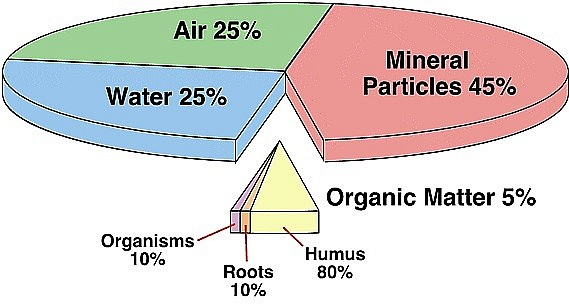
I initially dismissed that 5% as insignificant, but soon realized it is a "simple but not easy" task because it requires a continuous supply—all that matter is constantly being transformed. That is why humanity cannot create this type of soil; it can only be found in a primary forest: a closed, local cycle.
We easily overlook that tiny 5% to target the remaining 95%. If we want minerals, we apply chemical fertilizers; if we want air, we plow; if we want moisture, we irrigate. Yet Fukuoka's natural farming is "non-action." Non-action is not "doing nothing," but rather like a boat going with the current and the wind so it "doesn't need to act"—much like how that small 5% activates the other 95%. For that reason, "a single straw can start a revolution."
"It has taken me over thirty years to reach this simplicity."
— Masanobu Fukuoka
Action and Neglect
"In seeking to return to nature, there is no clear understanding of what nature is, and so the attempt proves futile."
— Masanobu Fukuoka
Ms. Do Tu Thao (Hoa Binh) shared: "Seeing that dổi (Michelia tonkinensis) trees had high value, in July 2021 we spent $4,000 to clear 3.5 hectares of hillside right after harvesting acacia. We built a 100 m³ water tank on the hilltop and bought $4,000 worth of seedlings to plant during the dry season. Then we sowed soybeans on the bare, leveled ground to improve the soil, but nothing grew.
By spring, we planted 5,000 banana trees. Seedlings were only $0.20 each, but the cost of pumps, irrigation systems, and labor reached $12,000. The fruiting of bananas brought high hopes—but mass monoculture planting led to disease. We spent $1,200 on microbial solutions but failed. A storm came and leveled everything.
Next, I tried Mombasa grass, which required monthly mowing just to keep the farm accessible. After a year, the costs hit $2,000 for mowing plus $1,000 for its eventual removal.
Exhausted, broke, and stripped of faith, I finally surrendered. Only then did I notice the areas I hadn't touched—wild trees were growing as thick as paint buckets (30 cm diameter)."
"The first question to ask is what-grows-here, not what-to-grow-here."
— Masanobu Fukuoka
Mr. Bui Anh Tuan (Lam Dong) recalled: "In 2016, I stopped all chemical fertilizers and pesticides, and stopped mowing. Cogon grass and Siam weeds overran the coffee. That year had a terrible drought, and yields dropped from 7 tons to 3 tons.
To save the farm, in February 2017—the peak of the dry season—I intercropped perennial forest trees (Black Star and Siamese Rosewood) across the 3-hectare farm. I woke up early to water each one, but 8 out of 10 died. The coffee farm continued to deteriorate. The once-lush monoculture coffee farm turned into a ruin."
Fukuoka practiced non-action farming; we were either too "active" or simply neglectful. And so we continued, learning our lessons along the way.
From Farm to Forest
Mr. Tuan shared: "To get short-term income, I intercropped bananas throughout the coffee farm. Wherever the bananas grew, the soil cooled down. Two years later, in 2019, I planted perennial forest trees under the banana canopy; 9 out of 10 survived.
The most useful thing I could do was increase the organic content in the soil to 5%.
Currently, 80% of the farm has long-term timber species across more than 20 species. Many native forest trees regenerated from stumps I thought were long dead; these grew much faster than the ones I planted.
Knowing how to slow down and let the 'farm work itself' is even faster than 'working the farm'.
I used to think that prioritizing the ecosystem would mean less to harvest. That was true for the first few years. From the fifth year onward, I was overwhelmed by nature's generosity. Beyond coffee, crops like avocado and banana—which I thought were secondary or hard to grow on hills—are now thriving with surprising ease.
The total yield of a forest farm is many times higher than a monoculture.
My mother went from trying to stop me—fearing the shade and leaves would affect the coffee flowers—to admitting that where there is shade, the coffee trees stay green longer."
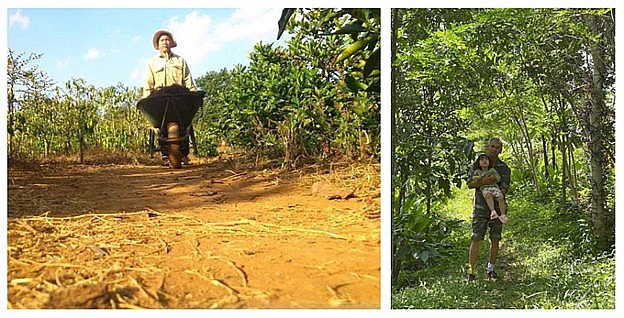
Same spot, 10 years apart. In 2016, Tuan worked on his bare coffee farm.
Today, Tuan’s father and daughter enjoy the cool shade of the forest garden they nurtured together.
Mr. Che Dinh Nguyen (Daknong) recalled: "In 2017, I impulsively began practicing organic monoculture. The more I worked, the more I lost: capital, health, and family harmony.
It was not until I encountered 'the straw' in 2022 that I had an epiphany 'the forest is the solution.' I finally understood that only a forest could restore humus and retain water, serving as both a protective belt and a sanctuary for my later years. Now, I have dedicated 40% of my 7 hectares to forest restoration, while in the remaining 60%, I intercrop high-canopy timber and legumes to create on-site biomass and natural windbreaks."
A trend of forest restoration has emerged within the forest farming movement over the last 5 years.
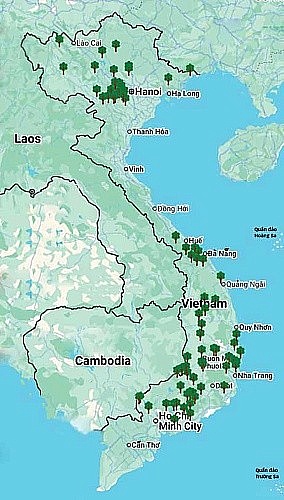
Each tree on this map represents an emerging forest.
A delegation from VIFORA (Vietnam Forest Owners Association) visited several forest owners in late 2024. They concluded:
"A 'One-Straw' lifestyle is forming, rooted in integrated livelihoods, natural farming, and simpler living. In forestry, this means shifting from plantations to high-value natural forests with under-canopy crops. Some models are quite impressive."
— VIFORA delegation
This "natural forestry" maximizes natural regeneration and succession, lowering costs while achieving a high multi-species index. Pioneer trees "cool the soil" to facilitate regeneration across patches ranging from small plots to thousands of hectares.
"Cooling the soil is an important step toward success."
— Masanobu Fukuoka
The Inner Forest
Mr. Nguyen Minh Hai (Gia Lai) has nurtured a forest from 7 hectares of farmland. His 20-year-old forest inspires many. Yet on Google Earth, his forest looks as fragile as an ice cube in hot water—surrounded by monoculture fields. This is a common situation for many such forests.
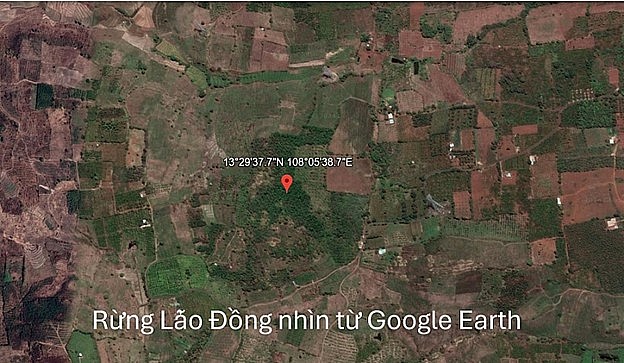
Hai's forest from Google Earth—a cool "ice cube" of biodiversity in a "cup of hot water" of monoculture crops.
"People ask me, 'Forest restoration shows results when you are old or dead, so how will you eat in the meantime?' Humans often want immediate results. I don't have as much as others, but if we adjust our lifestyle, we'll be fine."
— Nguyen Minh Hai
Many in this movement reinvent themselves. Mr. Ho Cao Duc Quan (Daklak) shared:
"Returning to the village, I realized how poor my homesteading skills were. It has been a joyful 5-year journey learning to hunt, gather, farm, build houses, dig wells, weave baskets, find underground water… and countless lessons in self-reliance I am still mastering."
Beyond individual skills, weaving oneself into a community is the next challenge. Ms. Nguyen Thuy Tien (Da Lat) noted:
"We lean on a close-knit community where we exchange everything without money. In times of disaster, while each family is self-sufficient, together we have an abundance of food and fuel through mutual sharing."
Jack de Bruijn, a Dutch mechanical engineer in Daklak, realized:
"I grew up in a culture taught to mold reality to our needs. Everything was a problem to be solved; we 'fought' nature to get what we wanted. My forest has made me much more humble. I am not strong enough to compete with nature, nor do I want technology to confront her. Thus, I had to learn to work with her, letting her lead the way, even letting her reshape my own desires. I don't mow to keep the ground bare; I plant shade trees so the grass recedes. I don't level the land but use natural contours to guide water. I even built my house around a large boulder instead of breaking it. Very often, the best thing to do is nothing."
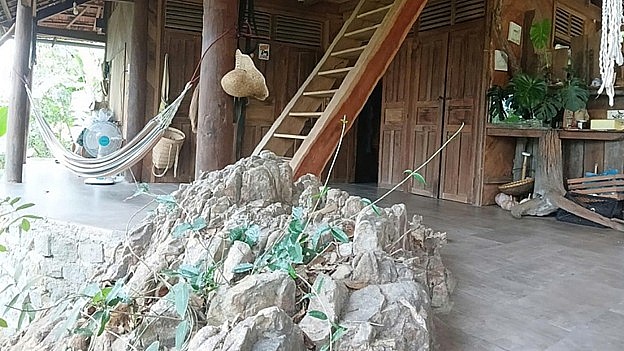
"I even built my house around a large boulder instead of breaking it."
Mr. Hai reflected: "A farmer does not become a forest nurturer in a moment. Nor is it overnight that a monoculture farm becomes a multi-layered forest. It is a process—a 20-year journey, still ongoing. A parallel growth of the forest and the nurturer.
I initially grew the forest for a living. Now people offer to buy timber, but I refuse because harvesting would damage the entire ecosystem I've nurtured. The goal of making money has faded. I find greater joy in nurturing the forest. Without it, the meaning of my life would be greatly diminished."
The Social Field
But Chi, who designed the book cover for the Vietnamese edition, said:
"I have no land, only a wild garden in my head and a small field in my heart; everything can be straw."
Indeed, in this movement, we call each other—straw.
A collective of Saigonese professionals—from engineers to marketers—contributed their "straws" to bring the book to life in Vietnam.
In 2016, the book's reader group hit 10,000 members. Groping for a way forward, we approached Mr. Duong Quang Chau, a permaculturist with 20 years of experience living with mountain communities. When asked about his fees, he responded:
"I never charge for what I learned from the mountain people; it was a gift, and I am simply passing it on."
Since then, gift-based sessions on natural farming have sprouted wherever people listen. It created a ripple effect of generosity: families opened their homes—hosts provided shelter, and guests contributed labor or produce. Surplus was shared, and skills were traded freely.
In this community, every farmer is a professor, and every farm a living curriculum.
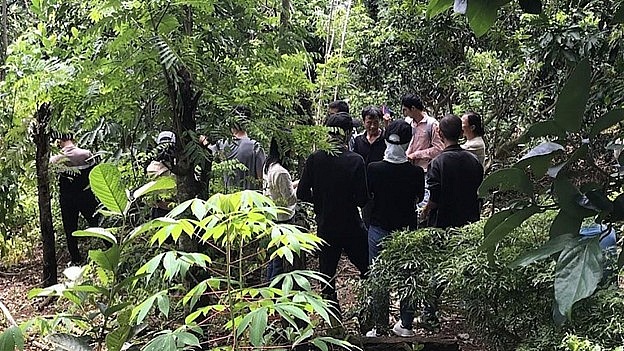
Every farmer is a professor, and every farm a living curriculum.
In addition to field meets, online forums flourish. Mr. Nguyen Trung Dzung, who provides IT support, shared: "Forest restoration is more than just planting trees. I found a blank space to fill myself in, and I feel useful."
For Ms. Le Thanh Phuong, "natural" is a lifestyle, not just a place. "It's about small daily choices—what to eat, who to buy from. I choose to connect with these 'straws' because I trust their transparency and minimalist way of living." Now a mother, she is even more motivated: "I want my child to have a 'village'—with cakes from Aunty Yen, cashew butter from Aunty Vy, and brother Rom to play with at the seasonal markets.
Not everyone needs to farm, but everyone can be a sympathetic consumer."
These seasonal markets in Saigon were initiated by Ms. Lai Hong Vy. Selling chemical-free, farm-grown, and homemade products, the market connects makers directly with buyers. "It's where customers know exactly what they buy," Vy shared, "and where vendors look forward to meeting each other."
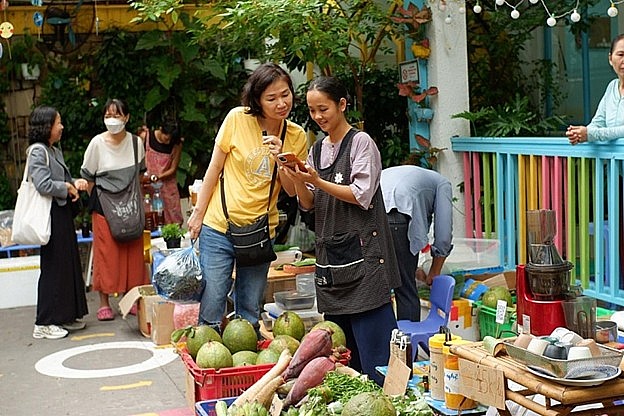
Everyone can be a sympathetic consumer.
Today, traveling across Vietnam, every 15 minutes to 3 hours of driving, one can encounter a "straw" or a "bundle of straws"—individuals and families who have moved from the city to the countryside. Around them, local communities continue to weave these links, helping them stand firm on their journey home.
Looking back over 10 years, the book was the catalyst that began the journey of returning to nature for many, but each person's intrinsic motivation determines how their path unfolds. Whether in the city, the farm, or the forest—it is all good, as:
"The ultimate goal of farming is not the growing of crops, but the cultivation and perfection of human beings."
— Masanobu Fukuoka
And anyone, anywhere can contribute a "straw" to this generative field.
COMMUNITY REFLECTIONS
SHARE YOUR REFLECTION
3 PAST RESPONSES