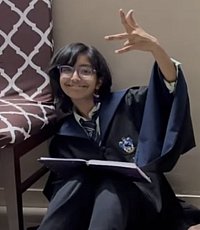
When I was ten, I made my mother a promise I had no idea how to keep.
I read fast — fast enough that a book would last me a day, maybe two, and then I'd be standing in front of her again, empty-handed and hungry for the next one. She finally said the only reasonable thing a parent can say to a child like that: I can't buy you a book a week. You'll have to re-read the ones you have.
Re-reading all the time felt boring. So I came up with what seemed, at ten, like an airtight solution. Fine, I thought. I'll just write one, and then I'll read that. How hard can it be?
It turned out to be much, much harder than I thought. But that small, stubborn bargain was the beginning of everything. Five years later, at fifteen, I have a book with my name on the cover. It's called From Lost to Found, and I still can't quite believe it's real.
❦ THE SEED WAS ALREADY THERE ❧
Before that book, I hadn't really written anything — a line or two of poetry here and there, nothing more. But stories had been all around me my whole life. My dad is a storyteller. My mom told me stories when I was little, and she's a movie buff, so we watched stories together too. Like any kid playing alone, I made up stories out loud constantly. The seed, I think, was already planted. I just hadn't noticed it sprouting.
I'm homeschooled, and for years now I've learned mostly by following whatever I find interesting down its own rabbit hole. That's how I discovered I'm fascinated by history — which, when you think about it, is just stories that happen to be true. Everything, in the end, comes back to stories.
I wrote two chapters of that first book entirely out of my head, then stopped. It wasn't until 2023 that I sat back down and decided, properly this time, that I wanted to finish. And somewhere along the way, without any single moment I can point to, a quiet thought settled in: maybe this is my thing.
❦ LAYERS AND LAYERS AND LAYERS ❧
When I started, the whole plan fit in one sentence. I was deep into a phase of reading mysteries, and my only thought was: I want it to be a kidnapping. A teacher gets taken, the kids find the teacher, the end.
But nothing I write ever stays that simple. I add layers and layers and layers. My mom would read a draft and say, this doesn't make sense — they can't just find one clue and have the whole answer. There have to be hurdles. So I started adding the hurdles. And while I was deep in that, something shifted.
I realized I didn't want my villain to be completely evil. Because no one really is. We're so quick to split the world into black and white, but if my hero was allowed to have flaws, then surely the villain had a story too — and from inside his own head, he believed what he was doing was right. I followed that thread so far that the "villain" eventually turned into one of the good guys. A whole family secret unspooled, a thirty-year-old drama I never planned for. (There was even an ancient summoning at one point. I had to cut that.)
I didn't really outline any of it in the beginning. The story just went the way it wanted to go, and I followed.
If the hero has flaws, then maybe the villain has a story too. It's really hard to fit a whole person into one box.
One of the listeners on our call said something that stayed with me — that she wished we did more of this in the world, taking the time to look at people from different angles instead of trusting our first easy judgment. I think that's true. I just stumbled into it because I was trying to write a believable bad guy.
❦ THEY'RE MY BABIES ❧
The hardest part of writing, for me, isn't the blank page. It's that I have to stop sheltering my characters.
I have to put them in difficult situations. I have to let them hurt — not just the emotional kind of pain, but real obstacles with no easy way out. In one of my earliest drafts, before I even knew the term for it, I'd written what's called a "Mary Sue": a heroine so flawless she had nothing to overcome. She was twelve and a half, and she solved the mystery faster than her own father, who is a professional detective. It didn't add up. So I had to learn how to give my characters flaws, fears, hardships — how to stop rescuing them.
It's still the thing I struggle with most. They're my babies. I don't want to hurt them. But they have to be hurt, because otherwise there's no story. Pain, it turns out, is what makes an adventure worth following — in a book, and maybe outside of one too.
❦ A VERSION OF ME ❧
I build my characters before anything else now. What started as filling in a template has grown into full pages of "lore" — what each one looks like, what they fear, what they want, the whole backstory behind them. I do this first because a story has to be character-driven. There's a test I think about: if you could swap one of your characters out for any other and the story barely changes, then that character is just being pushed around by the plot. They have to drive it themselves, through their own choices.
And here is the strange thing I've learned. To make a reader feel something alongside a character, you have to know that feeling yourself first. My characters are all, in some way, a version of me — me with one trait turned up loud. When an idea lands on the page it feels like it came out of nowhere. But the longer I sit with it, the more I recognize it. Oh, I think. That was always a part of me.
Writing has made me far more aware of myself than I used to be. All the tiny things — a flicker of body language, what's left unsaid beneath the words — I've had to learn how emotion actually works in order to put it down honestly. It's also why I won't let a machine do it for me. People ask about writing books with AI, and I get genuinely bothered about it. When you ask it for a story, it gives you events — but they feel hollow, all plot and no person underneath. I'll use it to bounce ideas around, to ask me questions that get my own gears turning. But I draw a hard line at putting its sentences into my book. The whole point is that someone, somewhere, has to have actually felt it.
❦ WORTH SO MUCH MORE ❧
When the physical book finally arrived in my hands, I waited to feel transformed. I didn't, exactly. In my head I'd considered myself a writer for a long time already, so the leap to "published author" hasn't quite settled in. A little imposter syndrome, maybe. The name on the cover is mine; it just hasn't caught up to me yet.
What I didn't expect was how I'd choose to share it. My first plan was ordinary: give away a few copies, sell the rest online. But it started to feel transactional. If someone in our community were to ask, did your book come out? and I'd say, yes, it's on Amazon, want to buy it? — something about that sat wrong with me. My mom suggested another way, and the more I thought about it, the more it felt right. I discovered, too, that I love signing books by hand, which is something you simply can't do through a screen.
So I give my book away. In return, I don't ask for money. I ask for an act of kindness:
I won't ask you to pay for my book, but I'd love to hear an act of kindness you'll do instead, because that will be worth so much more. I'm not writing to get rich. I'm writing so I can share my stories with the world — and if we can make it a better place in the process, then why not?
It fits the book, really. The heart of From Lost to Found is a question: how do we move on when we've lost something, or someone, important? Moving on is never easy. But maybe we can make it a little easier — maybe we can lessen each other's loneliness through small kindnesses for people we don't even know, and may never meet again. Supporting a local library. Lightening someone's load. Offering a listening ear. My main goal was never fame, and it definitely wasn't money. It was for stories to reach as many people who are looking for them. There are authors I love so much that they've shaped me — and for the smallest chance that I might become that for one other person, I want to send my story as far as it can go.
❦ THE WORDS POURING OUT ❧
My mom says I don't read books — I drink them. She's right. I race through the first time, desperate to know what happens next, and only afterward go back to linger over my favorite scenes.
The reason I keep writing, through all the writer's block and the procrastination and the days when I manage only a word or two, is a feeling I can barely put into words. When I really get into the zone, into the scene, and the words start pouring out — when I can read back what I made, messy and imperfect as it is, and see that it exists because of me — that feeling is addictive. It's what draws me back every time.
I'm not sure I have advice for anyone whose own creative spark has dimmed; I'm only fifteen, and mostly I just have thoughts. But here's one. You can't do any single thing in isolation forever, even something you love. Sometimes the spark comes back not by pushing harder, but by stepping away — trying something new, or reconnecting with something you used to love, and letting it freshen everything up. There's no one answer, because everyone is different. Just find the thing that brings you joy. Even the smallest thing.
For me, it was a ten-year-old's impatient promise and a stack of books I'd already finished. I had no idea what I was beginning. I'm so glad I began it anyway.
— as told by Reva Agrawal on a Story Booth
COMMUNITY REFLECTIONS
SHARE YOUR REFLECTION
10 PAST RESPONSES
How does one get your book? You already sound so wise and I hope you continue to write, poetry, plays, novels, movies! The sky is the limit when you already have such facts down. This is why I love Independent Films, a different story with diverse characters not trying too hard. Thank You and Keep Writing Please!
The gift your mom gave you, by not quickly buying another book, is priceless. Happy writing!