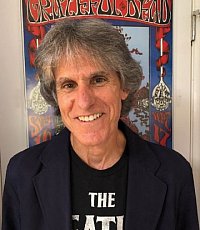
I grew up in a large, boisterous Italian family on my mother's side — uncles and cousins and aunts who were loud and brash and full of love, who told you exactly what they thought and laughed at the top of their lungs. There was always music, always games, always a story being told. None of my relatives were trained storytellers, performers, or public speakers. But they knew how to enjoy life, and when they talked, it was real. Their conversations were genuine, had guts and power.
As a young kid, I just sat and listened. I took it all in, absorbing the rhythms and cadences of their language without realizing that's what I was doing. I think it was the best thing that could have happened to me. Before I ever told a story, I internalized the elements that made a good story.
An important event that shaped my life was when my father died when I was four months old. I had no memory of my brief time with him, and yet I felt his spirit was alive and present — he became almost a spiritual being to me. I learned about who he was as a person through stories my brothers and my mother told about him. But the only contact I had was with his spirit. When I was maybe three, my mom had me kneel and taught me how to pray — not only traditional prayers, she taught me how to make up my own prayers in which I could speak directly to God and directly to my father. That was my initiation into the spiritual world. Through prayer I learned to communicate with invisible presences. I've been listening for the unseen ever since.
A lifeline, thrown
In college I searched for a spiritual path of my own. I conducted an informal survey of the world's religions to see what might connect. That connection occurred at Gold Mountain Buddhist Monastery in San Francisco when I met the Venerable Master Hsuan Hua. I didn't actually meet him, it was more of an encounter. The moment he entered the room he looked directly at me and into my soul. He seemed to know who I was — where I was going, or maybe where I shouldn't be going. I was only twenty years old, and had only a vague idea of what I was doing with my life. But Master Hua threw me a lifeline. He reoriented my internal compass, so that it pointed toward the path of compassion, wisdom and service. A decade or so after I met Master Hua, I made a firm commitment to that path, and I'm still walking it today.
Twenty years after that first encounter with the Venerable Master, I had the opportunity of a lifetime to work with Reverend Heng Sure at the newly opened Berkeley Buddhist Monastery. When Reverend Heng Sure discovered that I'd been a storyteller on the festival circuit for several years he invited me to begin telling stories after his lectures, and soon after to teach a storytelling class. He encouraged me to dig into the trove of traditional Buddhist stories and empowered me to adapt those stories for modern audiences, integrating my sense of humor, contemporary perspective, and Buddhist practice into the tellings.
When Master Hua carried Buddhism from China to the West, he was well aware that the moment the seeds are planted in new soil, a new kind of fruit ripens. The principles remain the same, but the specific practices change. The Master believed in expedient means--whichever teaching method works most effectively for each individual student. He encouraged Reverend Heng Sure, who'd been steeped in the Western folk music tradition of Peter, Paul and Mary and Bob Dylan to use his music as an expedient means of teaching Dharma through music. Reverend Sure wanted me to do the same thing with stories. He gave me a basic framework, provided oppportunities, then got out of the way and let me get to work. Thirty years later I'm still telling stories for our Dharma Realm Buddhist Association, and for the last several years for ServiceSpace. I search for stories that are universal. Stories that focus on principle and virtue. But I update the stories so that they're a reflection of our everyday lives. Most importantly, I keep the stories light, and infuse a generous dose of humor. A story is best when it isn't heavy-handed or preachy.
One student at a time
I taught for thirty-five years — theater, public speaking, and debate. Twenty-one of those years were in a middle school. I'll confess I didn't hit my stride right away; you don't walk straight out of a teacher-training program and become a great teacher in your first year. I was pretty mediocre at the start.
Then, maybe my third year, I had a student named Thuy. Thuy sat in the front row and beamed her hundred-watt smile at me every single day. She trusted me completely and invested so much faith in me, I thought, I can't give second best. I have to bring my best self to the classroom every day. Because teaching isn't just a job; it's an opportunity to make a difference.
I learned you can't really think of a class as a class. It's a group, but it's made up of individuals. You make connections one student at a time, by paying attention — making eye contact and, in effect, saying: I see you. I know who you are. I'm here for you. Once students understand that, your discipline problems all but disappear. The middle-school years can be turbulent — you never know which version of a kid will show up on any given day — and the work, for me, became a practice of equanimity. I was never a strict disciplinarian, but I drew clear lines in the sand when it came to how we treated each other. I stressed kindness, cooperation, and tried to build a sense of community in the classroom. It was the same in the debate class: It was perfectly acceptable to debate passionately, to disagree with a person's argument, but it was never acceptable to make personal atacks. With our after-school theater program — we worked together like a team, each person contributed to the whole. It was never about one person, one star, one lead role. Our goal was to work together for a greater purpose.
A huge aspect of teaching is seeing potential. I once told a parent her daughter, Nishka, was going to be a fantastic public speaker. The mother said, Nishka? She hardly says a word. But the girl had studied classical Indian dance, and she carried this incredible poise — I just knew the potential was there. She went on to speak at our eighth-grade graduation, then her high school graduation. The goal is to see potential, draw it out, support it, and provide opportunities for it to grow.
Getting out of the way
Here's something people don't expect: I'm a reluctant performer. I don't crave the spotlight. But I've invested years to studying performance skills, so I might as well put them to good use. When I first started performing, there was ego in it, of course. But the practice, over time, became this: take the performance skills I've learned and use them to serve a better purpose than the ego.
A while back, when someone introduced me before telling a story, he said, Brian knows how to get out of the way of the story. That's the ideal. I want to be a conduit — to the story, to its principle — and then to step aside and let the story take center stage.
I'm not the story. I'm telling the story — but where does it exist? It exists in the mind's eye of the listener. A storyteller allows those mental pictures to unfold in the minds of the listeners. If you can do that, you've done your work.
The world, without earbuds
I've been running for decades, and I never run with music. I want to tune in to nature instead. When I run, I'm surrounded by beauty: animals, birds, the wind, the weather. Running has become another spiritual practice, a chance to listen to the world around me and, at the same time, tune in to my own inner nature. Stories materialize on those runs, sometimes fully formed. Since I never carry a pen when I run, I'll repeat a line like a mantra until I can get home and write it down.
And then there's my wife, Wren, who is far more tuned in to nature than I am. She'll say, Do you hear that woodpecker? — and sure enough, once I listen, there it is. One day, at the end of a run, I passed a dead squirrel in the road not far from our house. Whenever I see a dead animal I say a small prayer and chant to the goddess of compassion, hoping someone will spare it the indignity of lying there. While I was out running Wren was walking in the neighborhood. When she arrived home a few minutes after me, she told me she'd just stopped to pick up a dead squirrel around the corner. My prayer had been answered...by her. She's taught me, more than anyone, to tune in.
Whatever we have to give
For me, teaching, storytelling, writing, the morning runs all became one practice. I was raised Catholic, and it built a solid foundation; later I found my way to Buddhism. But that loud, joyful family of mine — not one of them college-educated, every one in love with life — taught me just as much as any spiritual teaching. Does any of this change the world? I don't know. I had coffee last week with a former debate student who's headed to medical school in the fall. He wanted to thank me for helping to build the foundation of his life. We dont have to change the life of every student, but if we impact a few, that's good enough. We do what we can, in our small circle, and hope that work ripples out.
Each of us has some specific skill we can offer. We give what we can, every time we can. It could be resources, it could be attention, it could be love. And if everybody's doing that, then we are changing the world.
There's a story about two men who live on neighboring farms. They've been lifelong best friends, but because of a recent conflict they no longer speak with each other. One day, a carpenter comes by looking for work, and the angrier of the two says: build me a tall fence along the property line, so I never have to see that awful man again. The carpenter works all day. When the farmer comes out at the end of the day to check on the work, he sees that the caprenter hasn't built a fence at all. He's built a bridge — and the neighbor is already crossing it, hand outstretched, apologizing for how wrong he'd been.
As the carpenter packs up and says goodbye, the men say, "Wait, we have so much more work for you."
The carpenter answers: "I'd love to stay, but there are many more bridges to build all across the land."
Maybe right now, at a time when we need to build bridges more than ever, it's a good time to tell that story. A story like that brings us together — so that for a few minutes we all live inside the same story, in the kind of world we wish to see. After the story is told we carry a little bit of it with us into our lives. In the grand scheme of things, storytelling isn't much. But it's one small way I can help build bridges. Whatever you have, in your own small way, that's enough. Just give it, every time you can.
— as told by Brian Conroy on a Story Booth.
 Brian Conroy
COMMUNITY REFLECTIONS
SHARE YOUR REFLECTION
7 PAST RESPONSES