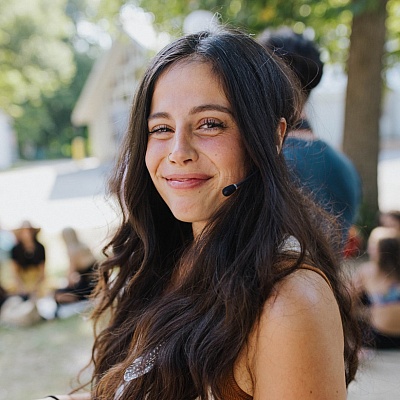
There is a running monologue in my head, and there always has been. Tina Fey once described having something in you that needs to be written as being like the flu: you are sick with it until you finally get it out. That is most of my life. I take everything in, turn it over, and it comes back out as words. I am a storyteller by nature — I think I was one long before I had any idea what to do with it.
But there was a long stretch of years when I forgot.
I remembered it all at once while delivering my grandmother's eulogy. She was my mother's mother. When she died I went home to Rochester relieved, of all things, that for a few days I had a break from the writing load at my job. Then the question came up of who would give the eulogy, and no one felt they could. So I said, okay. I guess I'll do it.
And the writing of it, and the delivery of it, became — I know how this sounds — like the best stand-up routine of my life. I hit every beat. And somewhere in the middle of it, I felt her arrive: the performer kid. The one who snuck into play rehearsal four years too young, and was so persistent they finally let her stay. That kid walked back into the room. And she brought a quiet, terrible realization with her: the person I know I am got lost somewhere along the way.
That day, I wrote a letter to my future child — whoever she might be — promising I was going to find her.
The Girl Who Went Quiet
To understand how she got lost, you'd have to go back to a freshman year spent as a four-season athlete and singing in four different choirs. Yet by sophomore year, I nearly didn't pass due to low attendance. I was being bullied online by kids at my school. I developed back pain no doctor could explain. Bad enough that I stopped running, stopped sports altogether; my body was carrying what I couldn't say. There was an abusive relationship in there, too.
Everything I thought I was fell apart. For a good fifteen years, I was coping with all of it, healing from it — and still, quietly, making every decision I made because of it.
What that leaves behind is hard to describe, but a lot of women know it instantly. There is a chronic lump in your throat. It is built out of all the small moments — the times you decided you weren't pretty enough, weren't capable enough, weren't simply enough as you were. The times you quietly traded whatever lit you up for whatever felt safer, or more loved, or less likely to be used against you. Those little moments add up, over years, into a single belief: that the truest, most alive version of you isn't the one worth keeping.
The Portal
I had every intention of a beautiful, mindful pregnancy — the kind where you grow quietly closer to yourself, where the whole thing feels like an invitation. Instead, pregnancy leveled me to the ground. I was a burrito on the couch, so sick I couldn't keep anything down, in and out of the hospital, moved through appointment after appointment like cattle — as if some part of me were rejecting the whole thing. Perhaps a deep resistance to becoming a mother.
No one had told me this could be a sacred rupture, something asking me to face my own soul, and no one prepared me for how much it would wreck me instead of gently open me. I had no one to talk to about any of it. Society doesn't leave room for a pregnant woman to say "this is breaking me open," let alone hand her the language for it. We're not taught that birth itself is sacred or how to celebrate a mother's unbecoming.
I didn't have the resources, the words, or a single person to say any of it out loud to. No one warns you about prenatal depression; we only ever talk about the after. A month before my daughter was born, I wrote a single line in my journal:
I feel so lonely.
It did not stop when she arrived. Two days after we came home from the hospital, I fell asleep on the couch, and for a moment I was convinced I had died. I could see my body, but I was completely paralyzed. I couldn't breathe. I just slipped into the void. Everything and nothing. And after that surrender, a surge of light burst into my body, and I sat up on the couch gasping for air.
After that, my health declined. Every infectious thing and freak-condition under the sun surfaced at once. Mastitis. Epstein-Barr. MRSA. Corneal Ulcers. Rashes. Eczema. Oh my.
I have spent the seven years since healing what motherhood cracked open in me. I had to grieve a birth that felt disempowering, and then learn to love the woman I was in that moment anyway — which is, it turns out, what life keeps asking of all of us: to love ourselves a little deeper, and be at peace with who we were, doing our best.
Sending My Voice Into the Dark
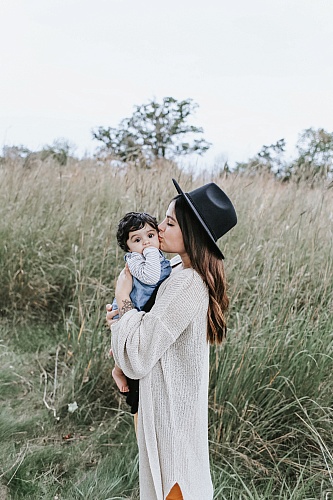 By the time I came home from the hospital, something in me had already decided what came next. Turning a microphone back on was its own kind of courage — reclaiming the performer part of me that had gone quiet for so long, the part that had once snuck into choir four years too young. But stories, culture, spirituality, consciousness, every existential question anyone was willing to sit with me and ask — that's what had always fed my soul, long before I had language for any of it. I'd already spent twenty years in media production by then; I could build a podcast episode in my sleep.
Like a soul anthropologist, I started examining the intersection of motherhood and remembering, interviewing women all over the world, collecting their stories, and sharing what I found for anyone who needed to hear it. It came together fast. I was in the right place at the right time, having the right conversations with the right women, like the whole thing had been waiting for me to show up. My first interview went up four weeks postpartum, out of a hope that somewhere out there were other women who felt motherhood ripped them wide open, too.
There were. Hundreds of them wrote back from all over the planet, telling me how motherhood had been a spiritual initiation. My podcast became my audio diary and my community, more than a hundred episodes — and underneath all of it, the plain relief of learning I was not alone.
Every conversation turned into its own small master class. Herbalism, astrology, human design, mindfulness, Buddhism, the divine feminine — the women I interviewed handed me their specialties like gifts.
I chased every thread while sitting in my own meditation practice, developing my own intuitive gifts. It fueled my own growth as much as anyone's; I don't think I could have found my way back to myself any other way.
But somewhere in the middle of all that talking, every single day, I started to outgrow the very life the podcast was helping me build. I was unhappy in ways I couldn't quite name yet, and terrified I'd just settle — that I'd keep talking about transformation without ever actually letting my own life change shape. Then my health came crashing down, and it all burned to the ground.
And that's when life threw me the best plot twist it had.
I decided to jump fully in — into living instead of narrating, into experience instead of commentary — and for a while I almost gave up my voice completely, stopped speaking, stopped writing, just to be inside my own story instead of describing it from the outside.
The Blahhhss
I'd met Scott somewhere in the middle of all of it — introduced by a mutual friend, though we spent the first year and a half as nothing but voices on the phone, separated by a border neither of us could cross.
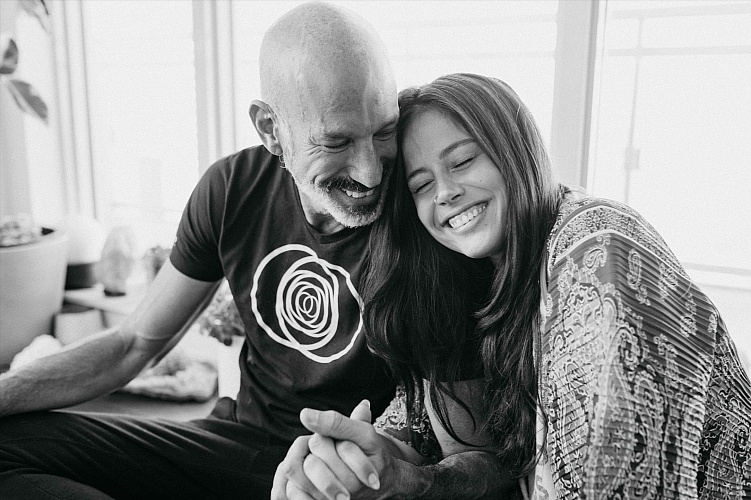
There was an instant kinship with no expectations that allowed us to show up as our true selves. The friend on the other end of the phone became the wholemate I never imagined I'd get to have.
As my life was quietly burning down, underneath was the deepest knowing that the only way to reach the life I had glimpsed was to jump, headfirst, into the unknown. So I jumped. I left my first marriage and walked away from my old life with nothing but my clothes, my plants, and my books — and I declared the terms of the new world I was moving into:
Love moves mountains. Magic is real. Presence is everything. And epic plot twists are most welcome.
What Scott gave me was the greatest gift of my life: the space to become fully myself and nothing else. His love let me live those quiet years exactly as they needed to be lived — devoted to being a mother, to presence, to helping him build what would become WishWell, healing slowly from years of postpartum and every illness my body had been quietly carrying. It became its own kind of portal. We started traveling together, talking to people all over the world about presence and connection, handing people the same gift we'd found in each other. People comment on it constantly — the way we show up together, the way our love is just visibly, obviously there. That's a gift too, being witnessed like that. Love moves mountains. I actually believe that now, because it moved ours.
With the extraordinary support of our co-parents, we built an entire relationship across a border, on purpose, slowly — because you don't rush the foundation of something you actually want to last. So every Sunday, I would travel over 8 hours to make it work. One week with our kids. One week just the two of us. Every week for over a year and a half.
On my travel days, I usually sat in silence. My whole life looks completely different now, I'd think. After the pandemic, financial distress, and my health, I felt like I had been caged for years.
Brick by brick, we let the children meet each other slowly, on their own time, nothing forced. It was only once everyone felt ready, once the buds of our new family felt sturdy, that I moved to Canada for good.
We are a blended family of five — Scott's teenage twin girls, and Luna, seven, who carries a little of each of them — and we gave ourselves a name: the Blahhhss (the extra h's and s are silent, an inside joke that's just stuck). What binds us isn't only art, though there's plenty of that — the enormous chalkboard where we paint family murals, the smooth rocks we gather from the lake, paint, and give away to strangers. It's humor. It's food. It's the sheer amount of life we've chosen to actually experience together instead of separately.
On Luna's way home from the hospital, a nurse in the elevator said she had never seen a newborn so aware. That awareness never left. Since she was two, whole stories have come flowing through her — she paces the room telling it aloud, singing the songs, making every sound effect. Now she draws them like comics by hand. It has become one of her greatest tools for healing, after her own family structure changed around her.
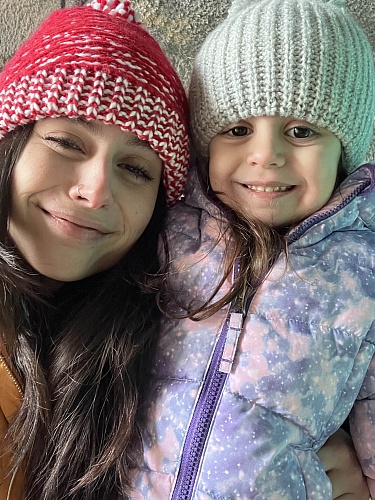 Homeschooling was never really a decision so much as a way of being a mother inside a completely new paradigm — not a rejection of anything, just the shape our life had already taken, and the chance to actually steward her gifts instead of scheduling around them. On the week other five-year-olds were starting kindergarten, she was sitting in New Mexico around a fire with indigenous elders, learning the names of canyons carved deep into the Earth.
Letting her keep her voice, whole and uncorrected, letting her stories matter simply because she made them — that's its own kind of medicine. Every time I hand her a tool I didn't have at her age, I'm parenting the child in me too: the girl who had the pictures in her head but never the technology, or the permission, to make them real.
Somewhere in those years I got quietly disheartened that my stories were meaningless, and I think that's part of why I stopped trying. Doing this with her now — watching her make something out of nothing and calling it good — has resparked my own creativity in ways I didn't expect. It's made room for everything I loved as a kid: doodling woodland creatures, belting showtunes, dance parties in the kitchen, and tender moments between characters that tug on your heart strings.
Presence Over Performance
The next chapter, Scott and I are building together. When I asked him how he was going to tell the story of what we'd created, I realized I'd already witnessed most of it myself — on our travels together, watching it take shape one wish, one room, one stranger at a time.
It began in a moment of profound connection Scott felt in a room full of strangers, and grew into a simple ritual: offering someone your presence as a gift. The idea is presence itself, not crowdfunding but crowdfocus, sixty seconds of focused attention, can shift things.
The first time I met Nipun, he described himself as a lifelong advocate for the lemonade stand — an empty vessel for love, more interested in a thousand small moments of connection than any single grand impact. We imagine we need the big gesture. What actually changes things is the micro — showing up as love, over and over, in whatever small moment is right in front of you, and choosing it on purpose.
I've seen it firsthand: it's those micro moments, not the grand ones, that add up to a magical, meaningful life. On my birthday a few days ago, I was walking down the street and passed a woman holding a sign, asking for help getting a bus ticket home — twelve hours north. I stopped and gave her the only five dollars I had. 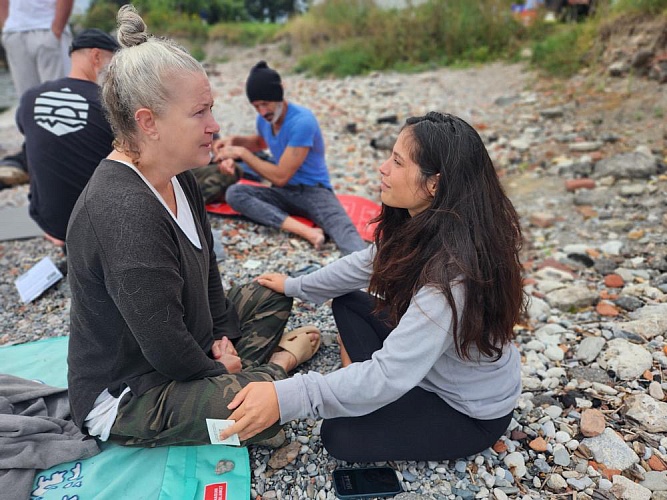 She told me that every other person whopassed acted like she's invisible. It was just being seen, just having someone acknowledge she existed, that was everything.
I think it really is that simple. Presence is everything. It might be the most sacred thing we have to give each other — our attention, freely offered, with nothing wanted in return. My life, more and more, feels like a living reflection of that.
The Writer of My Own Story
On our first date, Scott said something that has quietly rearranged my life ever since: you are the writer of this story. Not a character waiting to find out what happens to her. Not someone whose plot was decided long before she showed up. The writer.
That's the whole practice, really: living the story first, then having the nerve to sit with it, reflect on it, tell it out loud, and keep rewriting it until it finally sounds like you. The bullying, the back pain no doctor could explain, the near-death experience that split my life into before and after, the re-birth, the podcast, the quiet years, the health crash, the border, the jump — none of it was ever proof that my story was happening to me. It was material. Mine to shape, to spiral through, to keep rewriting until it finally sounded like me again.
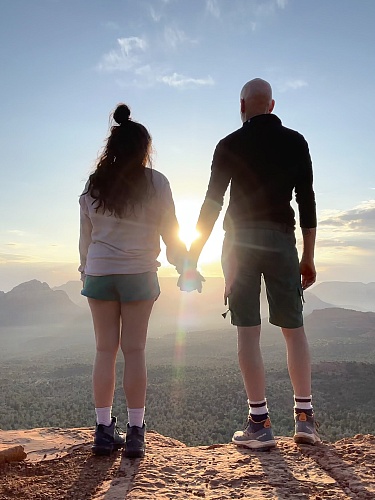 Courage, it turns out, isn't one dramatic leap. It's the daily, unglamorous decision to keep authoring your own life instead of accepting the draft everyone else already wrote for you. It's choosing joy and presence when despair would be so much easier to justify. We've been sold this grandiose, voyeuristic idea of what a meaningful life looks like — the highlight reels, the reveal, the likes. What actually changes a life is smaller and harder than that: showing up, fully, for the people already in front of you, over and over, until presence itself becomes a devotion.
That's the world I want to leave behind — for Luna, for Scott's girls, for whoever's story brushes up against ours. Not a blueprint to copy. We didn't come here to be the same as each other. We came here to become so unmistakably ourselves that the people who watch us can feel exactly how deeply we've met our own hearts. That's the inheritance.
On the day I gave my grandmother's eulogy, something in that room stayed with me long after I sat back down — and later, I wrote a promise to a child I hadn't met yet: I would find Her.
And it hasn't happened in one dramatic moment. She's found in the still moment — hands in the dirt, listening to the trees. She's found in the present moment — mid-song in the kitchen, mid-story with Luna, mid-silence with Scott over coffee before the day claims either of us. She's found every time I remember that I'm the one writing this story, and that I always get to choose what happens next.
— as told by Lena Wilde Ryan on a Story Booth. View 12 video clips from the live conversation.
COMMUNITY REFLECTIONS
SHARE YOUR REFLECTION
1 PAST RESPONSES
I lost my sister in law abruptly this month- but I read much of her own story w/i the pages of today. I am grateful.