
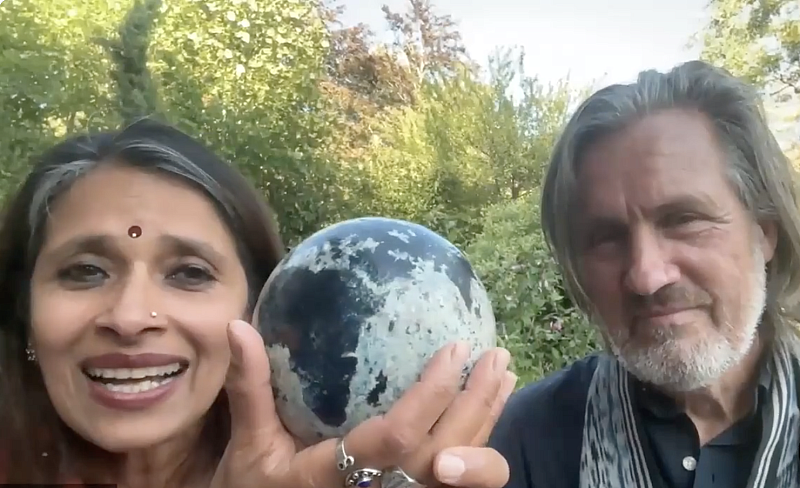
 We travel with a small earth sphere. It is a fragile piece of art, made by the French artist Michel Granger, and if you look carefully you will see it is an earth without borders — a precious little jewel seen from far out in space. By now, some sixteen thousand people have held it. We thought it was simply a travel companion. It has become the superstar of our journey. Whether we are with children in the favelas of Brazil, Indigenous elders in the Andes, or young refugees in Uganda, something happens when people hold this earth. Their faces soften. You can almost hear the recognition: That's me. That's home. That's us. It may be the truest thing we have learned in two years of traveling the world: beneath all our differences lives a longing to belong — not just to a place or a nation, but to life itself.
The Question Under the Tree
Our story begins under a tree. Twenty years ago, we met beneath an old ash tree on a little mountain in the French Jura — we call it our love tree. Neither of us was from France; Rama began life in India with a passion for justice, Alexander came from Germany by way of entrepreneurship, philosophy and poetry. Our lives had been full of wandering, always with purpose. But for the first time, on land that was neither of our countries, we began to belong to the land.
As more and more people came to us — students, doctoral candidates, neighbors, visitors from all corners of the world — everyone felt at home. And we realized that every place on earth carries this power, if we would only tap into it. Any place where people come together with intention and concern for one another — where you can be yourself, be safe, be seen, and because you are seen and safe, become all that you were meant to be — is a home for humanity. That is how the name dropped into us. Little by little, partners around the world began to say: but we are homes for humanity, too. The movements that most transformed the world around them, we noticed, so often began around a kitchen table.
By the time thirty such homes had emerged around the world, we sensed something new stirring. The drama on the planet was growing exponentially — and yet so were the people building new impulses, coming together in new ways. Out of that tension, we literally went on our knees and asked: How do we serve? What is the next level? The answer came under another tree, after many days of deep connection with the earth, in silence — and it came to both of us with such clarity that we knew it was ours to take on: a seven-year journey to every country on earth, traveling home to home, restoring our relationship with the mother who carries us. We call it the One Home Journey — a journey of humanity's homecoming to who we truly are.
A Family in Every Language
People tend to think cultures close in on themselves. Our experience is the opposite: in every culture, there is a background knowing that we are all interconnected. In India, we say Vasudhaiva Kutumbakam — the earth is one family. The Native Americans say Mitakuye Oyasin — we are all related. Southern Africa gave the world Ubuntu. In the Philippines, it is Kapwa. In West Africa, where we head next, we will encounter Bu. For thousands of years, these concepts were deeply practiced: care for your immediate community and ecosystem, yes, but know that you are part of the great whole.
What has surprised us most is finding this wisdom alive where one would least expect it. We went very purposefully into refugee camps, slums, and war zones, to witness what people build there against all odds. In the most crowded neighborhood of central Beirut, receiving a hundred displaced families a day, we found an organization called Ahla Fawda — "the beautiful chaos" — making the displaced feel: we belong, we are one, we are here for each other. Everywhere, we saw that people are not waiting to be helped. That is an old paradigm. Everywhere, people are already building.
And everywhere — this is the part we never anticipated — the world kept making us family.
The Girl and the Tree
In Chile, we spent time with the Pewenche — a Mapuche people whose name means "people of the pewen," the araucaria tree that lives only in their region. Their food comes from the tree, their shelter comes from the tree, their spirituality flows through the tree. Their entire life is woven around it. These are people who fought, with their lives, for a tree that was almost extinct — and they succeeded. Today the araucaria is a national treasure of Chile.
We stayed with Alex Meliñir, a community leader and his family, and his eldest daughter — just eleven years old, but eighty in wisdom — creates little artworks from the bark of the pewen. 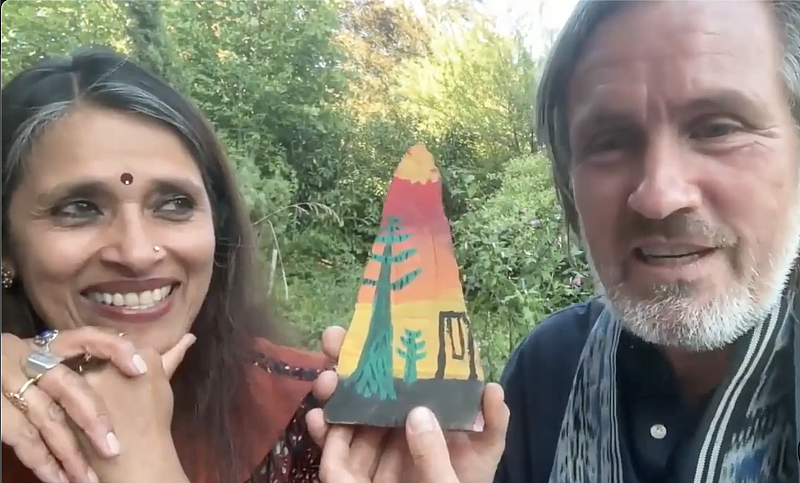 She held a small exhibition, and we were her first visitors. Watching her, we saw nature and culture come together in the energy of a reimagining child carrying the tradition of her ancestors. It deepened something that happens to us daily on this journey: falling in love with life. We are not blind to what is happening in the world; if you read too much of the news of the day, you can jump straight into the abyss. And yet something profoundly alive is emerging, with new force. That little big girl, in her spirit, walks with us still.
A Full Moon in Uganda
A month and a half into our journey, under a full November moon, we crossed overnight from Tanzania into Uganda. Young people we had only ever met online — refugees, permitted to leave their settlement to come and receive us at the border — had organized everything. Among them was Roger: twenty-four, with a natural ease and leadership you might expect from a graduate of Stanford. Many of the young people we work with call themselves our kids, and we are happily adopted. On our last night together, Rama said to him: mother and son, I think we have some talking to do.
And Roger shared — he doesn't mind us sharing it forward — everything that happened to him. He had just graduated from high school, the first child in his village to do so, dreaming of university, when his family was kidnapped in the violence of the Congo. Before his eyes, his mother and sister were brutalized and killed. Separated from his father and brother, not knowing if they were alive, he landed in a refugee camp at seventeen. After a long period of trauma in which he could not speak, he connected with another boy who, Muhindo, had been orphaned at thirteen when his village burned. Together with other young people, they began saving about a dollar a week from odd jobs. First they created a little home. Then a school, built entirely by hand, for two hundred children — where the young refugees themselves are the coaches, mentors, and teachers.
"I've lost everyone, but I have 200 children, and I'm their dad."
That night we held a healing ceremony for his mother and sister, and a prayer for his father and brother. Roger never went to college, never sat in the workshops and circles so many of us have had the privilege of attending. And yet his depth, his consciousness, his oneness humbled everything we thought we knew about where wisdom comes from.
Godparents in the Andes
In a different register entirely: high in the Bolivian Andes lives one of the oldest Indigenous villages on the continent. It takes a long, long time to get there, and it has been devastated by climate change. Most of the parents are away in Chile, trying to scrape together a living, so the village is mostly children. The headmistress of the school told us, "There is nothing here" — and yet these children win all the prizes and trophies, not just in sports but in poetry, in theater, in everything. Their homes are built in the shapes of their traditional caps, and their governance is done entirely in equality — two men and two women from each of the four communities that make up the village — an ancient system of balance and shared care for the land, held in the middle of poverty and drought, with extraordinary dignity.
And then the parents and grandfather of a ten-year-old girl asked us — an Indian and a German — whether we would officially become her godparents. A sacred ceremony was performed, and her hair was cut for the first time, by us, to mark that she now has godparents who will be there for her. For this deeply traditional community, so devoted to preserving its culture, to weave two travelers from the other side of the world into its family — that is what this journey keeps revealing. We set out to visit homes. Everywhere, we are being given one.
The Stories That Burst Through
Rama carries a story of her own about late blooming: for the first forty-five years of my life, I was convinced I was the least creative, least talented human being on earth — and definitely the least talented Indian woman, since Indian women are supposed to be multi-talented dancers and singers and cooks and God knows what else. But working across so many countries in conflict, she kept encountering people who, in the midst of utter loss, broke through — whose hearts broke open, and who in transforming themselves transformed their communities. After a peace mission to Palestine in 2013, all the stories I [Rama] had gathered over a lifetime burst through me. At forty-five, I began enacting them — and that became the Theatre of Transformation: a way of showing that a hundred-year-old Holocaust survivor who found refuge in Ecuador and a little girl in Senegal who survived violence no child should know are interconnected, and that every one of us carries the capacity for transformation.
Now this is how we share where we are on the journey: Alexander offers the poems that come to him each morning in communion with earth and heaven, and I [Rama] enact one story from every continent — so that a community in one corner of the world can feel: I have a sister, an aunt, a brother, a grandfather at the other end of the earth. Stories and poetry, somehow, transcend language. And at the end of a gathering, we plant a Unity Garden — a practice that began on our own land, where visitors plant a tree for their culture, and plant into it the gift their culture brings to the planet. A garden can be tiny — a school plot, a balcony — but as you water it, you are nurturing all of life, and all the others with whom we share this earth.
Welcome Home
People sometimes ask us practical questions: What gets left behind? Who takes care of the Unity Gardens afterward? How will you measure it? We understand the questions, and we gently refuse to comply with them. What we are witnessing cannot be cut and pasted or scaled, because it must grow from each person's calling, each culture's gifts, each place's soil. Home means homegrown. What can spread is not a model but a quality — the quality of a place where human beings feel at home, in unity and connection with all of life.
This is why we speak of ourselves not primarily as citizens of nations, but as earth citizens — and there are as many ways of being an earth citizen as there are people alive. Imagine the book we could write together, if instead of an ID card that says only where you were born and where you may or may not go, every person of every culture could write a page of the future in their own hand.
On the morning of the day we shared these stories, a poem arrived, as one does each day (for Alexander). It is called "Lifeline":
For centuries, I have been hanging on the line to get through to life.
When life finally picked up, I was flabbergasted.
I knew her voice since time immemorial.
In fact, we have been lovers in the golden days of long gone millennia.
Once we were one.
But then, I forgot her.
And her voice fell silent within me.With everything dying around me, and within me,
I found myself clinging to an old willow tree, crying for help.
When a willow leaf sailed into my palm,
bearing a number and a single word:
LifelineSince then, I'm trying to dial in.
To establish connection.
To get through.When my call at last was answered,
there was silence on the other side.
And then, just one line
by life's eternally familiar voice:I always loved you.
Welcome home,
from now on - forever.
— as told by Rama Mani and Alexander Schieffer on a Story Booth. View 12 video clips from the live conversation.
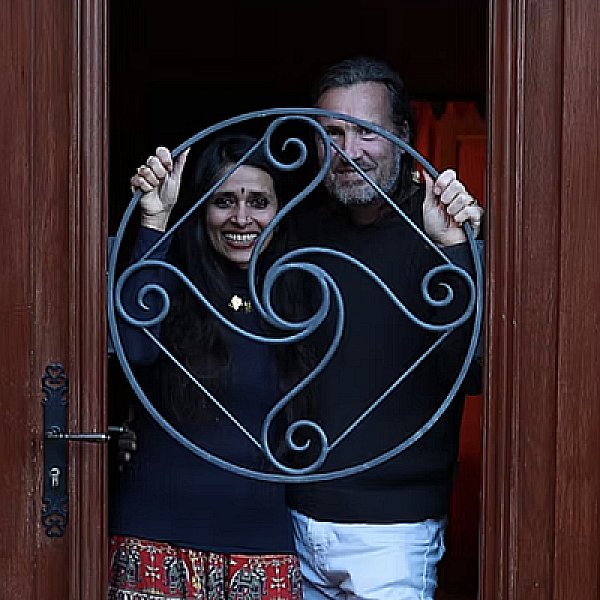 Mani and Alexander Schieffer are co-founders of the Home for Humanity movement and are traveling the
COMMUNITY REFLECTIONS
SHARE YOUR REFLECTION
2 PAST RESPONSES
Recently I had a strange image of our great sphere on whose surface, every single sentient being lives. Each insect, bird, mammal, tree and human in one moment, in one space on the earth. The image was of us held by gravity and with a straight line underneath each one of us all. That line would arrive at a space in the middle of the earth where we were all joined.