
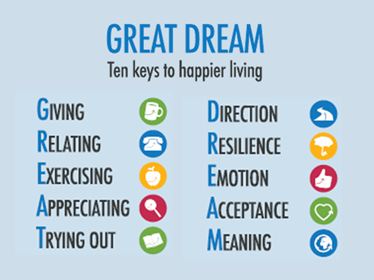
Action for Happiness has developed the 10 Keys to Happier Living based on a review of the latest scientific research relating to happiness.
Everyone’s path to happiness is different, but the research suggests these Ten Keys consistently tend to have a positive impact on people’s overall happiness and well-being. The first five (GREAT) relate to how we interact with the outside world in our daily activities*. The second five (DREAM) come more from inside us and depend on our attitude to life.
1. GIVING: Do things for others
Caring about others is fundamental to our happiness. Helping other people is not only good for them and a great thing to do, it also makes us happier and healthier too. Giving also creates stronger connections between people and helps to build a happier society for everyone. And it's not all about money - we can also give our time, ideas and energy. So if you want to feel good, do good!
Q: What do you do to help others?
2. RELATING: Connect with people
Relationships are the most important overall contributor to happiness. People with strong and broad social relationships are happier, healthier and live longer. Close relationships with family and friends provide love, meaning, support and increase our feelings of self worth. Broader networks bring a sense of belonging. So taking action to strengthen our relationships and create new connections is essential for happiness.
Q: Who matters most to you?
3. EXERCISING: Take care of your body
Our body and our mind are connected. Being active makes us happier as well as being good for our physical health. It instantly improves our mood and can even lift us out of a depression. We don't all need to run marathons - there are simple things we can all do to be more active each day. We can also boost our well-being by unplugging from technology, getting outside and making sure we get enough sleep!
Q: How do you stay active and healthy?
4. APPRECIATING: Notice the world around
Ever felt there must be more to life? Well good news, there is! And it's right here in front of us. We just need to stop and take notice. Learning to be more mindful and aware can do wonders for our well-being in all areas of life - like our walk to work, the way we eat or our relationships. It helps us get in tune with our feelings and stops us dwelling on the past or worrying about the future - so we get more out of the day-to-day.
Q: When do you stop and take notice?
5. TRYING OUT: Keep learning new things
Learning affects our well-being in lots of positive ways. It exposes us to new ideas and helps us stay curious and engaged. It also gives us a sense of accomplishment and helps boost our self-confidence and resilience. There are many ways to learn new things - not just through formal qualifications. We can share a skill with friends, join a club, learn to sing, play a new sport and so much more.
Q: What new things have you tried recently?
6. DIRECTION: Have goals to look forward to
Feeling good about the future is important for our happiness. We all need goals to motivate us and these need to be challenging enough to excite us, but also achievable. If we try to attempt the impossible this brings unnecessary stress. Choosing ambitious but realistic goals gives our lives direction and brings a sense of accomplishment and satisfaction when we achieve them.
Q: What are your most important goals?
7. RESILIENCE: Find ways to bounce back
All of us have times of stress, loss, failure or trauma in our lives. But how we respond to these has a big impact on our well-being. We often cannot choose what happens to us, but we can choose our own attitude to what happens. In practice it's not always easy, but one of the most exciting findings from recent research is that resilience, like many other life skills, can be learned.
Q: How do you bounce back in tough times?
8. EMOTION: Take a positive approach
Positive emotions - like joy, gratitude, contentment, inspiration, and pride - are not just great at the time. Recent research shows that regularly experiencing them creates an 'upward spiral', helping to build our resources. So although we need to be realistic about life's ups and downs, it helps to focus on the good aspects of any situation - the glass half full rather than the glass half empty.
Q: What are you feeling good about?
9. ACCEPTANCE: Be comfortable with who you are
No-one's perfect. But so often we compare our insides to other people's outsides. Dwelling on our flaws - what we're not rather than what we've got - makes it much harder to be happy. Learning to accept ourselves, warts and all, and being kinder to ourselves when things go wrong, increases our enjoyment of life, our resilience and our well-being. It also helps us accept others as they are.
Q: What is the real you like?
10. MEANING: Be part of something bigger
People who have meaning and purpose in their lives are happier, feel more in control and get more out of what they do. They also experience less stress, anxiety and depression. But where do we find 'meaning and purpose'? It might be our religious faith, being a parent or doing a job that makes a difference. The answers vary for each of us but they all involve being connected to something bigger than ourselves.
Q: What gives your life meaning?
* The first five keys are based on the Five Ways to Wellbeing developed by nef as part of the UK Government's Foresight Project on Mental Capital.
This article is reprinted here with permission. Action for Happiness is a movement of people committed to building a happier society. The organization is a UK-based with participants in over 120 countries.
Enjoyed this story? Get one hand-picked story in your inbox each morning. Join 138,197 readers — free, no ads.
Subscribe Free
COMMUNITY REFLECTIONS
SHARE YOUR REFLECTION
11 PAST RESPONSES
Yeah this is a great blog, and yes it is an important stuff....
thank you,.. i am very glad, thankful for this kind of article, I can now share this to my friends, family and to other people who are suffering from unmanageable problems.
Thanks very much this is very great partaker inspirational words that increase my spiritual internal, also shown me right direction how to live my life.. this was a great motivational word i really appreciate the administrator Organization of the Dailygood.org.. May the Almighty God's multiply your Motivational Inspirational Knowledge Amen
Thanks From Tino
The most important thing about knowledge is that it HAS to be shared.
The more you share, the more you gain.
Everybody may not share your thoughts / ideals
But even some who do can take the process forward by leaps and bonds.
Thank you and continue the good work.
Mahesh Kumar
You...are...awesome! This blog is so great. I really hope
more people read this and get what you're saying, because let me tell you, its
important stuff.
Each of these keys are actions. The more I think about and relate to people who think about these actions the more I habitually do these things. The more I do them the more I perceive the world as a safe and enjoyable place, which in turn encourages me to take these types of action.
There is a program starting in schools Joyce called 'bounce back' learning just these things, let hope it gets more momentum and becomes a norm in schools.
These are awesome and spot on. Thanks for the list! Linda
Sounds to me like scriptures for the Non-Believer...out with the old, in with the new(age religion)!
Awesome :-)
Everyone's life would become more happier if we adopt these 10 points as our values in life :-)
Thanks again for sharing .
Wouldn't it be wonderful if these ten principles were taught from 2nd grade up! And teachers had kids practice these principles to one another daily, and throughout the school year! How much of what we were taught in school really impacted our lives later? Also, each year the mantra every morning should be Eleanor Roosevelt's famous quotes of which there were many. "no one can make you feel inferior without you giving them permission."I learned it in my 60's. Boy, if it had been taught me as a youngster/teen/young adult.And Ah yes, touch. Our family dr. years ago whether in office or house call would provide a warm squeeze on a shoulder, a knee or tweek my toes. His mere presence was soothing but the touch was magical. Bucket seats in cars/ couches that recline individually, separate cell phones, tech devices, all seem a conspiracy to phase out true closeness, warmth, support, love.