
The rule that almost broke me was the one that made everything.
When I signed on to attempt a Guinness World Record for visiting the most places of worship in a single month, I imagined logistics: maps, bus schedules, a six-foot chart of Chicago pinned to my wall. What I did not imagine was Guinness telling me, five weeks before I started, that at every single place, I'd need a real person to sign a verification form.
I thought: They just made this impossible.
What I didn't yet understand was that they'd made it into something far better than a record.
I should back up. I grew up in a small town south of Chicago, went to Lutheran grade school and Catholic high school — the kind of childhood where, as I tell people, even a complete idiot would know her Bible stories. But my sophomore year, a priest named Father Savella taught a course called World Religions, and something cracked open in me that never quite closed.
For years I sat with that curiosity. Then my daughter was born, my husband and I found a multi-faith community in Asheville, North Carolina, and eventually I spent twelve years writing a multi-faith Sunday school curriculum for kids. Somewhere in those years, I realized I needed to stop reading about other traditions and start showing up.
So I did. I visited mosques and temples and gurdwaras and synagogues. I learned when to take off my shoes, when to cover my head. I learned that across every tradition, people pass along their faith to the next generation the same way: you tell a story, you make a craft, you bring kids into ritual and let them participate as they can.
Then, in June 2023, I read an article about a man in Delhi who'd set a Guinness record by visiting 76 places of worship in one month. I looked up at my husband and said, with more confidence than knowledge: "I think I could beat that."
By September, I was living out of two Airbnbs in Chicago, riding buses and L trains. I had 85 appointments carefully arranged. And then, on the fifth day, Guinness emailed: someone in India had already pushed the record to 111.
My initial reaction was to freak out. My Guinness judge emailed and said she hoped I'd keep going. What choice did I have? I was in Chicago for the month.
That Friday night, I lay awake thinking: This is not good enough. So Saturday morning, after my two scheduled stops, I got on the L and rode to a Seventh-day Adventist church I'd emailed twice and called once. No one had ever responded.
It turned out to be an art gallery during the week. On Saturdays, they set up coffee, arrange a sanctuary, and worship. I walked in with a half-formed spiel and a stack of verification forms. The man at the door said: "Oh my gosh, that is so cool! Of course we'll sign your form! And there's another Adventist church here and here — go there too, they'll be there this morning!"
So I went. At the next one, a Spanish-speaking congregation, a guy named Jori came downstairs and signed my form, then told me there was a second congregation on a lower floor. At the next church, I stayed for the service and then joined them for their potluck in the basement afterward. I ended up with six signatures instead of two.
And something shifted. I understood: if you show up where people are and meet them where they are, they will be interested, and they will be welcoming. For the next two weeks, I kept my appointments, but before and after and in between, I visited every place I hadn't heard back from. I just rang the bell.
That is how I ended up with 185.
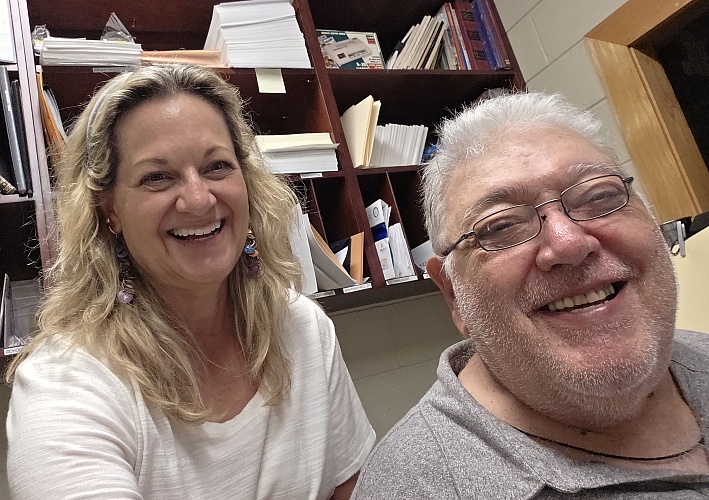 I met administrative assistants, security guards, custodians. Building managers gave the best tours — they know every nook and cranny. I met a woman who told me she and her husband had moved from Wisconsin to Illinois so they could access IVF, sharing this deeply personal thing while showing me her place of worship. I met Nic at a Greek Orthodox church, who told me his whole immigrant story — how his family brought his grandparents to America so finally, after many years, they could all once again be in one place.
At the Buddhist Temple of Chicago, a recently retired Japanese minister showed me their sanctuary, then said, "Oh, but wait — you really have to see this." She led me to a large closet. Inside, among urns of ashes, sat an altar made by Japanese Americans in an internment camp during World War II, built from whatever materials they could find so they could maintain their practice. When the war ended and they were barred from returning to California, they moved to Chicago and brought that altar with them.
Back in the fellowship hall, a small, elderly woman overheard us talking. "I was in the internment camps," she said. "I was six." She told me about working in soap factories because no one else wanted to handle lye, about working in munitions factories while being told she wasn't trusted. Then another woman came up: "You were in the camps? I was too!" And they began talking to each other.
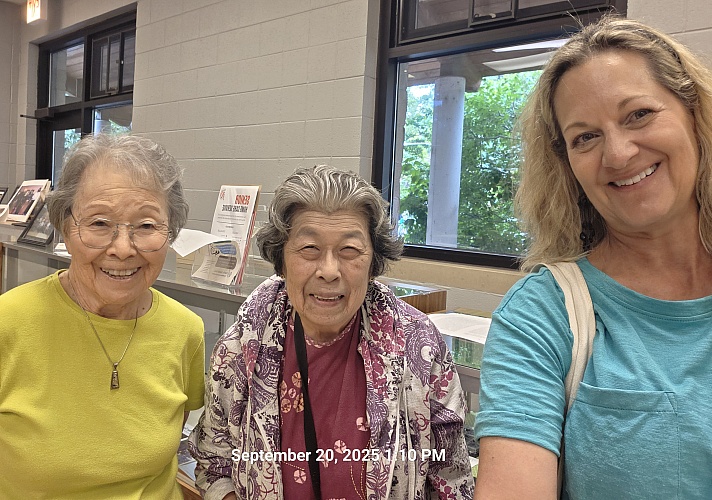
I don't know how a person like me would have had that experience without the Guinness attempt as an excuse to ring the bell at noon, waiting around until one o'clock when people finally arrived for the gathering of their social club.
People ask what enabled me to connect with communities so different from my own. I'm kind of just an old white lady — in some ways that worked to my advantage, because people looked at me on their security cameras and decided to open the door. But connection isn't one-way. I walk into places believing we are already connected — all humans on this planet, in this time, at this particular door. How did we both end up here? There is something miraculous about that.
Of course, I can put that out there, but then someone has to be ready and willing to receive it. And that was the real gift — how many people I met who were ready.
At the Downtown Islamic Center, Nadeem was skeptical at first. Over two dozen security cameras watched me approach. We sat and talked for forty-five minutes. By the time I left, he was telling me other places I should visit and offering introductions. We're friends now.

What I saw everywhere was resilience and creativity. Huge Polish Catholic churches, built a century ago for immigrants who've since moved on, now serving Hispanic congregations. A Buddhist temple inside a UU church. A Lutheran congregation from India holding services in Hindi and Urdu, renting space on Sunday nights to a white evangelical church. People figuring it out, sharing what they have.
I went to over twenty worship services. Many were not in English. And I discovered something: when you don't have to worry about words — what they mean, or are trying to mean — you can let the experience wash over you. It takes the mind out of the picture. You hold it in your heart instead.
People always ask for my favorite place of worship. I can never answer that. There was no space I walked into and thought, I'm glad I don't worship here. Some were cathedrals with soaring ceilings. Some were tiny clapboard churches that smelled musty and served breakfast to the neighborhood. It didn't matter. The people who I met were all connected to their space. It was meaningful to them. And as a result, it became meaningful for me.
When someone asks what I learned, I keep coming back to one thing: when you meet people where they are, amazing things can happen.
I currently self-identify as an amateur mystic. My son says I have a better chance of getting another Guinness record than finishing my basement renovation. My daughter told me this was the trip I'd always wanted to take — the first one planned just for myself. They both know me well.
But here's what I'd say to anyone. You don't need a world record as your reason. You can go to a website, find a holiday or a service, send an email, make a call. You can say, I'm here to learn. If this isn't a good time, I'll come back. And if you're feeling particularly brave, you can just show up.
It does require a certain bravery to cross a boundary — one set up by yourself, or by culture, or by history. But that is the only way barriers come down. And it requires less bravery than you might think, because on the other side of that door is a fellow human being. In my experience, they are almost always welcoming, almost always kind.
Ring the bell. See who answers.
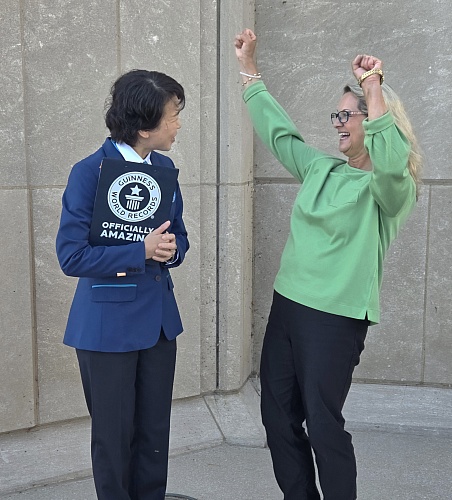
— as told by Vicki Garlock on a Story Booth
COMMUNITY REFLECTIONS
SHARE YOUR REFLECTION
20 PAST RESPONSES
Thank you for sharing. Maybe take some children with you, or teenagers.
How about collecting songs/hymns/music as you go?