
As my taxi turns left into the ashram entryway, I squint from the mid-afternoon July sun bouncing off the gray concrete outer walls. I am excited to be back here in the Brahma Vidya Mandir Ashram in rural central India. The older sisters living in this intentional, spiritually-focused community, have known me all my life. They and my father were followers of Mahatma Gandhi and his disciple and spiritual successor, Vinoba Bhave. In the late 1960s, when I was a child, my family and I lived in Gandhi’s Sevagram ashram, about five miles down the road. Though I did not much care for the walk between the ashrams, I loved visiting the sisters, my cousin, who’d been a member since 1964, and even Vinoba.
It’s 2018 and seven years have passed since I was last in the ashram; I have been looking forward to the warm welcome I always receive. As I hop out of the taxi, I look around in anticipation of seeing Usha di, Nirmal-di, Kanchan, and the other sisters. However, the entryway is empty. The long sidewalk in front of me is empty. The wide covered walkway to my left, and the central garden area, are also empty. As the driver removes my second suitcase from the taxi, I wonder, “Where is everyone? Did they not receive my letter saying I was coming?” I scan the area again, and a light disappointment rises up within me.
Then, from the distance I hear a faint, “Swasti.” Glancing across the garden, I see Kanchan, a sister who is my age and a good friend, walking towards me. She is dressed in her simple white khadi, cloth woven from cotton thread that she spun herself. She approaches, takes my hand, and says, “We waited for you. We waited as long as we could, but you did not come.”
Waited for me? Waited for me for what? What happened? Where is everyone? These thoughts tumble around in my head as Kanchan continues: “Nirmal-di. She is no more.”
“What?”
“Yes, she is no more. Last night. We prepared her body and this morning we waited for you as long as we could.”
Regret fills my heart. I could have been here last night. If only I had known. I could have come directly to the ashram instead of spending a couple of nights at a friend’s house less than five miles away. Had I known, I could have been here to say goodbye to Nirmal-di herself, or at the very least been here early in the morning for her cremation ceremony. “What happened?” I ask.
Nirmal-di had been suffering from paralysis that was slowly getting worse. For the past couple of months, though her ninety-year-old body was slowly failing, her mind was alert as ever. She enjoyed visits from family members. She talked with each of the sisters and spent time with the local villagers and friends who came to see her.
Slowly, over the previous two weeks, Nirmal-di found it more and more difficult to swallow solid food. Often she could not keep food down. She went on a liquid diet of fruit juices, and soon her body rejected even that. As the sisters encouraged her to continue taking water, she said “Why? This body is stone, you are putting this water on stone. It is not necessary.” Nirmal-di often referred to herself as “this Gandhi vehicle.” When her body was strong, when she and three other women walked for peace, throughout India, for twelve years—speaking and embodying a message of peace and women’s power—she talked about being a vehicle, yet she knew she struggled with her ego. It was years later, as we sat together and she told me her stories and reflected upon her life, that she felt she was speaking truth when she said, “I am a type of flute, which is just empty. It has nothing in itself.” In the context of all the stories Nirmal-di shared with me, I knew that her attitude of being a vehicle or instrument was not self-deprecating. Rather it reflected the decades of concerted effort she put into decreasing her attachment to her ego.
On Sunday, 29 July 2018, the day before I arrived, various sisters stopped by her room throughout the day. In the late afternoon, Nirmal-di became a bit agitated. Around 6:30 in the evening, she was lying in bed on her left side, facing the wall. Her body jerked slightly, resulting in her lying flat on her back. Several sisters and Panchi, a woman from the village across the river, who was her long-term attendant, arranged her thin mat and pillow to support her body and enable her to breathe a bit more easily. Though she spoke no audible words, they saw her foot ever so slightly marking a rhythem, and they knew she was reciting the name of god, “Ram Hari. Ram Hari. Ram Hari.” She was in her own bed, with at least two or three beloved sisters, and Panchi always at her side. She was not alone. She was peaceful, and she was ready to let go of the instrument. As she breathed her last, those in the room quietly bore witness as her atman, her soul, moved on to its next journey.
The tranquility in the room remained as the sisters began their community’s end-of-life ritual. There was no outburst of grief, for according to their teachings, Nirmal-di’s death signifies the end of this life, yet her atman, herself, her soul, is eternal and is released from the limitations of the physical body. The sisters’ teaching of life and death originate from a worldview grounded in an Advaita Vedanta philosophy: a worldview that understands there to be an underlying unity to all life. Everything is a part of the essence of reality—Brahman. The Bhagavad Gita, a central text for the sisters, talks about how death is not an end: The atman “is not born, it does not die; having been, it will never not be; unborn, enduring, constant, and primordial, it is not killed when the body is killed.” The text goes on to say, “As a man discards worn-out clothes to put on new and different ones, so the embodied self discards its worn-out bodies to take on other new ones” (Bhagavad Gita 2:19, 22. Translated by Barbara Stoler Miller, 1998). So, Nirmal-di’s death is but a passing into something new; her eternal atman is changing its clothes. This worldview and decades of deep learning lead the sisters to an understanding that death is not something to be dreaded—it is simply part of samsara, a fact of the cycle of life. The atman is returning to its roots, to its home.
I gained a deeper understanding of the sisters’ response to death, a philosophy that has deeply influenced me, when I learned of the death of my father. I remember standing in the silence of my room and wondering where he was, where his atman was. There were tears and I was sad, but my heart was not heavy with grief—I was more curious. What were his new clothes? Was I feeling his presence? Or was it more that I was not feeling the lack of his presence?
Upon Nirmal-di’s death, one of the sisters walked to the opposite side of the ashram, almost directly across from her room, and rang the ashram bell. Since this was during the time of evening silence, the sisters knew that the bell indicated she had died, and they gathered inside her room, or on the veranda just outside of it. They sat on the floor and in chairs, and started chanting the Gitai, Vinoba’s poetic and beautifully accessible translation of the Bhagavad Gita from Sanskrit into Marathi, the mother language for those in the central Indian state of Maharashtra. Then they chanted the Vishnu Sahasranamam, a prayer of a thousand names of the god Vishnu. The words of the Gita and prayer were deeply familiar to the sisters, who have been chanting them together during their daily community prayers for decades. The words, being chanted in unison, were not only heard, they were felt: the gentle vibrations that emanated from the sisters’ oscillating vocal cords filled not only their throats and heads but also resonated throughout their bodies, and the entire room. The physical feelings, the sounds, the meaning of the words themselves and the deep emotions they contained, embraced the sisters and held them together. They were indeed one, Brahman: the essence of the universe. Though Nirmal-di’s body no longer had signs of life, she remained present with them.
After sharing this time together, most of the sisters returned to preparing for the rest of the evening. A few sisters remained in the room singing, as Jyoti-di and Ganga-ma gently removed Nirmal-di’s clothes and rubbed a thin paste of ghee and turmeric over her body. Then they covered her body with a khadi sheet, tucking the ends around her face. Throughout the night, at least two or three sisters remained in the room, quietly singing various devotional bhajans and chanting different prayers.
A year or so before her own death, my cousin Veena-di had taken the last yards of her handspun khadi cloth and cut it into handkerchief-size squares. Then she decorated them, individually, one for each sister. In the center of the handkerchief, were two lines of Veena-di’s carefully handwritten script, in green Sharpie ink: the top line read “Om,” and beneath it, “Ram Hari.” Nirmal-di treasured her handkerchief and had told Jyoti-di that she wanted it as part of her cremation cloth.
The tradition for many in India is to cremate the body within twelve hours. In the morning, the cremation site was prepared and the sisters waited for me as long as they could. When the allotted time elapsed, Jyoti-di and Ganga-ma bathed Nirmal-di’s body, and again rubbed the ghee-tumeric paste all over it. Then they covered her with a new khadi sheet. They wrapped her body in a way that allowed her face to be visible, then secured the handkerchief so that the words “Om, Ram Hari” rested on her chest. Jyoti-di then framed Nirmal-di’s face with garlands of burnt-orange marigolds and scattered a few other flowers over the rest of her covered body.
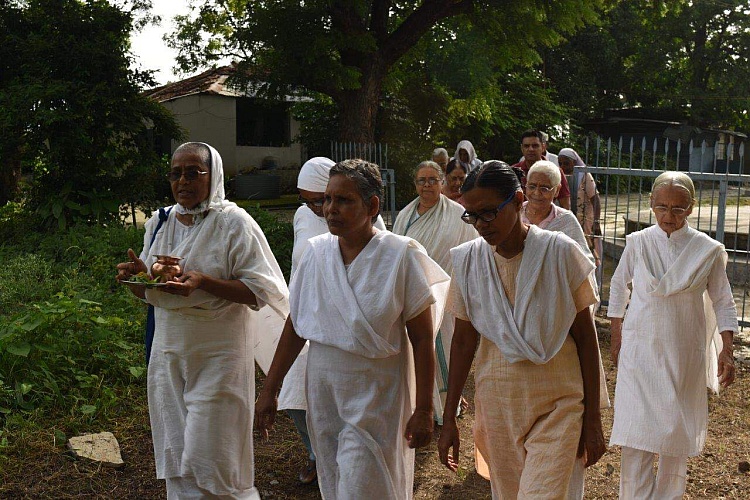
The sisters then reconvened in Nirmal-di’s room. They placed her body on a narrow, wooden cot, and carried it to the veranda in front of Vinoba’s room—the area where they meet three times a day for their community prayers and gather for other meetings. After a brief service of singing bhajans and chanting prayers, they brought in a litter and covered it with a thick layer of dried grass. They laid Nirmal-di’s wrapped body on top of it and carefully secured it to the litter in several places with rope. They took care to keep the “Om, Ram Hari” over her chest. Then the sisters, along with a few of the workers from the village, lifted the litter to their shoulders, and began to walk slowly away from the veranda, along the ashram’s walkways. They sang a dhun, short phrases that are sung first by a leader and then repeated by the others. They sang praises to the gods Rama and Sita as they passed the well, and processed through an iron gate marking the western border of the ashram.
They slowly walked down the dirt path, turned left, and then descended a slight hill that opened onto a small empty field belonging to the ashram. Centered at the top of the eastern edge of the field was an oblong pile of carefully placed logs and kindling. After putting the litter on the ground, the sisters untied the ropes, carefully lifted Nirmali di’s wrapped body, and placed it on the top layer of logs. The litter was dismantled and placed on top and around her body, becoming part of the kindling. All the while, other sisters walked slowly around the pyre softly singing and chanting. Then, just as Jyoti-di and a few other sisters began to light the funeral pyre together, everyone chanted the first verse of the Ishavasya Upanishad,
ishavasyawidam sarvaṃ yatkinca jagatyam jagat
tena tyaktena bhunjitha ma grdhaḥ kasya sviddhanam… (Ishavasya Upanishads. Translated by Donald G. Groom, 1981).
These words mean, “The Eternal is complete in itself; The finite is complete in itself; …When one completeness is taken from another, Completeness itself remains.” As the wood caught fire and a steady blaze grew, the words reminded the sisters of the absolute unity of all life.
Traditionally in India, women will prepare the bodies of female family members who have died, but they usually do not play a role in the cremation itself. More often than not, they do not even attend the cremation. However, in this ashram, the first Gandhian ashram for women, the men defer to the sisters. The sisters are not only present, they are the ones preparing and carrying the body, igniting the funeral pyre, and conducting the ceremony—they are the ones in charge and performing the entire ritual.
It usually takes four to five hours for the fire to consume the body and all the wood. Gradually, as they were ready, everyone present left the field, returned to the ashram, their rooms, or their homes in the village, and began preparing for the rest of their day.
By the time I arrive at the ashram at 2:00 in the afternoon, Nirmal-di’s cremation of that morning is over, but the opportunities to remember her are not. That evening, as we gather in her room, there is a quiet sense of calm. In the center of Nirmal-di’s worn, dark lacquer-stained wooden cot—now empty—is a garland of natural-white khadi thread surrounded by yellow zinnias, and a few sprigs of green leaves. On a low table beside the bed a small brass incense holder holds two long sticks of incense, and beside it is a stainless-steel plate with a brass oil lamp in its center. Our movement into the room causes the flame of the oil lamp to gently flicker, and the two thin trails of smoke from the incense sticks to waver as they flow upwards. The long side of the bed is pushed up against the back wall of the room, creating more space for the sisters, family, and villagers to file in and sit cross-legged on the floor or on chairs along the walls. Once everyone is settled, Lalita, a sister who often leads the singing, starts a bhajan in her sweet soft voice. When she comes to the chorus for the second time, everyone quietly joins in the singing. Then each person, who wants to, is invited to sing, read, or share.
While one sister reads a passage from the Gita or Upanishads, another shares a poem they composed. One villager begins sings a bhajan and the others join in, while other villagers sit in silence. Knowing Nirmal-di’s connection to Gandhi, I asked Lalita to lead us in singing Raghupati Raghava Raja Ram, an old song popularized by him. As each of us speaks in turn, the rhythm of the slowly spinning ceiling fan is heard in the background.
A subdued reverence permeates the room; there are tears and sniffles from the villagers and Panchi, who had cared for Nirmal-di for so many years. For the sisters, however, there does not seem to be a feeling of profound loss. Again, the words of the Ishavasya Upanishads that we are all one, all part of Brahman, and the idea from the Bhagavad Gita that at death we are simply changing our clothes are intimately familiar to them.
For over five decades, these women have been chanting the Gita twice every single day during their moring and evening community prayers. Long ago, Vinoba took Bhagavad Gita, and his Marathi translation, the Gitai, and divided them up into twenty-one relatively equal parts. The sisters chant a section of the Gitai in Marathi during their 4:30 morning prayer and the same section of the Gita is chanted in Sanskrit at their 7:45 evening prayer. They begin this cycle of read-chanting on a Friday, so every third Friday they begin chanting from chapter one, verse one. In this manner, they recite the entire text, in two languages, thirty-four times a year. They also chant the eighteen verses of the second chapter of the Gita every evening and the Ishavasya Upanishad every morning. Every morning after the pre-dawn prayer, they study the Gita, Upanishads, Brahma Sutras, and other texts together. They intimately know these texts and the teachings contained within them.
While I sit amongst the sisters and friends, surrounded by the familiar sounds, the physical vibration from the chanting, the words and the experience itself embrace me. I too am reminded of the Gita’s teaching that the atman is eternal and that in dying Nirmal-di is simply changing her clothes. The death rituals the sisters have developed reflect their theological understanding of a cyclical nature of life; simultaneously they serve to physically hold us together in community as we mark the passing of a loved one.
About five years after they founded the ashram in 1959, the sisters developed a ritual following the cremation of a community member or friend: a handful of ashes and a few small pieces of bone are retrieved from the funeral pyre and placed in a special copper vessel. These ashes and bones are then placed in a hole in the ground just in front of a tree that is planted on the high point of the southern side of the ashram, called the samuhik samadhi. From this place, when sitting on the low southern wall, with their backs to the tree, the sisters look can out at the river and have an uninterrupted view of the horizon.
In 2008, after the death of a long-time friend of the ashram, I was present for his cremation and the ritual that followed. A few days later, Kanchan and I were talking about this ritual. “Oh Swasti,” she said, “You know, many people call and ask if they can put the ashes of their family here. This is not for the general public; this is for those who belong to this place.”
Smiling, and slightly laughing, I jokingly responded, “Kanchan, don’t worry. I won’t ask to put my family’s ashes here!” I was surprised and deeply touched by her reply:
“Oh no Swasti, for you it is ok. This is your place.”
Ten years later, I was making my first trip back to India since the death of my father in 2011. The sisters invited me to bring a handful of his ashes to the ashram. In the morning following Nirmal-di’s cremation, the sisters again prepare the seating area in front of Vinoba’s room. On a small, low table, draped in a white khadi cloth, are two copper vessels. Each would fit comfortably in my cupped hands. Both are covered with a small square of white khadi. Scattered on top, and around the vessels, are a few small white, orange-stemmed, fragrant jasmine flowers. One vessel holds the last handful of my father’s ashes; the other is currently empty, waiting for a handful of Nirmal-di’s ashes.
Then I gather with the sisters, others from outside the ashram, and Nirmal-di’s younger sister and nephew, who arrived early in the morning, at the cremation site.
Having been asked to take photographs for Nirmal-di’s family members who could not attend, I take a position about five yards away from the group, in the small empty field waiting to be tilled. The undisturbed remains of the day-old funeral pyre are at the field’s edge. While the ashes in the center of the pyre are mostly black and shades of gray, the outer edges almost glow from the light dusting of bright white ash that encircles the whole mound. Beyond the mound, the sun filters through the branches and leaves of a line of tall trees. The sunlight is being transformed into white opaque ribbons. When the wind stirs, the ribbons become speckled with flecks of white, shades of gray, and even black ashes that dance up from the funeral pyre.
The sisters, dressed in white khadi, slowly walk around the remains of the pyre, again singing another dhun. While a rhythmic chime rings from a pair of hand cymbals, the others respond with a slow clap accompanying each word.
In the center of the cremation site, there are larger pieces of black ash that still retain the shape of pieces of bark. Around this area, Jyoti-di bends over and sprinkles a few drops of water. As the droplets hit the black ash bark, there is a tiny poof as ash collapses into itself. As her hand passes over the length of the remains for a second time, she gently lets flower petals and flowers fall from her fingers. Then, she scans the pile and with a stick, gently moves the ashes around to expose a few small pieces of bone. She moves the bones to the edge and picks up a few pieces and puts them into the special copper vessel held by Nirmal-di’s nephew. He bends down and adds a handful of ash into the vessel.
Following a few more songs, Nirmal-di’s sister, nephew, and Jyoti-di start to lead the procession back up the dirt path, retracing their steps to the veranda in front of Vinoba’s room. Kanchan and I bring up the rear. I stop. She stops with me. As we turn and look at the edge of the field and the oblong pile of white, gray, and black flecked ashes, I ask her, “So what do you do with all the ashes and remaining bones?”
She looks at me, head slightly tilted and replies, “It is ploughed into the dirt and then the field is planted.” I am struck anew by a familiar phrase reflecting a sentiment from Jewish and Christian traditions: “ashes to ashes and dust to dust.” As we continue up the path, I see a very active line of huge black ants. The ordinariness of life indeed marches on in the midst of death.
By the time Kanchan and I catch up with the group, they are almost in front of Vinoba’s room. I am instructed to collect the copper vessel with my father’s ashes. I do so and we join the others as they climb a half dozen steps towards the ashram’s highest ground at its southern end. Behind the two-story Lal Bangla, the property’s original house, a tree stands at the center of a small, open dirt yard sparsely sprinkled with dry, spindly clumps of grass. As the procession comes around to the front of the tree, we see a concrete cover has been removed, revealing a hole in the ground. In front of the hole, beside a small pile of dirt, Jyoti-di places a basket of flowers and a small brass vessel full of water. Once Nirmal-di’s nephew reaches the open hole, Jyoti-di guides him in sprinkling the contents of his copper vessel into the hole. Then she motions for him to follow it with a small handful of dirt, a few flowers, and a sprinkling of water. Nirmal-di’s sister, and everyone else, then does the same—adding a little dirt, flowers, and water.
The sisters continue to sing and chant quietly in the background as I approach the hole with my copper vessel. Jyoti-di stands beside me; I feel surrounded by a deep calm and love. I remove the cloth covering from the vessel and tap my father’s ashes into the hole. Like everyone else, I place the dirt, flowers, and water in the hole, and as I do so I am thinking about him. Here in this ashram, as his ashes are put back into the earth, I cannot help but wonder what other journeys his soul has taken, or clothes his atman has donned. Or perhaps his traveling from one life to the next is no longer necessary—perhaps he has reached enlightenment? Who knows.
What I do know and feel, is profound gratitude: it is so fitting for my father, his ashes to be included in this community ritual. He was first inspired by Gandhi when he was thirteen; and his commitment to Sarvodaya, to working for the uplifting of all humanity and the Earth, permeated his everything he did. Though he lived a good portion of his life away from this community and from India, he remained, at heart, one with them.
Although I miss being able to pick up the phone and talk with my father, or have a spirited discussion with him in person, on this day, as my father’s ashes are placed in the hole, I am at peace. He was a good man. He and my mother instilled in my brother and me a sense of being a part of this community, even from afar. Now his ashes are in this place, with others who work for Sarvodaya and who were inspired by Gandhi and Vinoba.
As Jyoti-di and I talk about this day, she reflects on their rituals and the ashram itself, and says, “This is a very auspicious place. There is a special peace here, in this ashram, because of this samuhik samadhi: this community of those who have passed on from this life. All the virtues and good vibrations of these great people are here. People come inside the ashram gate, and they tell us that they feel a special type of silence, of peace here. When they go outside the gate it is not there. So that place, that samuhik samadhi, is very special.”
With Nirmal-di’s and my father’s ashes added to the samuhik samadhi, the sisters’ rituals for the dead are complete. It is just after 11:00 in the morning, and the bell is rung for lunch. The sisters, Nirmal-di’s sister and nephew, friends, and all of us, gather in the dining hall for lunch. Life continues. There is no need for goodbyes.
COMMUNITY REFLECTIONS
SHARE YOUR REFLECTION
6 PAST RESPONSES