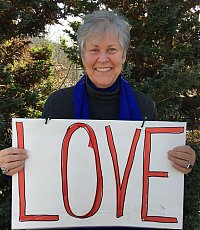
A friend of mine, a child psychologist, had never protested anything in her life. But when she saw families being separated at the US-Mexico border, she understood — as a therapist — that this would be a lifelong trauma for both children and parents. So she did something that took enormous courage for her. She made a protest sign and went to stand at the intersection in our small town where four roads meet. She got mixed reviews, as you can imagine. But she came home and wrote a beautiful editorial. Her final line was: What is your line in the sand? What would cause you to risk doing something you've never done?
I read that as a big question, so I sat with it all weekend in reflection. Years earlier, I'd been part of an anti-war group at Davidson College where I worked. We read, we met in protest and we published a booklet. But we discovered that being anti-war was causing wars on campus — it was an argument, not a path to peace. So the group regrouped and asked: "What could we advocate and practice that would actually eliminate the need for war?" The answer we found was loving. LOVE was the word. If we taught love, lived love, sought to become love, then maybe we'd never need the protest signs again.
I was still thinking about my friend's question when my grandchildren came to visit that weekend. I asked them — knowing my life, knowing my stories — what would I put on a sign? They didn't hesitate. "That's easy," they said. It's 'love' ." They made my first LOVE sign that afternoon.
The next Wednesday, I went to stand where my friend Erica had stood the week before. She arrived too, with her protest sign. I thought, "Well, this is going to be interesting — the two of us, side by side." She looked at me. She looked at my sign. Then she laid hers down, crossed the street, and said: "If your sign works, I'll never need mine."
She went home; she hasn't been back. That was nearly eight years ago. I've missed standing twice — once with a horrible case of first-wave COVID and once when I was being operated on for cancer. But otherwise, it's certainly been the most disciplined I've ever been at anything.
~ An Energy Transfer ~
I live in a mountain town of about seven thousand people, near Asheville, North Carolina. Lots of holy houses here. Everything from Buddhist to really fundamental Christian has a home. Every Wednesday afternoon, a few of us stand at that intersection with our love signs while twelve or fifteen hundred cars pass through. Someone counted once. That number is a lot of people.
Our standing with LOVE signs isn't a performance and it's not about us. We don't chat and visit. We gather ourselves in spirit, and then we transfer that loving spirit through eye contact, through a wave, through a smile, one person at a time. I've insisted on making eye contact. Looking into eyes is like shaking a hand. It's purposeful. It's an energy transfer from us to the person in the car. I know it works because when I'm in the grocery store, people will come up and say, "You didn't look at me on Wednesday!" With fifteen hundred people, sometimes we miss someone. But the people passing notice. Because when anyone makes eye contact, it's real. It's like standing in front of someone and saying: "We're connected; we're sending our personal love."
People frequently share love stories with me afterward — in the produce aisle, at the post office, wherever I go. Never the opposite. Not once in all these years. A five-year-old showed up one Wednesday last year with her mother and asked if they could stand with us. I said of course, we have extra signs. That little girl looked up at me and said, "I've wanted to do this my whole life!" She's five and she stood for the full hour with that sign, waving. She hasn't been back. She just needed to do it once.
~ The Girl Who Was Watching ~
Here's what the sign has taught me: Once you hang "LOVE" around your neck, you have to live the word. The LOVE sign becomes an every-minute-of-the-day reminder you believe in love. You can't advocate for it if you're not going to practice it. And practicing it is hard; it's not as easy as wearing the sign. You have to embody the word.
A man stopped one day with his wife and four children when we were standing. His wife and three children went to talk with other folks in our group, but he stayed with me, his twelve-year-old daughter beside him. His opening volley was: "You must be liberal." I said, "How do you know that I am liberal?" He said, "Only liberals talk about love."
Pause: I have a process I call Verbal Aikido. When something hard, some challenging statement, comes at me, I watch it approach, catch it in my hand, let it pass by (and through) my heart before I symbolically catch it in my hand and guide it back (in a martial arts kind of motion) through and past my heart again before I reply. So I said, after catching that sentence with Verbal Akido, "Well, you must be liberal too — because here we are, both of us talking about love!" He didn't know what to do with that statement. Then he tried to catch me with Bible verses, but he didn't know that I grew up in the South. I went to Sunday school from birth until after high school. I could talk with him through all of our conversation. And all of it went through my heart to meet his with verbal akido and LOVE.
But here's the thing I realized minutes into that conversation. His daughter wasn't listening to his words or mine; she was WATCHING ME. She was watching whether I was actively loving — or just holding a sign that said the word. Had I been anything else but embodied listening, making eye contact or representing love--- anything other than what was written around my neck, I would have had no credibility for her (or for her father!)
When she left, she turned around, gave me the hand signal for approval, and smiled. And I thought: We were here for her.
~ Carousel Queen, Community Outcast ~
People ask how I came to organize my life around love. The truth is, I didn't plan it. But I've known since I was three years old that I felt everything, especially soul centered concerns, intensely. I was tall, big, serious, full of mystical experiences I couldn't understand or share. I was always called a "Pollyanna" (a naive, overly sweet person) — which was the era's way of dismissing someone who took goodness seriously.
In high school, I was nominated from my school for a state competition that judged how you looked, how you thought, and the grades you made. The judges asked every candidate what they wanted most in the world and most everyone said somewhere in their answer--world peace — because that's what you said in those contentious days. I said it, too and explained how it fit into my life. The judges called me back after the competition and told me: "You know why you won? Because you had a plan to accomplish that peace." I did. I'd already been living a small version of it.
And then I was pregnant at seventeen. I went straight from Carousel Queen to community outcast. My physics teacher, who I adored and would have done anything for, never spoke to me again. Nobody wanted the story, the how or the why. Hardly anyone was curious or compassionate. They just wanted me to be the failure that fit their story---a fall from glory! But I knew it would pass. I knew kind people eventually would find me. And I knew the experience of being accused and outcast would form me — that I would never again assume I understood anyone from the outside.
Because I was not the obvious story; I was more, but I became guilty until proven innocent. And you know what? That interpretation was perfect. It kept me in college for all the right reasons. It made me be a mother early who learned and taught through lessons from being a mother. It taught me I could stick to things without being invested in them — which turns out to be one of the most useful things a person can learn.
~ You Have a Lineage ~
I spent thirty years at Davidson College with my English Education degree, starting as a secretary and ending as an assistant dean — which could never happen now, because I didn't have advanced degrees. But it was a different, more expansive time. I grew up in that small town that housed an exceptional small liberal arts college. After severaI work positions, I became the first Director of their Bonner Scholars program — a national service-learning initiative I was hired to design for Davidson College with the sponsoring Bonner Foundation. From personal learning experience, I insisted that we, the staff, meet every student personally at least twice a year to ask first who they were becoming through service and how closely that becoming matched their purpose and then whether they had met the required quota of 40 service hours/month for their scholarship. Because I believe that the foundational process in service is loving the people we're serving as we are being changed ourselves. The students made fun of me at first. Called me the Queen of Cheese because I had them hold hands in a circle and talked about LOVE operating in their service scholarship. I wore a cheese hat and claimed the title. I mean, we have to be light about this loving process---it's FUN! By the third year, they were calling the circle themselves, holding hands and singing. By the fourth year, they were teaching the circle to other schools and calling it BONNER LOVE.
Years later, through what I can only call "magic", I ended up in Calcutta at Mother Teresa's mother house. It was a hundred degrees, literally. Mass was in Hindi and Latin. I was the biggest person there, sitting on the floor, the only one sweating, and panicking about what on earth I was going to say to this holy woman after the service. When I got to the front of the line, she was bent nearly double with age, her eyes looking up from beneath her bent neck. She took my hand and said, "What is your name, dear?"
And I thought with relief: "okay, that's a question I can answer!"
"Ruth," I said. And she replied: "Oh — you have a lineage. Go live it."
The biblical Ruth — a story of love that isn't demanded, but is freely given, of community found in the most unexpected places, of loyalty and patience -- she gave to me that day. And in another, closer relationship, I was named for my grandmother, who lived service in community and spread that idea through institutions all over North Carolina. Her mother was a pioneering photographer and educational advocate. My lineage runs deep, even when it comes sideways.
~ What the Storm Remembered ~
When Hurricane Helene came through our mountains in Sept., 2024 — we'd never had a hurricane in the mountains — the rivers crested almost thirty feet above normal. We lost millions and millions of trees. Water made new riverbeds. Whole segments of the mountains "slid" down, became rivers of tree-laden soil and rock. They say it'll be a hundred years before the land recovers. It was stunning.
My house wasn't damaged, but some people around me lost everything. So I went to the FEMA (Federal Emergency Management Agency) lines and stood at the back to listen. People were angry, scared, heartbroken. By the time they got to the front of the line, most were in tears and in shock. There wasn't anyone around to hear stories — to witness. So I became that witness for a couple of weeks. I just stood with people sharing their stories -- heroic, love-filled, generous, heart changing stories.
What I found was that without fail, buried inside every story of loss, there was a kind of miraculous love story. People had saved one another's lives. Strangers were feeding whole neighborhoods. Folks from Louisiana rode horses up into the mountains and pulled people out of mud and debris. Canada arrived like saviors driving a squadron of almost 100 repair power trucks! I mean, it was inspirational — the outpouring from people who didn't owe us anything. For three months nobody asked who you voted for. It simply wasn't relevant. They only asked what we needed. And then supplied it.
Now, a year and a half later, we're working at forgetting that relational, generous, loving. We're forgetting the community born of shared hardship and trauma. We are travelling back to being separate. So our LOVE group has begun collecting LOVE STORIES from the time when we were helping each other — because I think remembering might knit us back together with something deeper and more powerful than our divisions -- toward a powerful loving base of feeling and operation.
~ The Bonus Round ~
I'm about to turn eighty this first week of June. I've had cancer twice. I live in a six-hundred-square-foot solar home that's honestly more space than I need. I have created a nature sanctuary on my tiny lot. I call this part of my life the bonus round. I'll share something about getting older: nobody pays that much attention to old people, which means an older person can get by with a lot. I intend to push that limit. I intend to become an ELDER and all that beautiful title contains, rather than just a silent OLDER!
The other day, a quote arrived in my mailbox with no signature, no return address — just a passage from the Dalai Lama: Every day, think as you wake up: today I am fortunate to have woken up. I am alive. I have a precious human life. I am not going to waste it. I could read that every morning for the rest of my life and be satisfied. Who sends something like that? I can't wait to find out. And I can't wait to live the message.
One of the bravest things you'll ever do is keep your heart open in a world that gives you every reason to shut it. (from REWILDING)
Many people ask how I've managed not to become cynical. I have absolute trust in what presents itself. And patience is essential. I think it really is about practicing — and not berating yourself when you don't do it perfectly--, or when you do the total opposite. I have a huge, forgetful heart. That's a grace, not a failure. It means I get to begin again every day and maybe every moment on an especially challenging day.
If you drive through my town on a Wednesday afternoon, you might see us — a group of dedicated souls on the corner of our town intersection, LOVE signs around our necks, waving to every car that passes. It's the biggest shot of joy you can imagine, because it's a sacred offering, really. It's our chance to change the air around where we are and then to share it to all passing by as we stand still, in one place, with LOVE, and mean it as best we can in that moment.
I believe and think many people already know that we can live in, with, and for LOVE. That life is possible. They're just waiting for someone to stand still to remind them. And right now, I want to be that someone.
— as told by Ruth PIttard on a Story Booth
COMMUNITY REFLECTIONS
SHARE YOUR REFLECTION
54 PAST RESPONSES
As I read this I was picturing doing a similar LOVE initiative in my environment and what it would entail. Lots of courage and perseverance for a start.
Love to you Ruth.
Your stories always inspire me. When we did a pod together, it was suggested that each of us go out and carry LOVE signs like you do. I made giant individual C-H-O-O-S-E L-O-V-E letters and got 10 friends to help me hold them outside City Hall. It was a blast and I consider this a reminder to go out and do it again. Thank you for living the love. Pam
On a busy street in Camden Maine. I could sit at the end of the driveway with the sign LOVE. Just need to be comfortable doing it with a walker as I am insteady.
Happy Birthday dear friend. I am going to see you one Wednesday afternoon on that special corner in Black Mountain. It’s going to be soon.
Oh, how I will carry your wisdom with me in the coming days! Return to it again and again when looking for light in the dark. How you shine! You and your wide open heart, taking a stand for Love, showing us how to be new every day, to remain curious, to try again and again to love and be present to all that is possible when Love is the lens. Wishing you such a love filled, laughter filled, grace filled birthday. THANK YOU FOR EXISTING!!!
May you continue living each moment with love, for love and radiate that LOVE to each and every person on this planet! May that LOVE make peace attainable on this earth!
As our most popular birthday song in Hindi says : May you live thousand years and with each year consisting of Fifty thousand days!
And may you continue to live in and spread the LOVE you have lived in every moment of your life now on as well just a little more shinier by the moment! Happy Happy Birthday Dear Ruth!
Many Happy Birthdays and days of LOVE.
Thank you for living love and modeling love.