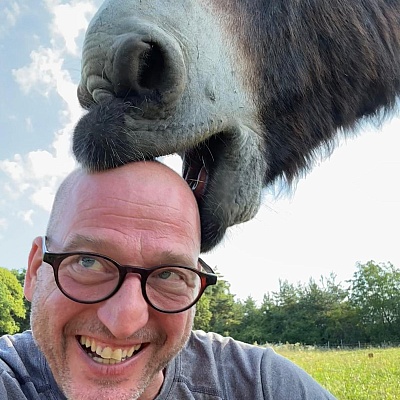
For twenty-five years, Andreas Nussbaumer was one of Austria's most successful sales trainers — two books, packed seminar rooms, five flights a week. Today he and his wife Elisabeth steward Hof-Sonnenweide, a sanctuary in Weppersdorf, Austria, where some 150 rescued farm animals live out their lives. In this Story Booth conversation with Kerri Lake, he traces how a phone call about a flooded oven, and children on the other side of the world, unraveled one life and started another — in his own words.
She Is the Reason We Are Here
I have to start with my wife, because she is the reason we are here.
At thirty-five, Elisabeth bought a horse called Liberty. Mystic, magic. She still had her own consulting company then — in the morning she would drive out to Liberty, and at ten o'clock she would start her workday. Two years later she sold the company and walked away from normal business. She wanted to live with animals. We searched for four or five years, and then we found this place: Hof-Sonnenweide.
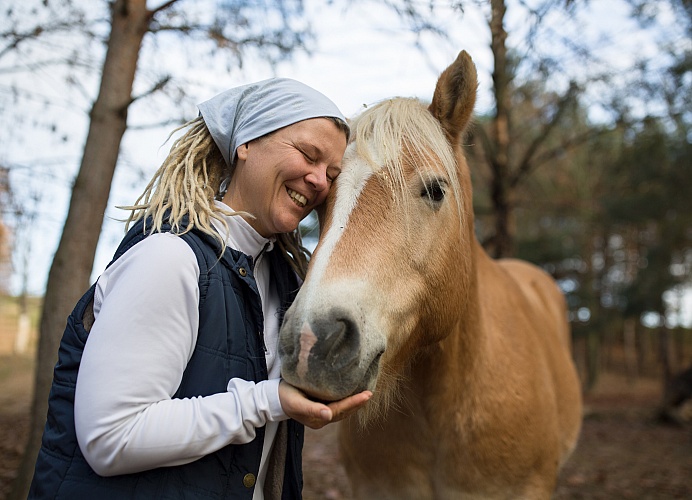
We moved in with two horses, two dogs, and two cats. In the beginning the animals ran alongside our life, like a hobby — I was working as a sales trainer and speaker, so most of the time I wasn't even here. Elisabeth ran the farm.
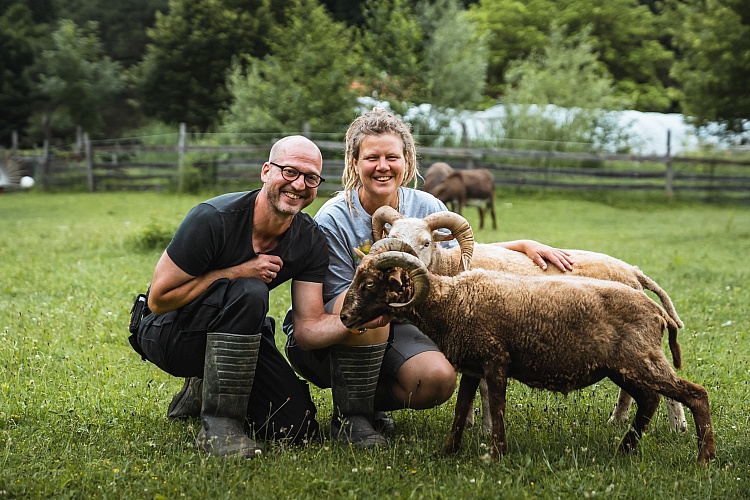
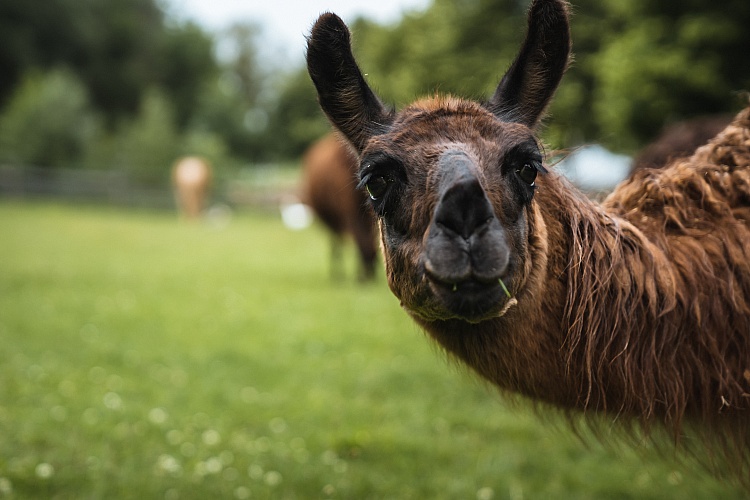
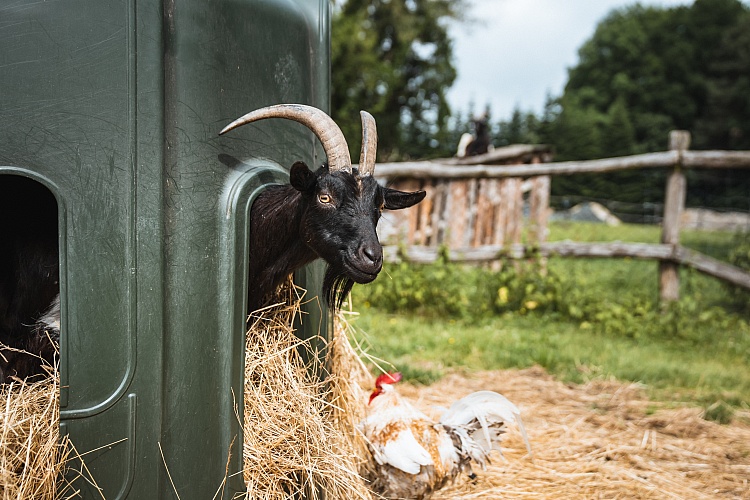
Then the neighbors discovered we had space — forty-five thousand square meters of it. You have so much room, don't you want two goats? Yes, come on, bring the goats. We have two pigs — don't you want two pigs? And so the number rose and rose. Today we have about 150 animals — horses, donkeys, cows, pigs, sheep, goats, llamas, nandus, ducks, geese, chickens, dogs, cats. The pigeons we don't calculate. All rescued, taken in when people couldn't care for them anymore.
Higher, Faster, Bigger
Before, my life was higher, faster, bigger. I wrote two books, and after the second one, in 2018, the really big business started — a lot of money, a lot of travel. And it didn't feel good. Every time I arrived at a goal, at something I had wanted to have, it felt empty.
The strange thing is, I didn't realize it. It was normal for me. And then three things happened.
The first was Elisabeth. She had founded an organization for sustainability, helping sustainable companies and people become visible. So she was living in this world of reduce, reuse, recycle — and I was on a plane five times a week, flying around, earning money. Two completely different directions under one roof. You could feel the tension of it.
The second was a phone call. I was somewhere in Germany, a thousand kilometers away, and Elisabeth called in the morning: there was water in the oven, where the fire should be.
I said, "Why does this always happen when I'm not here?"
And she said: "Because you are always not here."
That touched me very deeply. Because, of course, it was the truth.
The third thing was a wisdom conference in Germany that Nipun invited me to. One of the speakers was Lobsang, who cares for children in the Himalayan region — children with no parents, or whose parents have no money to feed them, in a place where the nearest x-ray is a two-day journey.
The day before, I had given a training. I had helped a mineral water company get its sixtieth bottle onto the supermarket shelf. The sixtieth bottle — where one should really be enough. That was my business.
After Lobsang's talk, we went to him and said, "We have some money for you, for your children."
And he said, "Yes, okay, I can take it. But not for my children."
We didn't understand. And he explained: "In our region right now, many people don't have enough food. So our children have decided not to eat one evening, and to give what we save to those people."
I don't know how to explain it. My whole world crashed down in that moment. I had come from this nonsense business, and on the other side of the world, children were choosing not to eat because somebody nearby had nothing.
That day I decided to change my life. It took a year and a half — contracts were signed, appointments were made — but I lowered my training days, and lowered them, and then I quit completely.
You Cannot Count It in Carrots
My business had been financing the farm, and without that money we needed another way to live — so, for four years, we grew and sold organic vegetables professionally. Elisabeth's idea, of course. Who else?
The transition was hard. On one side, I knew exactly what I could earn in a single day, just giving talks. On the other side, I was pulling carrots out of the earth. I calculated: how many carrots would I have to sell to earn what one day of talking earned? You cannot count it. You cannot physically grow that many carrots. It's absurd.
But here is what shifted. For thirty years, I had measured my satisfaction in money — I had trained it, the way you train anything for thirty years. And slowly the satisfaction moved away from the money entirely, into just being, surrounded by the vegetables and the animals.
The vegetables were part of the teaching. We started everything from seed, which is the harder way. A lettuce seed — you can barely see it, it's so small. And within two or three months, you have a whole plant you can eat. To start from zero and end with abundance: for me, that was magic.
They Read Us
But the deepest impact came from the animals — not one specific animal, all of them. What they teach, and what I tell every visitor, is how to be in the here and now. Not thinking about the future, not chewing on some drama from the past. Here. Now. That is where satisfaction arrives without any money, without anything. Brother David Steindl-Rast — one of my heroes — says the present moment is everything you need, the greatest gift we all have. I try to live that here. I don't always succeed — there is a lot of world-pain — but I'm trying, more and more often.
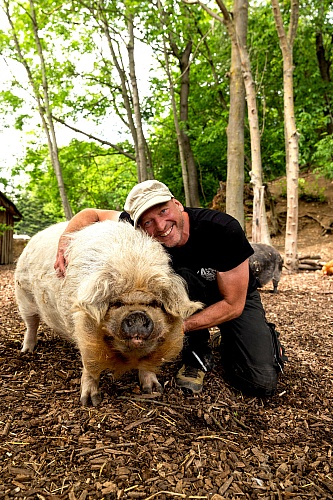 And the animals show you, every single moment, whether you are actually present. When I came home from my trainings, I was a different person. I had played a role all day — I trained salespeople, and salespeople are sharks; if you are not totally focused, they eat you alive in the seminar room. I played the strongman for twenty-five years. Elisabeth could feel it the moment I walked in — she had her own special word for it.
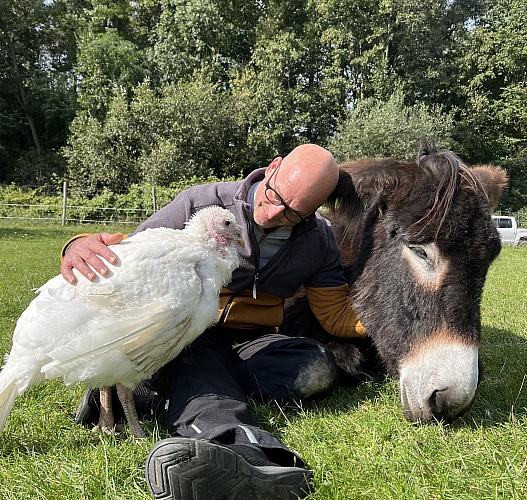
And not only Elisabeth — the animals felt it, too. When I calmed down, when I let the role fall away, they would come towards me, curious, wanting to interact.
And when I was still in that tense state? They go away. They don't want to deal with you. They say, "go away" in that kind of state.
Elisabeth walks our horses and donkeys in the forest without any lead rope; they simply follow her. And she knows: on a day when she has had a quarrel, or read the news and carries that world-pain, she doesn't take them out — because they won't follow.
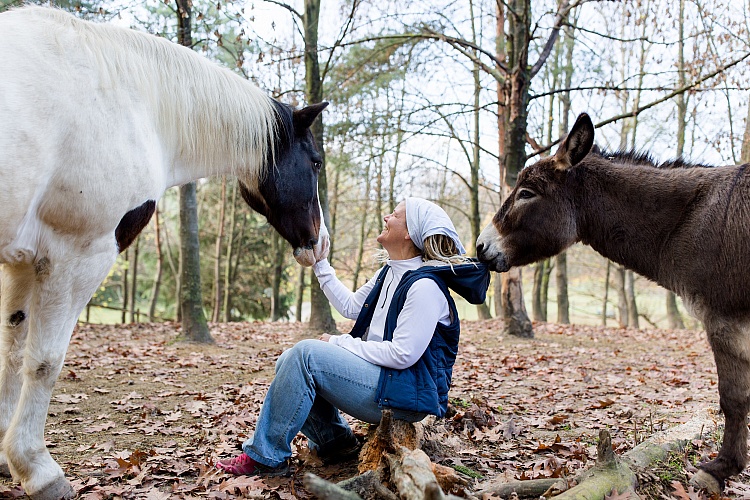
Even between species there are lessons. When horses sense danger — a piece of paper, some leaves — they run. Sometimes the mind switches completely off; they are just running. Donkeys are different. This is why people call donkeys stupid: when they face danger, they stand still. But they are not frozen — they are thinking. Once, Elisabeth was out with a donkey when hunters began firing nearby. The donkey stood for two or three seconds, moved calmly out of the forest, then stopped and waited for her. Ten seconds, total. That difference fascinates me. When you face danger — or just a person who is angry with you — don't switch off your mind and run. Take three, four, five seconds. Think about what to do next.
Are We Smart Enough?
We have to be realistic: we cannot save all the animals on this planet. What we do is a drop on a small stone. So the larger work of the sanctuary is communication — showing people that these so-called farm animals are just as intelligent and social as the pets we adore. Maybe as we are. On our podcast — Lass die Sau raus, "Let the Sow Out" — a university researcher shared a question that has stayed with me: are we smart enough to understand how smart animals are? Of course we aren't. Pigeons can identify cancer on X-rays and tell a Monet painting from a Picasso. Chickens dream, calculate, and even pass the marshmallow test — leaving food now, understanding more will come later. Chickens have a sense of the future.
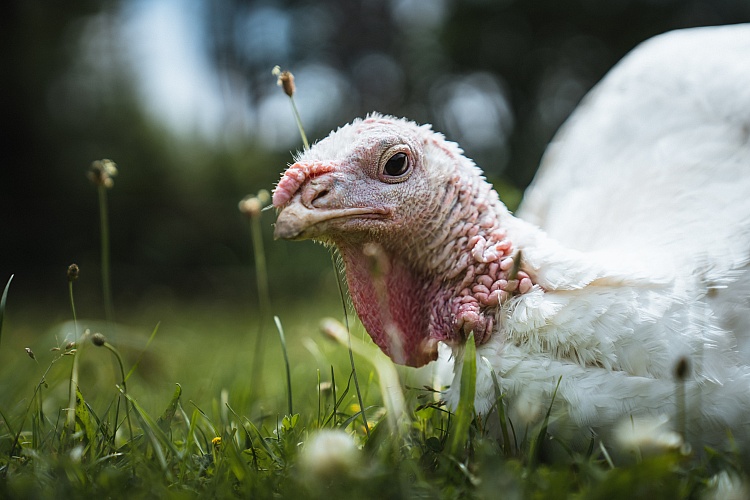
And you don't need a laboratory to see it. The pigs know the sound of our roosters calling their ladies — because a rooster who finds a worm doesn't eat it; he calls the hens over and gives it away. He's a gentleman. As for our goats, I am fixing fences week by week, because they always find the weakest point. Sometimes I think they are just letting us carry on with our business. Every animal is a different personality — what a joy, to know them as individuals.
One Touch
Thirty-five years ago, I was around twenty and the number one in karate in Austria. I went to an international training with Hidetaka Nishiyama, who was at the top of the pyramid. An old man by then, he was small and thin. Five hundred fighters were in the hall. And he called me out to demonstrate.
I thought: I'm strong, I'm fast, I'm going to show him how this works. He stood there completely loose and said, any attack. I thought, this guy is laughing at me. So I chose my fastest, hardest kick. And in the instant my leg began to move — before it had moved a millimeter — he touched my knee with one fingertip, and it was like a thousand volts through my body. His finger knew what my leg was going to do before my leg knew. Fine, I thought — the leg is slow, I'll punch instead. Same thing. One touch, before my fist had started.
I thought about that lesson again recently, and I finally understood the circle back to the animals. Nishiyama read my body without needing to see it; because you cannot see it that fast. He felt it. And that is exactly what the animals do with us. They read us without watching us. Bit by bit, living here in nature, I am learning itwhat that elder knew -- to sense the whole individual, not just what the eyes can see. That capacity is natural. It's in us. It just takes remembering.
The Garden Police
When you grow vegetables, the first thing to learn is: throw away all your knowledge. Gardeners with fifty years of experience tell me that every day they walk out and find something they have never seen before. So you watch. You watch your plants, watch your surroundings, and then you do what you think is right.
While growing vegetables, we had a plague of snails. You can buy the poison corn that kills them in five minutes, but we didn't want poison — for them, or for us. We didn't want to burden the soil; our vegetables were growing in that very earth. So we simply let the snails be snails. But it wasn't that we had only a few. Tall meadows surrounded our fields, so it was a true paradise for snails. Yet, they were rarely a problem, because our focus was never on the snails. It was on the plants. We raised strong seedlings ourselves, planted them in healthy soil, used no synthetic fertilizer, and watered only in the first days, until the roots had literally taken root.
Then came the thing that amazed our visitors. Under almost every head of lettuce, dozens of snails rested in the cool shade beneath the leaves — and left the lettuce untouched. People thought we were lying, so we invited them to come and look for themselves.
There was one exception: if a plant had been weakened — if a chicken or a pig had taken a few bites out of it — it often took less than twenty-four hours for the snails to consume it completely. They are not evil. They are doing what nature asks of them. They are a kind of garden police. They take what is already failing.
You can't do anything about the snails. They're part of the system. But you can make sure your plants are strong and healthy.
One year, we planted two rows of peppers, a few meters apart. They were all the same variety; every seedling was from the same batch. The first row flourished. The second struggled from the very beginning, and we never found out why. Too much clay? Too many nutrients, or too few? We still don't know. But the weakened row was stripped to the stems by hundreds of snails in no time. So the question stopped being, "What can I do against the snails?" And the question became: "Why is this plant weaker here? What does it need to become healthy again? Or what plant belongs here instead? "
The soil was telling us something. When we finally planted something else in that spot, there was no problem at all. It was not something to fight against, but an invitation to ask, "What is this showing us? And how can we change what we can?"
That has become a philosophy for the whole of my life.
Don't Feed the Snails
One question keeps coming back to Elisabeth and me: how do we deal with the heartbreak about the state of the world that catches up with us from time to time? Our sanctuary is a little paradise, but even here, we can't shut ourselves off from everything going wrong out there.
To me, the snails are the answer. I can't make wars, hatred, injustice, or the endless stream of bad news disappear. As unpleasant as it is, they're part of our reality — part of the system. But I can make sure that I stay physically and emotionally healthy, like the strong vegetables that the snails don't eat. I can spend time with people who do me good. I can be fully present here at the sanctuary, pet the animals, laugh, feel grateful, and put my energy into the things I can actually influence.
The snails don't disappear. But just like I no longer view snails as pests on the farm, the brokenness in our world systems also no longer get to define my life.
Animal poison would have been the easier way to deal with the "problem" of snails eating the weaker vegetables on our farm; in five minutes, the snails could be gone. In my life and career, the sales training was the easier way, too. This farm sanctuary is the hard way. But it is much more satisfying, and much more the real thing. When we are old, shortly before we die, I am sure I will say: sales was the harder way, and the farm sanctuary was the right way.
 And when you look closely, there is a paradox inside it. Nishiyama walked the hard way for sixty years — and because of the hard way, he no longer has to fight. He touches with one fingertip, spending no energy, and no speed or large muscles are required. The hard way, walked long enough, becomes the easy way. And the "easy" way, it turns out, was the hard one all along.
There is still water that finds its way into the "oven" of myself — days of pain at the world when I cannot stay in the moment, when I forget it is a gift. But more and more often now, I manage. I come in from the field, I put the strongman down, and I wait. And when I am truly here, the animals come to me. Not before. The horses will tell you the truth about yourself that you were too busy to hear. All you have to do is stop being somewhere else.
— as told by Andreas Nussbaumer on a Story Booth. View 10 video clips from the live conversation.
COMMUNITY REFLECTIONS
SHARE YOUR REFLECTION
8 PAST RESPONSES