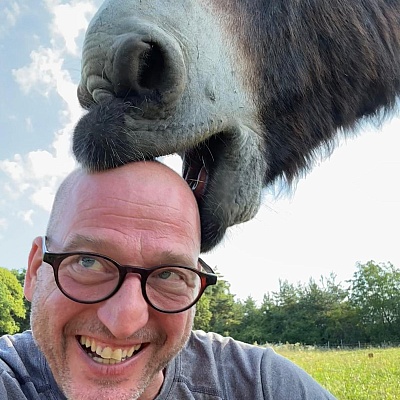
Andreas Nussbaumer used to be one of Austria's busiest and most successful business trainers. He wrote books, filled seminar rooms, and flew somewhere new five times every week. From the outside, his life looked like a great success. But on the inside, every time he reached a goal, something felt hollow and empty. Then three things changed him: his wife Elisabeth's gentle honesty, a phone call about a broken oven that was really about a broken marriage, and a story he heard at a conference about children in the Himalayas who chose to skip dinner so that hungrier neighbors could eat. That last one, he says, made his whole world crash down. He had spent his days helping a water company put its sixtieth bottle on a shelf — when one should be enough. He quit his career and moved full-time to Hof-Sonnenweide, a sanctuary in Austria where he and Elisabeth now care for about 150 rescued farm animals.
Living alongside horses, donkeys, pigs, goats, chickens, and llamas taught Andreas something no business seminar ever had. Animals cannot be fooled. When he came home still tense and performing the role of the confident trainer, the animals moved away from him. When he let that mask drop and became genuinely calm and present, they came close, curious and friendly. Elisabeth's horses follow her through the forest without a leash — but only on days when she isn't carrying worry or anger. The animals, Andreas says, read us without even watching us. They sense who we really are.
The farm also taught Andreas and Elisabeth a surprising philosophy through their vegetable garden. When snails threatened their crops, they refused to use poison. Instead they focused on growing strong, healthy plants in rich soil. Remarkably, the snails left the healthy plants alone and only consumed the ones that were already struggling. This became a guiding idea for their whole life: you cannot make the hard or broken things in the world disappear, just as you cannot make snails disappear. But you can focus your energy on staying strong and healthy yourself — spending time with people who lift you up, being present, and putting your effort into what you can actually change. The snails, like the world's troubles, don't define you. Only your own roots do.
Let's Talk About It
1. Andreas felt empty even when he was very successful, until he changed his life completely. Have you ever worked hard for something and then felt a little disappointed when you got it? What do you think makes something truly satisfying — not just exciting for a moment?
2. The animals at the sanctuary could tell when Andreas was pretending to be calm versus when he really was calm. Do you think the people around you — friends, family, even pets — can sense when you are stressed or upset, even if you don't say anything? Has that ever happened to you?
3. Andreas and Elisabeth discovered that healthy plants were left alone by snails, but weak ones were quickly eaten. They stopped asking "how do we fight the snails?" and started asking "what does this plant need to grow stronger?" Can you think of a problem in your own life where instead of fighting the problem, you could ask what you need to become stronger or healthier?
4. Andreas says the hard path — leaving his career, starting over, growing vegetables from tiny seeds — turned out to be the most satisfying one. Can you think of something difficult your family has done together that ended up feeling more rewarding than the easier choice would have?
After-Dinner Experiment
Tonight, try the animal test on each other — gently and kindly! One person leaves the room for sixty seconds and thinks about something that made them feel stressed or frustrated today. They come back in and try to act completely normal. Everyone else pays close attention — not to what the person says, but to small things: how they hold their shoulders, how their voice sounds, whether their smile reaches their eyes. Then switch, and this time the person leaving thinks of something that genuinely made them happy or grateful. Come back and see if the family can feel the difference. Afterward, talk about what clues you noticed. Andreas says animals sense our inner state without even watching us closely — this experiment is your family's chance to practice that same quiet kind of attention. Finish by going around the table and having each person name one thing they are genuinely grateful for right now, in this moment.
COMMUNITY REFLECTIONS
SHARE YOUR REFLECTION
8 PAST RESPONSES