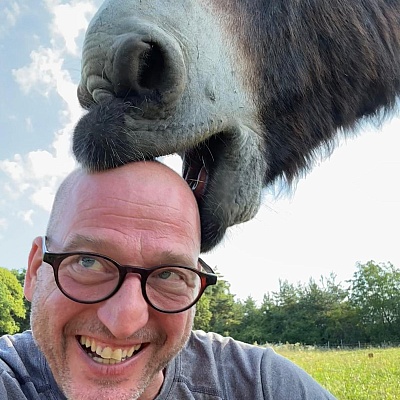
Andreas Nussbaumer had the kind of life that looks impressive from the outside. For twenty-five years, he was one of Austria's top sales trainers — two published books, packed seminar rooms, five flights a week. By most scorecards, he was winning. But here's the thing about scoreboards: they only measure what they're built to measure.
The cracks started showing in small moments. Every time he reached a goal he'd worked hard for, it felt hollow. Empty. He didn't fully understand why — it had been his normal for so long. Then three things happened close together, and they changed everything.
First, his wife Elisabeth. She'd already walked away from her own successful company to live closer to animals and the land. While Andreas flew around Europe training salespeople, she was building something quieter and more real at their farm, Hof-Sonnenweide, in Austria. Two completely different lives under one roof — and both of them could feel the tension.
Second, a phone call. Andreas was in Germany, a thousand kilometers away, when Elisabeth called to say water had gotten into the oven. His first reaction was frustration: "Why does this always happen when I'm not here?" Her answer stopped him cold: "Because you are always not here." He says it touched him deeply. Because it was simply true.
Third — and this one is hard to shake — he attended a conference where a man named Lobsang spoke about caring for children in the Himalayan region. Kids with no parents, or parents who couldn't feed them, in a place where the nearest X-ray machine was a two-day journey away. The day before, Andreas had spent his energy helping a mineral water company get its sixtieth bottle onto a supermarket shelf. The sixtieth bottle. "Where one should really be enough," he says. When he and his wife offered Lobsang money for the children, Lobsang said he'd accept it — but not for his kids. Why? Because the children had already decided on their own to skip dinner one evening and give what they saved to neighbors who had nothing. "My whole world crashed down in that moment," Andreas says.
He quit the training business. It took a year and a half to untangle the contracts and commitments, but he did it. He and Elisabeth turned their farm into a sanctuary for rescued animals — horses, donkeys, pigs, goats, llamas, chickens, and about 140 others. They grew organic vegetables to survive financially. He went from calculating his daily earnings in speaking fees to calculating how many carrots he'd have to pull from the earth to match one day of talks. "You cannot count it," he says. "It's absurd."
But something shifted. For thirty years he'd trained himself to measure satisfaction in money. Slowly, that measurement moved — into the soil, into the animals, into just being present. And the animals, it turns out, are brutally honest teachers. When Andreas came home still wearing the "strongman" persona he'd performed all day in seminar rooms, the animals would move away from him. When he let that role drop and became genuinely present, they'd come toward him, curious and calm. "They read us without watching us," he says. Elisabeth knows this too — on days when she's carrying stress or world-pain, she doesn't take the horses out, because they simply won't follow.
One of the most useful things Andreas learned came from watching snails. Their vegetable fields were full of them. Instead of using poison, they focused on growing strong, healthy plants in healthy soil. And something unexpected happened: snails would rest in the shade under lettuce leaves and leave them completely alone. But if a plant was already weakened — say, a chicken had taken a few bites — the snails would consume it within twenty-four hours. "They are not evil," Andreas says. "They are doing what nature asks of them. They are a kind of garden police. They take what is already failing." The question stopped being "how do I fight the snails?" and became "why is this plant weak, and what does it need?"
He applies that same thinking to the brokenness in the world — the injustice, the bad news, the things that feel too big to fix. He can't make those disappear. But he can make sure he stays strong: spending time with people who do him good, staying present, putting energy into what he can actually influence. "The snails don't disappear," he says. "But they no longer get to define my life."
Here's the reflection worth sitting with: Andreas spent decades chasing the "easy" path — high pay, clear metrics, applause. The farm felt like the hard choice. But he now believes the hard way, walked long enough, becomes the real easy way. The shortcut was actually the longer road.
What would YOU do? Think about something in your own life that feels like a "snail problem" — something you keep trying to fight or fix directly. What if the real question isn't "how do I get rid of this?" but "what in me needs to be stronger?" What would change if you asked it that way?
COMMUNITY REFLECTIONS
SHARE YOUR REFLECTION
8 PAST RESPONSES