
Natalie Porias is the CEO of Red Noses International, a movement of professional clown artists working across 11 countries to bring joy and psychological relief to people in hospitals, elder care homes, refugee camps, and disaster zones. She joined the organization more than twenty years ago as an intern. This story emerged from a Story Booth conversation, and is told in her own words.
I Just Googled It
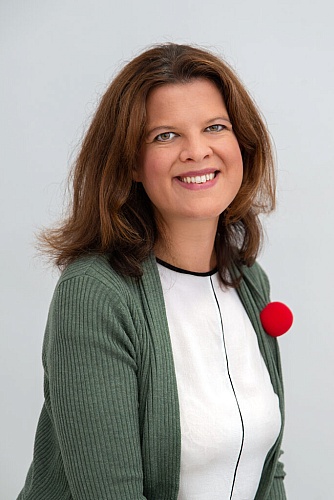 I always thought I was going to be a journalist. I never thought that leadership, the NGO world, and working with clowns was somehow in the stars for me. I was in my mid-twenties, fresh out of university, collecting one rejection letter after another — because the job market is looking for these superhuman people who have a ton of experience and at the same time don't cost anything. And then I saw an internship advertised at Red Noses. It was in fundraising. I had no idea what fundraising was. I just Googled it, and applied. Maybe a little bold. Or maybe when you're mid-twenties you're just like, might as well try.
I should say something about where I came from. I'm the daughter of a diplomat — I spent my childhood years for example in Ankara, in Turkey — and I had a wonderful life. I love my family; I learned so much from them: discipline, commitment, open-mindedness, how to take different perspectives, how to show up. But the part where emotions are welcome — where a feeling is something to feel and not just to handle — that was a bit underrepresented in my childhood. It wasn't part of the blueprint, let's say it like this.
So I walked into this office — we're still in the same office now — and it felt different. People were really nice here. You could see them smile. I'm not saying everything was perfect; we have our conflicts, people fight, it's not some happy bubble. But something was different. And then I was invited to an artistic workshop, with people coming from all over the organization — five or six countries back then. They were so united by this commitment to create art for something good, to connect people. They were so welcoming, and I had never felt so seen. It's hard to explain, because there is a difference between funny as in "haha, I was entertained" and this pure essence of joy. It's one of our basic emotions. We literally need it to survive.
I still remember taking the tram from my little flat to the office after that weekend, and knowing: this is the organization where I want to work.
Two Things Can Be True at Once
What I learned through the art of clowning is that all emotions are welcome. Not just the ones we like to feel. If you think about it, basically only joy is considered a positive emotion. So all the other emotions we have — are they not valid? Or are they equally important?
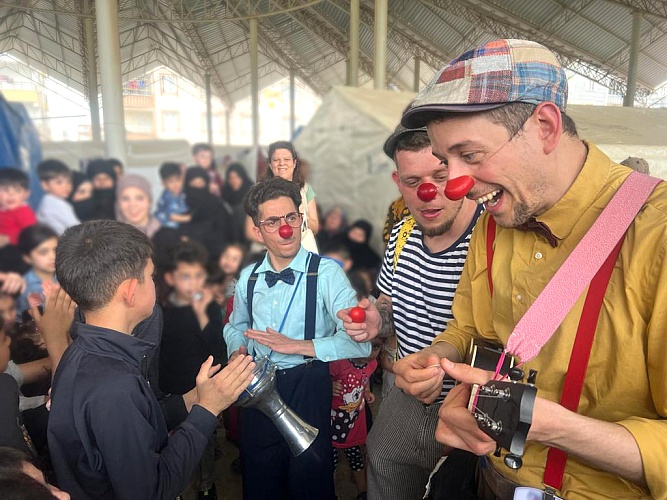
Clown play is not a binary. In a clown play, you are always saying "yes," because if you say "no," the game stops — there's nothing you can give your partner. And saying "yes" to an offer is also saying yes to all of the emotions. We go into hospices. I have seen children passing away, and it was a beautiful moment, and tears are okay. You can be ill, you can suffer, and you can be happy — maybe only for a moment, but both are true.
It's like a rainbow. You need the sun and the rain to have the rainbow.
Society looks for the binary because it's something we can control — light or dark, up or down. But the opposites create each other. Without dark there is no light. To accept that is what makes the human experience the human experience. For me it was such a liberating moment, such a secret to life. Very difficult sometimes to hold. So this is my little invitation: use the word "and" a little more in your day-to-day language, and you will see how things change. Replace "but" with "and". For instance, instead of saying, "This was a great job, but here are three things you should do differently," try: "This was a great job, and here are a few things that would make it even better." I learned that from clowns.
We Went Kind of Rogue
When the big earthquake hit Turkey, almost three years ago now, it was the weekend, and we didn't have a team there. But I knew immediately this was going to be a big one. An area the size of Germany was affected; that was hundreds of thousands of people. And I knew from my own work with traumatized children that earthquakes create the highest trauma response in people. We're not first responders, we're second responders — so we made contact with our partner organizations to assess the situation. And Turkey was a little crazy, because we didn't have a big partner on the ground. So we simply contacted somebody who leads a community center in one of the cities, and he invited us over, and I went with a team on a scouting mission for two weeks.
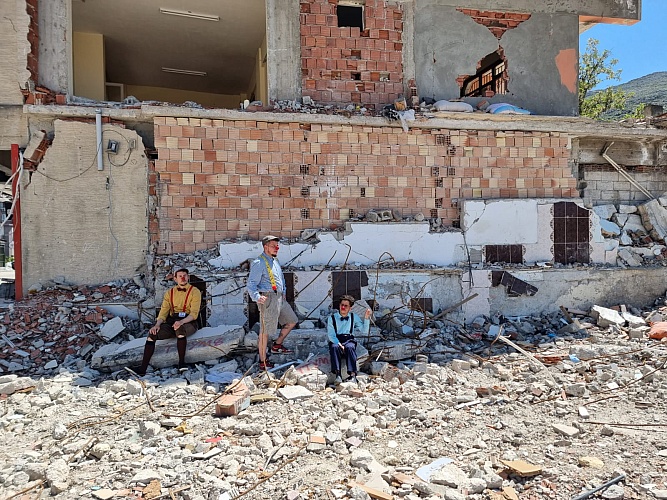
This was right after I became CEO. Basically my first assignment as CEO was a scouting mission into an earthquake area — a country that is very close to my heart, because I grew up there. Nothing was working, and there were no hotels. We flew into one of the largest cities you could still fly into, rented a car, and drove in. We slept in the community center: me on a bunk bed, separated by a curtain from my three colleagues, all of them male, all of them snoring. I had just become CEO, and here I was in the middle of it. But once you're there, you're just like — it's okay. I have a bed. I didn't lose my house.
One thing leads to another, and you get to know the one person who helps you. In our case, it was a teacher. We called her our Turkish mama, because she took care of us in this way, and she opened all the doors. I speak a little Turkish — just enough to order food, not to have a big conversation — but somehow, in these moments, you do not need words. Sometimes, we just started our activities right on the road, like street theater, because everybody was affected. And I remember in one of the makeshift camps, a lot of them organized by the military, I see this military man — I assume a general, the one with all the medals — walking towards us with soldiers, and I'm like, Oh, we're in trouble. But he just stopped, looked at the clowns, started to laugh, pointed, said something in Turkish, shook my hand, and took pictures with the clowns. "It's okay, you're allowed to work here."
That's the simplicity of human connection. You go in without an agenda — your only agenda is, "I want to connect."
Some of the nicest moments happen on the way from the car to the activity. In that same camp, one of our artists just started singing with a kebab vendor who had put a makeshift stand on the street — my teammate playing ukulele, the vendor singing in Turkish, a little crowd gathering. These were moments built on the pure essence of humanity. No transaction. This continues to amaze me, even after more than twenty years.
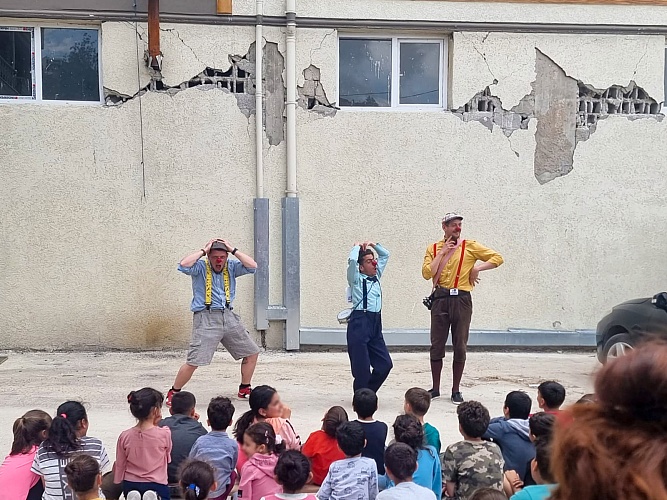
And I have to be honest: I was tired going in. The transition of taking over from our organization's founders was not easy — the original founders stepping out, a new generation stepping in -- it has its absolutely beautiful aspects, and there is also friction. Change never comes without discomfort. And counterintuitively — I didn't sleep well for two weeks, and I'm vegetarian, which is quite a challenge in Turkey, so I basically had to eat chicken because people shared their food with us and I felt too awkward to refuse — those two weeks gave me back so much.
One day, my manager brain kicked in: "Oh my god, we don't have an activity today. The center never reconfirmed. What are we going to do?"
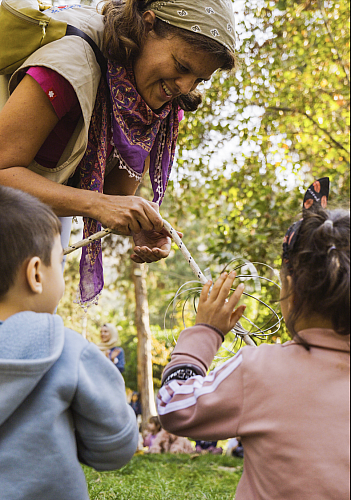 And my teammate just put a coffee in my hand and said — I'm not going to repeat the exact words, because they would need to be beeped out — "Calm down." And immediately, after I let go, children just came. The artists picked up instruments and the little circus props we bring, and made an impromptu circus workshop with five kids.
Not planned. So beautiful. You can't plan things, and somehow they work out.
There was one woman I will never forget. We were working a food line with a faith-based organization — food lines are always a little stressful, especially when you come with your kids and have to wait — and this elderly lady started interacting with one of our artists. That's the magic; they just gravitate towards each other. He kept trying to play his ukulele and dropping things and getting tangled, and she would step in, like, "Come on, dude." She sat there for at least forty-five minutes.
Afterwards, the gentleman who ran the food line came to me and said: I have never seen her laugh or interact with anyone. We really tried to get through to her. She hadn't only lost parts of her family in the earthquake — right before it, she lost her son in a motorcycle accident. Sometimes you hear these stories and you're like, come on, universe, are you kidding me? What else can you put on someone's plate?
Her story is her story — we cannot take that away, ever. But maybe we can put in a little sparkle, so that she feels it's not all dark.
You can have light and dark, and they can happen at the same time.
It Stays With the Clown
The clown is not a role you act. Your clown is born out of yourself — out of your shadow, the things you're trying to hide from society. It's a very vulnerable process, and it's why our artists train for years, more than 400 hours; simple does not mean easy. A clown is always present and never judges. You walk into the room and you don't see the sickness, you don't see the refugee camp — you just see the human being, and you're curious. When the red nose goes on, I don't even call my teammates by their real names anymore, only by their clown names. It took me a while to understand that.
As head of mission, I don't wear the nose. I'm in civil clothes, keeping the artists safe while they're deep in their interactions — and so people come to me. They say thank you, and then they start telling their stories, which is a huge gift. But I hear those stories as Natalie. The clown just sees the human being; I suddenly see what happened to the human in these difficult situations. Especially with groups who have experienced gender-based violence, which is a big topic for me, and one I find extremely sad and horrifying. In those spaces, it is hard. The artists have told me it's easier for them: once they take off the nose and go back into their real character, somehow the story stays with the clown. It's a bit complex; it took me a while to understand — and I think it's also very beautiful.
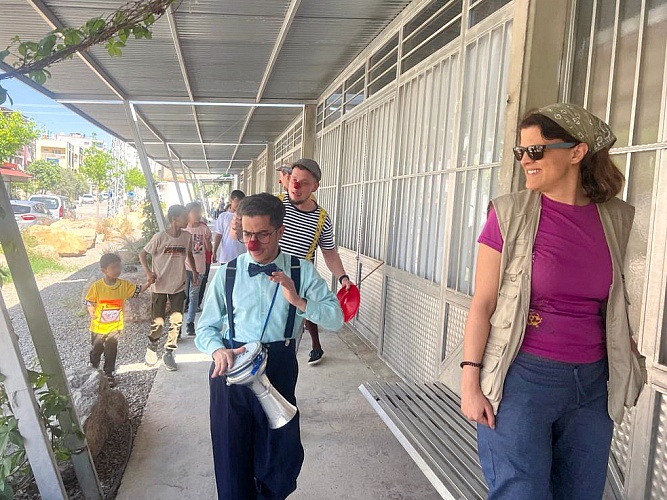
For me, without a nose, I had to build my own inner strength and resilience. I'm very vocal and open about it: I see a therapist once a week, and I think everybody should. I go to the gym once or twice a week, so why not see a therapist? It's gym for my soul. Don't wait until you don't know how to deal with your life anymore; go see a therapist when you're feeling well.
Strengthen the things that are going well, because they become your tools when things are not.
I talk to peers who also go on missions, because some things are hard to share even with your best friend if they haven't experienced the field. I make sure I have a session scheduled when I come back from a mission — even the beautiful things need to be made real. I take a quiet morning, a day off, sometimes a weekend where I don't talk to anyone and just go for a hike. Because if I'm promoting mental health, I need to lead by example. And I'm not this wonderful person who has no struggles and no vanities — I'm just a human. I had to work through my own belief systems like the people-pleasing or the striving for excellence. And then I realized: a clown never strives for excellence, so why should I?
What Would a Clown Do?
That's my question now, when I take something too seriously or get too stressed: what would a clown do, and what can I learn from them? I even think about writing a book one day — a short book, because clowns do not believe in big concepts — about presence, vulnerability, curiosity, not saying no. Not for leaders with titles, but for the mindset of leadership, for anyone who takes responsibility, even in their own family. Especially now, as the artificial becomes more important, the question isn't either-or. It's: how can we bring in the human more? It's an and.
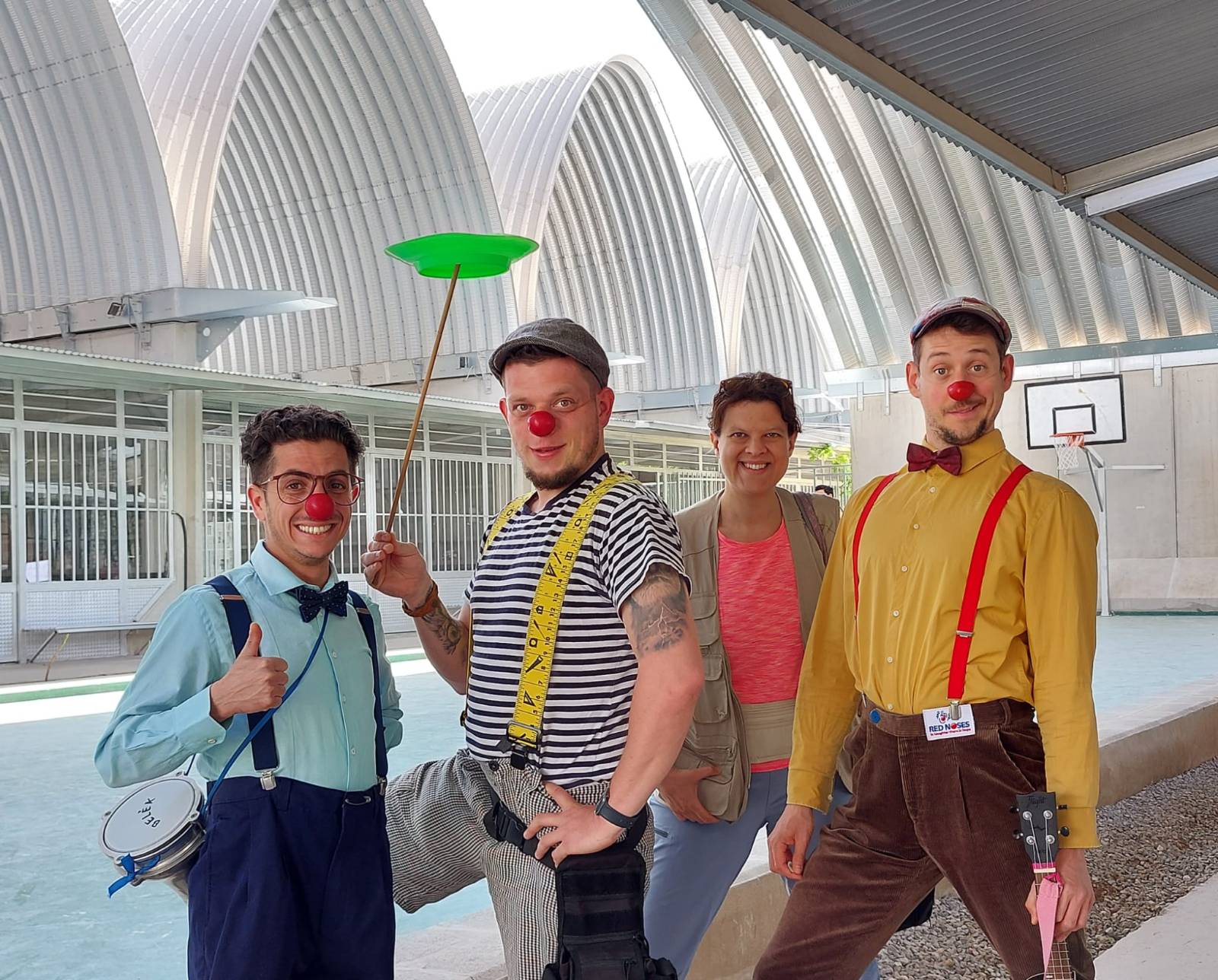
On the shelf in my living room, next to the pictures of my brothers and my nieces and nephews, there's a photo that our Turkish mama took of us on the way to an activity — me and the three guys I slept next to behind a curtain for two weeks. They were from three different countries: Slovakia, Croatia, Palestine. They signed it "Turkey 2023," and they signed it with their clown names: Leopold, Igor, and SimSim.
Twenty years after the tram ride home from the workshop, this is still what keeps me here. I washed the clowns' laundry, I did the fundraising, I became CEO, and I'm still not done. Somewhere near you, today, someone is holding both the sun and the rain. Maybe all any of us can do is walk in curious, without an agenda, and say, "Yes."
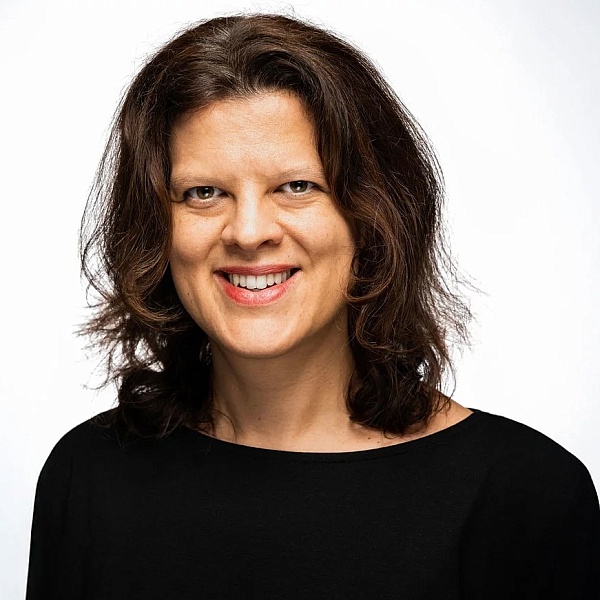 Natalie Porias leads
COMMUNITY REFLECTIONS
SHARE YOUR REFLECTION
6 PAST RESPONSES
You are making a huge difference in people's lives! As I discern my next vocation in this new chapter back in NYC, I've somehow become a secret agent of kindness, listening to young adults as they make their way in the world today. When they ask for advice, I usually share three ideas: find a therapist you like, figure out what brings you joy, and choose a vocation that makes a difference.
Thank you for telling your story. It resonates deeply.