
A Catholic boy from Kampala goes abroad chasing a business degree and comes home a Buddhist monk — to plant the Buddha's teaching in soil that had never known it, and to discover that the hardest ground, and the most miraculous harvest, both lie closest to home.
The boy who could not sleep
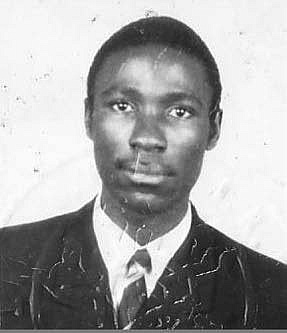
Long before he was a monk — before he had even heard the word — a restless boy in Kampala was learning to be still. His mother kept a saying close: "If you have nothing to say, keep quiet. If you have nothing to do, go to sleep." But the boy could not sleep. On the long, hot afternoons when she sent him to nap, he lay awake instead, watching her breathe, listening to the silence settle over the room. He did not know it then, but he was already meditating — and that ordinary stillness, learned at his mother's side, would one day carry him across the world and home again. He was born Steven Kaboggoza in 1966, into a Catholic family, in the green country Churchill once called "the pearl of Africa" — the boy the world would come to know as Bhante Buddharakkhita.
The search
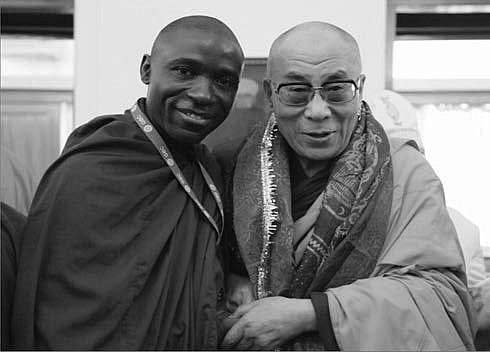
He did not set out to be a monk; he set out to be a businessman. In 1990 he flew to India for an MBA, and there, among the foreign students, he met two young Thai monks who quietly became his closest friends. They took him to the markets, fed him, and — without ever preaching — opened a door. What followed were years of restless seeking, a young man let loose in what he calls a candy store of faiths: he tried Baha'i, sat with Sufis, practised Hindu yoga, joined and left one tradition after another, and still felt hollow. One summer he took a night bus up into the Himalayas to Dharamsala and, in a crowd of Westerners — the only Black face among them — reached out and shook the hand of the Dalai Lama. Granted a private audience later, he asked how he might one day weave this wisdom into the culture of Africa. The answer was almost absurdly simple, and he never forgot it: "Find spiritual friends."
He took the advice to heart, and one of the friends he found was the teacher Vimala Thakar, a woman of luminous simplicity. Sitting with her once, pen poised over his notebook, anxious to capture every word, he heard her say gently, "Please stop writing." He looked up, baffled — surely he would want her guidance later. "I am writing in your heart," she told him. He set the pen down. It was, perhaps, the first time he understood that what he was chasing could never be stored on a page — only lived.
His path wandered before it settled. He even spent a season as a scuba-diving instructor in Thailand, sinking into meditation underwater in the posture of the Buddha. But in 2002, after years of training in the United States under the revered teacher Bhante Gunaratana, he took his vows — and was given a new name: Buddharakkhita, "protected by the Buddha."
Coming home a stranger
Then came the hardest journey of all. He had been gone seven years, and his family expected a prosperous businessman to step off the plane with a briefcase. Instead came a shaven-headed man in brown robes, carrying meditation books and a large Buddha statue. His sister, unsure what to call him, settled on "Pastor." His mother walked slow circles around the living room, tears running down her face, asking again and again, "Is that you, my son, Steven?"
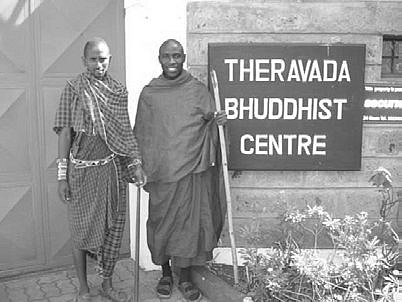
In a country that had never seen a Buddhist monk, he became a walking riddle. Children fled, certain he would eat them. Two women argued over whether he was mad — "A madman cannot afford to stay in such a good hotel," one finally decided. A tax collector demanded, "Where are your tax-tickets, you Maasai?" Taxi drivers slowed, saw his robes, and sped away. When he tried to buy land, the neighbours would not speak to him at all; sure he was a wizard, they addressed only his companion. Even the Buddha statue his name had vowed to protect drew suspicion at every border. "Is that a baby?" an official asked. "Where is its boarding pass?" Another recoiled: "It looks like African magic — witchcraft."
Returning good for evil
What he did with all that fear is the quiet centre of his story. After he founded the Uganda Buddhist Centre in 2005, a rumour spread that he was keeping a kidnapped child behind the locked door of his little temple. One day soldiers broke the door down to rescue the baby — and found only the serene bronze face of the Buddha. Later, a darker rumour took hold: that the centre was selling children's heads overseas to pay for its building. Bhante did not argue, did not defend himself. He opened a school and raised scholarships for ten village children — and chose, deliberately, to give one of them to the child of the very man who had spread the lie.
"It is always good," he says, "to return good for the evil that comes with human limitations." Months later a note arrived: "Mr. Buddhist, thank you for paying school fees for my kid." With it came a bunch of bananas.
The seed returns to the soil
And slowly the ground softened. The most improbable harvest, it turned out, was the one closest to home. Within a month of his return, his mother, his sister and her husband, and several nieces and a nephew had all become Buddhists — an echo, he notes, of the Buddha's first five disciples. But it was his mother who went furthest. She had been drawn in, at first, simply by the beauty of the Buddha statue; she would stand gazing at it, absorbed. She took the precepts, he says, "easily and naturally," as though she had been a Buddhist all her life without the name for it.
Then she asked to ordain. He warned her how hard it would be at her age — the shaved head, the robes, no solid food after noon. She only laughed. "If you can do it, I can do it." She would not settle for a temporary vow: "I will become a nun for the rest of my life. I will never disrobe." On the morning of her ordination he arrived to find she had already shaved her own head, before he could even ask. He gave her a new name — Dhammakami, "one who loves the Dhamma" — and in 2008 the woman who had first taught him stillness became the first Buddhist nun her country had ever known. The seed had returned to the soil it came from.
What grew
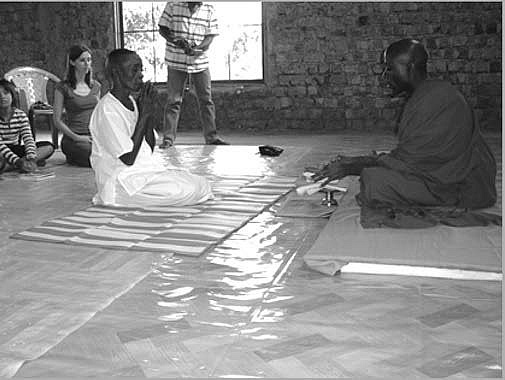
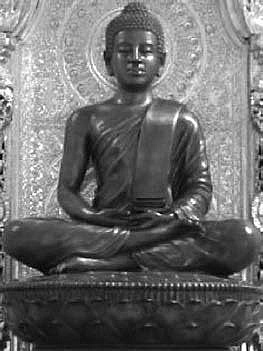
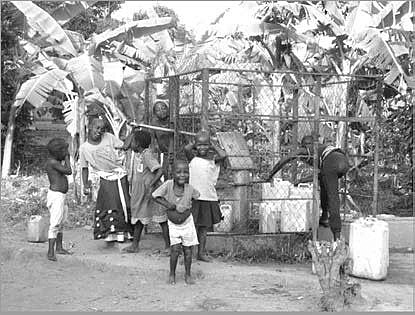
From a single monk's tent, an oasis rose on the shores of Lake Victoria: a meditation hall, a school, a clinic, and a borehole that, for the first time, brought clean water to the village. Where neighbours had once fled, they now waved as he passed — "Bye, Buddha!" The centre's bronze Buddha, a gift from Thai devotees set upon a Burmese throne, was cast with African features and named Mirembe — "Peace" in the local tongue. In his hands, the dharma did not replace a culture; it took root inside one.
Honour came to him as strangely as scorn once had. The same monk who had been frisked with suspicion at an embassy in his own city was later welcomed as a dignitary in Japan, where a Ugandan king rose to speak for Buddhism. He learned to hold both the same way. "Honour and dishonour," he says, "are just worldly winds." Even surviving a gunshot at close range did not turn him bitter; he speaks instead of transforming trauma into dhamma, and offers, with a smile, the four words that may be his whole teaching:
More dharma, less drama.
The orchard he may never see
Even now there are only a few thousand Buddhists in all of Africa, and just two monks for Uganda's forty million people. Bhante knows he may not live to see the orchard he is planting; his quiet hope is to ordain fifty-four novices, one for every nation on the continent. And so he keeps planting — patiently, in silence, without grasping, the way a sleepless boy once learned at his mother's side — trusting the seed.
"I have great faith in a seed. Convince me that you have a seed there, and I am prepared to expect wonders."
— Henry David Thoreau, a line Bhante loves
COMMUNITY REFLECTIONS
SHARE YOUR REFLECTION
2 PAST RESPONSES