
Ursula Kermer is an art therapist in Austria who, since 2013, has nurtured Mehr ist Mehr — "More is More" — a community of volunteers who knit and crochet squares that other volunteers assemble into blankets, twiddle muffs, and clothing for people moving through hard chapters of life. This story comes from a DailyGood Story Booth conversation, and is told in her own words.
Maybe this is a transformation
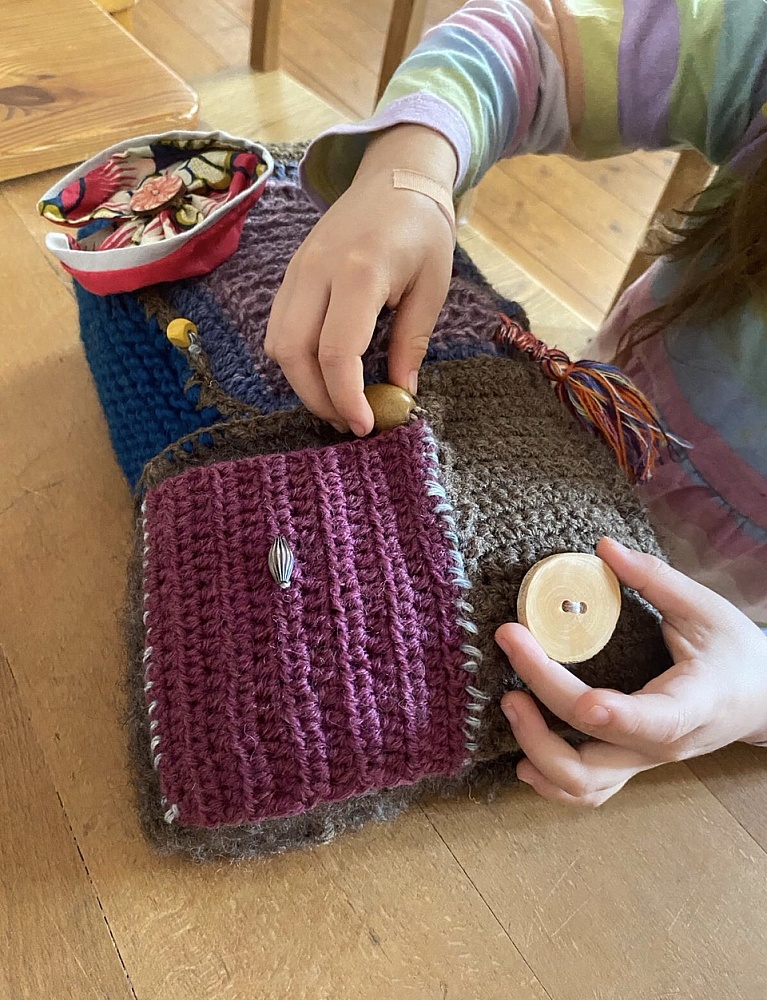 Two weeks ago, I went to a school. We were making a classroom blanket — the children create the pieces, and the blanket stays in their classroom, one thing they made together and share. There was one particular child. He took one of our twiddle muffs — a small knitted tube you can put your hands inside — and he stayed with it the whole time. Afterwards the teacher asked me what it is, and if it is possible to buy one, because this child suffers such anxiety, and she just saw that he calmed down in a very easy way. I gave her two of our muffs, for the classroom and for this child, so he can also take it home. And we made a plan that I will come back in a few months to make muffs with the children themselves. We first thought of the muffs for older people with dementia, but we found out they are really nice with children too — children with ADHD, children in the autism spectrum. They can cuddle it, touch it, hold it close to the heart, and it calms down.
Maybe this is a transformation. I have to be honest: when people ask me for stories of transformation — someone whose life changed completely through our project — my mind draws a blank.
Our project does not solve problems; it does not make crisis go away. But it's constant. And this constant space where they can reconnect — I think this is the power they get from it. They can come in every emotional state. One day, they can be loud, and then, they can be calm.
I should say something about where I come from. I am an art therapist. There are group sessions in art therapy, but often people come in single sessions, and it's an important guidance, a good experience — but within my own process I felt that community and good relationships are the basis of social health. Of psychological health as well. So I was always searching for ways to offer a social network. For a long time I worked with people in refugee homes, and after natural disasters we went to places where people were in very fragile situations. It was not the time to start a trauma therapy — the situation was still fragile — but we could offer activities for stability, to relax, space for children to play in a safe space. So I'm not the single-setting therapist, so to say. I work with teenagers now in single sessions, but I am always open for projects where we can create together, in community — a space where people can relax and calm down, connect, and get empowerment. A space where relationships are easier, maybe, than at work, or at home, or wherever.
If you ask me for one image of this whole journey, it is the network.
The network which is growing and moving, and provides a resilient safety — for me, and I hope for others as well.
It started with an idea
At that time, I was still working on a project in West Africa, in Niger, coordinating a network between designers and tailors. Through that project I got to know a designer in Austria — originally she's German — who was working with hand-knitted wear. 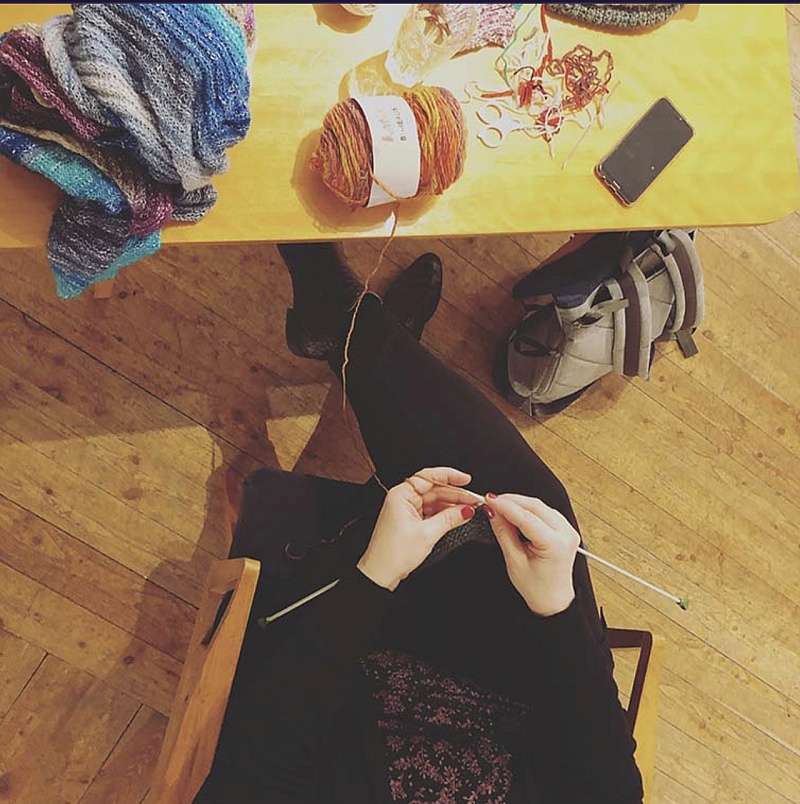 We talked a lot about handicrafts, about the difference between slow fashion and fast fashion, and about community knitting projects where people come together and cover public objects, or trees. We thought it's such a nice idea — people together, one goal, creating something with their hands, a symbol of this togetherness. But we also value handcraft a lot, and we saw that after one or two rainy days, everything is ruined. We wanted the same energy — to connect people — but also to honor the product we create together. So we thought about blankets. And boleros, a very simple item to cover your shoulders. That's how it started, in 2013. We got invited to design events, we went to social institutions, and we experienced this generosity of handicraft people. It started with an idea and a first set, and then it began to move in a very dynamic way. It still is. We don't have finance, and that makes us very free, very independent. I think this is the magic.
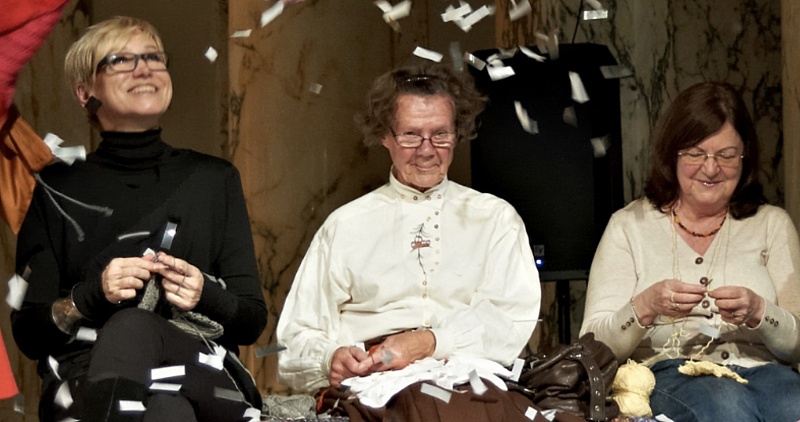
In our knitting circles, people come together and we are so different, right? Some people talk a lot, others are more quiet, and in these settings everyone can find their place. There is a social warmth evolving. It's like family. I remember when my mother was knitting, or my grandmother — it was always very calming. This repetitive movement of our hands somehow can calm our minds; we can regulate our nervous system. Especially in times where our digital appearance is bigger than our physical one, it's a good way to balance — to have the experience that we did something with our own hands. One of our knitters put it like this: "It's the unfocused chatting during knitting circles that's so great. I can relax so well."
The people who come to our community space have very diverse life experiences. In the outside world, I think, they would never meet — there would be no club, no café, no other event where they would connect. But they exchange experiences. One lady is in community politics, and there are always difficulties in neighborhoods, and people give advice to each other. During the COVID lockdowns, we met every week online for a knitting gathering, and this was so stabilizing. That group still talks about this time, and they are so thankful — even though they are so different, they have this experience as a social resource. And when we knit in public spaces, in the open, people passing by can talk to us. Men who usually don't knit in Austria stop and tell their stories, their memories of their grandmothers. Some of them tried, and sat down with us.
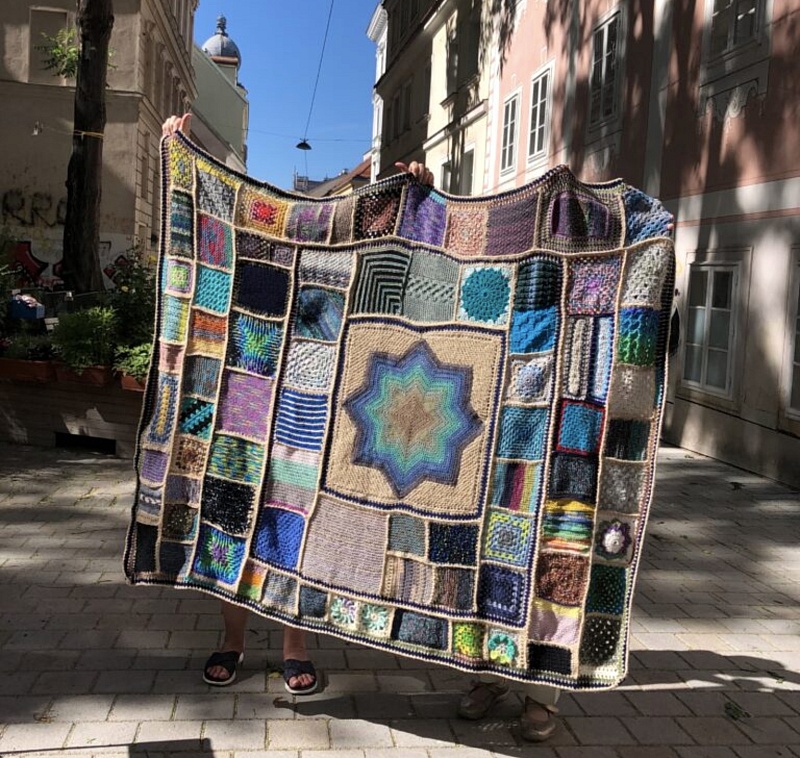
In this diversity, we can get a whole
Everything goes through my hands, so if I see a blanket, I can recognize who did what, more or less. We have one knitter who likes American football: he takes two colors, one for each team, and knits following the game. So we have striped pieces, and he can look at one and tell you who played and who won. We have one woman who appreciates Mehr ist Mehr ("More is More") so much because it gives her the opportunity to try very complicated patterns — really unique, different patterns every single time. And one woman is an artist; I would recognize her pieces from a hundred meters, her color choice is so distinctive. Everyone has their own universe.
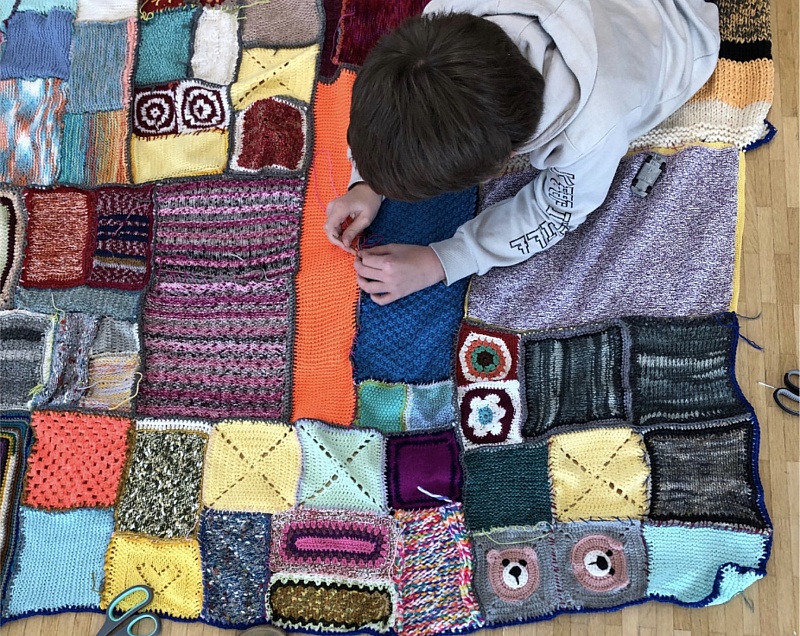 The squares come in very different sizes, so putting a blanket together is always like solving a puzzle. We are thrown to colors, we get our color mix, and then we put it together — and somehow it is so nice to experience that in this diversity we can find a form together. We can get a whole. In Vienna, we are about five, six women who puzzle together, and we are — how do you say? — we need to puzzle. We talk a lot about color, that it's like food — like we are thirsty to be with colors. It's not meditation, but it's quite fulfilling. I cannot describe it better.
And it's also like a resilience training. With creative processes we experience that it works, that it gets beautiful, that we can focus on what's good for us — in a very abstract way, but still: I can choose the color. I can choose the size. I can trust the process. This is the power of art, that we experience life in the essence of it. It teaches us so much about life, about community, and about non-verbal communication. In our project, it doesn't matter if you tell about yourself. You don't need to talk about your work, or if you have children or not, if you have a partner or not. Everyone can share whatever he or she wants to share. The activity makes it respectful.
Somehow, people find our blankets
We thought a lot about whom to gift our creations to, because sometimes gifting is not what people need, or what people want. So we connected with social institutions — people who know their clients — and we wanted it to be something like a choice. For example, we always provide blankets to a social counselor. Now our winter starts, it gets colder, and there are a lot of people with difficulties paying the heating bill. She has the blankets in her office, and people look at them and ask her what it is — and this is an opportunity for her to offer, and then they can choose.
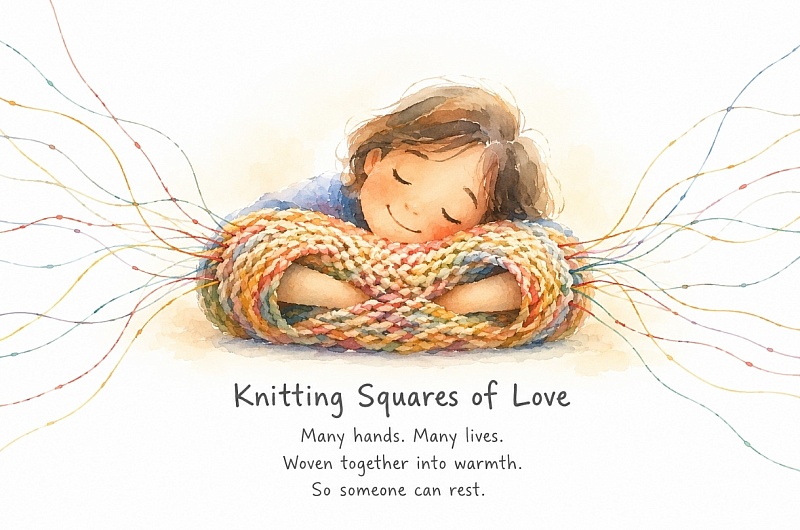
We also ask therapists, for example in rehabilitation centers, to pass them on, and to tell people our story: that we create this warm item in community, and we want to share this physical but also social warmth with them. I think we all know that if we go through a crisis, there are a lot of very silent moments where we are on our own and we have to process whatever changes in our lives. This could be a moment where you cover yourself in a blanket made by a lot of different people who have all experienced crisis. There is one institution for families with children with really severe illnesses, like cancer. The whole family can come for a holiday — also the siblings. It's a really powerful healing space, with sport activities and art activities and counselors. Our blankets are there in the space, people can use them, and if someone gets really attached to one, they can take it home. Somehow, people find our blankets. This is what I like about it.
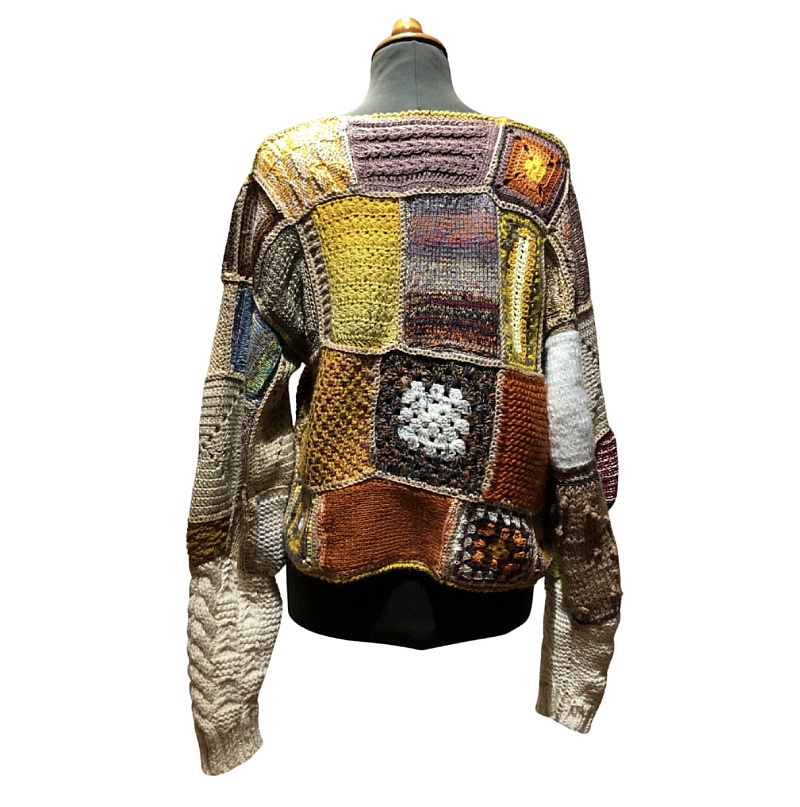 Most of our volunteers never see where their offerings end up. I photograph everything and communicate every step, so they know where it ends — but not with which person. I think this is also a respectful way. And the giving flows toward us, too. Until this spring, when I had to pause it because of other work, we got three or four packages every week — knitted and crocheted pieces, wool, pullovers, little animals, little dolls, everything you can imagine. What we can feel is that there is such a love to give. And it is so nice to channel it.
They are enough
For a big percentage of the people who join the movement, a big part of their identity is to help, to do something for others. I find this very, very interesting. Because, to be honest, to help someone else is sometimes also a compensation — a reaching out to be a valuable part of society. And there are not so many opportunities where you get validation for that. So this is what I try to do: to see them, and to give them that feedback. And to focus on their well-being — because there are women who have worked so hard in their lives that their bodies are aching, but still they carry bags of material. This is where I try to intervene.
Even if they don't carry that, they are enough.
Over the years, I asked myself several times: why am I doing that? How can I get finance? My other work — the work I get paid for — sometimes gets into the background, which is not so easy. Sometimes I thought, okay, I want to get finance for this project so I can work fully on it. But then I also see that this is the magic of it: there's no money involved. We are all equal — no one is working, everyone is sharing.And there is always something to do, always things I really like. I like to take the pictures, I like to communicate with the social institutions, with the knitters — I like all of it. For my life, it's a gift.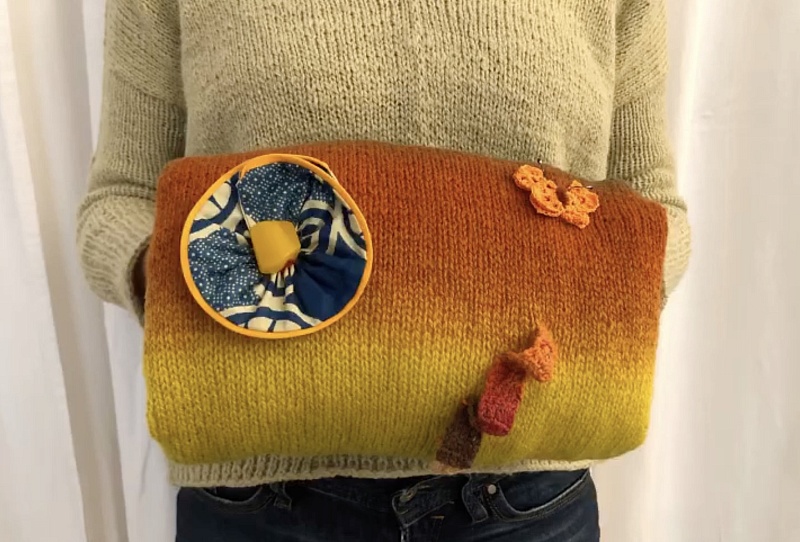
In a few months, I will go back to that school, and we will make twiddle muffs together, the children and I. Children mostly want to give what they make to someone they know — their parents, their grandparents, their siblings. Their social radius is maybe not that big, and I think this is something really nice; as adults, our perspective is wider, and we can feel joy when we help someone we don't know.
COMMUNITY REFLECTIONS
SHARE YOUR REFLECTION
3 PAST RESPONSES