
Prakash Mathew came to Fargo, North Dakota, in 1971 with everything he owned in one suitcase. In recent years, he and his wife Jane sat in their driveway after gardening, greeting whoever walked by — until she passed away last December, and he turned those extra chairs into something intentional: Driveway Dialogues, where neighbors circle up every other Thursday for conversations about trust, community, and loving your neighbor. This story comes from a DailyGood Story Booth conversation, told in his own words.
Do You Want Any Help?
Just today, I was outside trying to put together a Christmas tree, a winter tree, for the front of my house. I'm not a very handyman, and you could see that I was just struggling. And a young man who is a participant of the Driveway Dialogues happened to drive by. All of a sudden, he stopped and said, "Do you want any help?" And I said, "Yes, I do."
He didn't have to stop. But I think that is an outcome of this wonderful story I want to tell you about. Long-lasting relationships and friendship are formed through this driveway dialogue process.
Every other Thursday in the warm months, neighbors circle up lawn chairs in my driveway here in Fargo, North Dakota, and we have a meaningful conversation. We call it Driveway Dialogue. And let me be very honest with you about the motivation behind it. I have never experienced what we have experienced over the last ten years in our country — a divided country. And yet, whenever I walked around my neighborhood in these last years, not one person treated me poorly. I could have a good conversation with anybody. So why are we so divided? Can't we have a healthy community? I really felt a hunger to do something about this.
People are generally good people. The driveway is where I decided to test that.
All I Had Was a Suitcase
I should tell you how I ended up in Fargo, because everyone asks. I grew up in the southern part of India, and I went to college in the north, about over thousand miles from my home. While I was there, in 1968, a team came from the United States, and I was paired up with the one person from Fargo — the pastor of the downtown First Presbyterian Church, Ross Robson. We spent a day together and we just got along really well. His whole family eventually became my surrogate family.
He went back and told his church he had met this young kid in India and he really wanted to bring me here. They were praying for me for about three years, and I didn't know this was all going on. Then he sent me three graduate school applications, and I got admitted to all three places. So I wrote back to Ross and said, "Well, since you did all the work, where do I go to school?"
He humorously replied, "I just did that for fun. I'm the one who's bringing you — so you're going to North Dakota State University. You don't really have a choice."
I came with a suitcase in my hand, all my belongings in a suitcase. That was in 1971 — fifty-five years ago. I went to school there and ended up spending my working life at that university. I cannot even fathom how my life has come together in such a way. It was truly God's plan!
In India, my father had the opportunity to work with Mahatma Gandhi, so people often ask me, "Is Gandhi an inspiration for you?" And I say, "No, my dad was my inspiration. He is my hero." He was a true, true servant leader. I was blessed to have that model in my life.
We Will Sit and Shoot the Breeze
Jane and I had this in common. When we went for our walks, we could hardly walk two blocks without stopping and talking to someone. We both liked people. We wanted to get to know them.
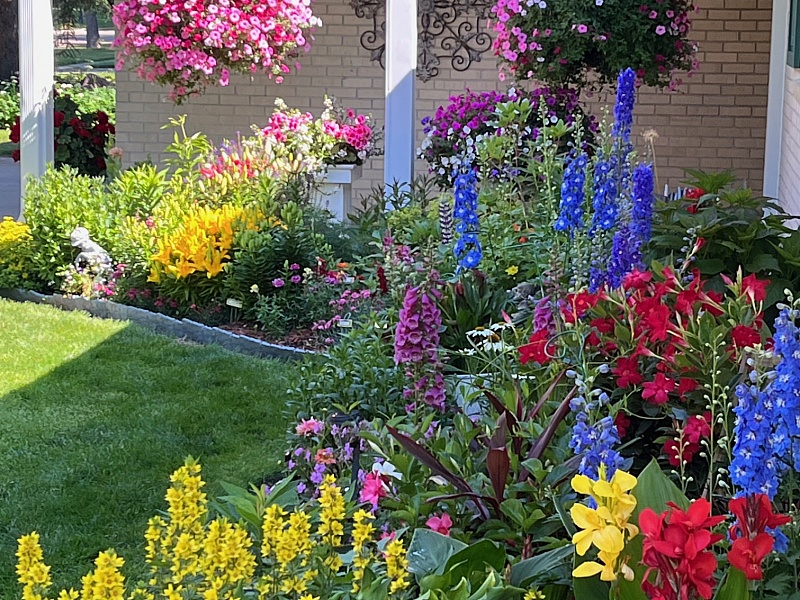 People were coming in front of our house primarily to see our garden. They all made the comment, "Prakash, you have a green thumb." And I said, "No, the last time I looked, I don't think my thumb is green." My philosophy about gardening was: what you put in is what you get out. I took care of the garden just like people — there every day, pulling weeds, giving water and nutients, and almost talking to the plants and flowers.
Nobody can walk by our house without us saying hello to them.
 If passersby had time, we always invited them. We always provided extra chairs, and we would sit and shoot the breeze — no real agenda. And as soon as they left, I wrote their name down. The next time they came, even a hundred feet away, Jane and I would look at each other: "Okay, what is their name?" As soon as they came, we surprised them by calling them by their name, and they could not believe it. And what happened was, they started doing the same thing.
That continued for about five years, until Jane died. She was in perfect health — she was a marathon runner — but one day last December she was at the gym, and she collapsed and died, just like that.
Something Very Intentional
When summer came, I knew I would still go and sit in the driveway, and that people would come and join me. At first I thought, well, maybe they're joining me in sympathy, because Jane has passed away. But in the meantime, I was thinking: I want to do something different. Something very intentional.
I tested the water with half a dozen people in the neighborhood. "What if we did this — sat in my driveway, but intentionally, every other week, with a topic?" They all nodded, and I thought, is that a formality? Nobody wanted to disappoint me. So I drafted a letter and put a framework to it. And then I thought, "What do I call this?" All of a sudden — I don't know where it came from — I said, okay, we're going to call this Driveway Dialogues. Everybody loved it.
Some people said, "Maybe we can go in the backyard." But there is something special about sitting in the front of the house. I do my barbecuing in the backyard. But when you sit in the front, it is welcoming.
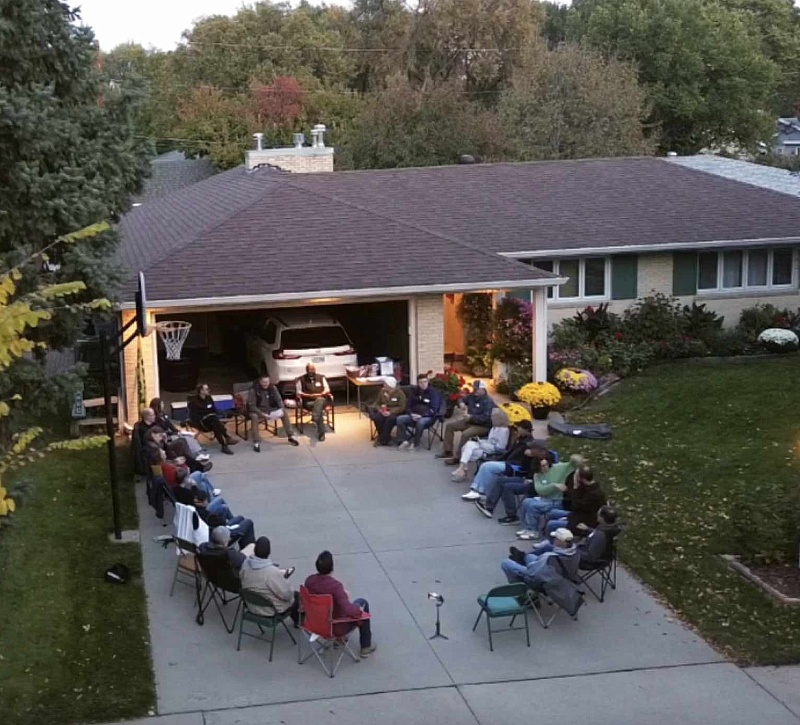 For the first meeting, we had about a dozen or more people, from about a three-mile radius. Somebody suggested name tags. I ordered pizza and beverages, and we got to know each other. That was the first step: in building a community, the number one step is getting to know people by name. People love to be called by their name — when a three-year-old comes and calls me by my name, it just melts my heart.
Then, our circle started growing and growing. One time, a participant named Scott was walking from his home, about six blocks away, carrying his lawn chair, and another neighbor asked him, "Hey, where are you going?"
"Oh, I'm going to Prakash's house — there's a session called Driveway Dialogue."
They conversed the whole six blocks down to my house, and by the time they reached my home, Scott said, "Do you want to come and join?" And he did.
What Kind of Seeds Are We Planting?
We put some guidelines together.
Number one: no talking about politics.
Our first dialogue was on "Relationships." "Building Trust" was another. "Loving Your Neighbor" was the third. "Freedom of Speech" was a very interesting one — we thought it might bring the politics in. That never happened. A young woman, who is a dynamite attorney, led that session and just laid the groundwork: "Nobody lectures to anybody."
Another week, the topic was "Reap What You Sow." There, as a gardener, I could easily relate. We spent almost fifteen minutes on one question: "What kind of seed are we planting?" If we are a negative force, we are going to reap negative results. If I'm going to plant zinnia flowers, I cannot expect a tomato plant to sprout out of that zinnia seed.
People often ask me, "Prakash, you're a person of color, and there are not a lot of people of color in this part of the US. How have people treated you?" I've been treated very, very well. Otherwise, I wouldn't have lived here for fifty-five years. I take very little credit for it. Most of the time, we know what to do. If you practice those things, it works like a magic.
You treat people with respect and dignity, and they are going to treat you that way, too.
We Need This
I originally planned to stop the dialogues for the winter. But everyone said, "No — we need this." So the next driveway dialogue is going to be inside my house. My son was here last weekend and we started setting up the chairs already. There are going to be at least a dozen new people, no exaggeration, who have never been to one of these sessions will be here. I have no idea how many are going to show up. It's a nice problem to have, in some ways.
When that young man stopped to help me while I was struggling with a Christmas tree in my front yard — I don't think that was a coincidence. That spirit is what has been planted, with a garden, a few extra chairs in front of the house, and a curiosity to care for others. Maybe that's where it starts: with a chair or two set out where people can see you, and nobody walking by without a hello.
COMMUNITY REFLECTIONS
SHARE YOUR REFLECTION
2 PAST RESPONSES