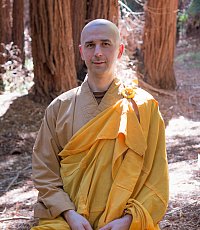
Bhikshu Jin Wei grew up in Poland and lived a colorful bohemian life before the Polish translation of a sacred text sparked a journey of inner growth and transformation. In 2013, he moved to the City of Ten Thousand Buddhas in Northern California, where he took full ordination as a Mahayana Buddhist monk in 2017. What follows comes from a Story Booth conversation, told in his own words.
What am I doing here?
I remember the moment I got my student visa and a plane ticket. Yes — I will fulfill my dreams. I'm going to the City of Ten Thousand Buddhas with one suitcase of belongings, ready to explore life. I crossed that spectacular gate to the city in Northern California. There were peacocks, deer, so much nature, and I was so happy and touched.
How long did this "honeymoon" last? Two weeks.
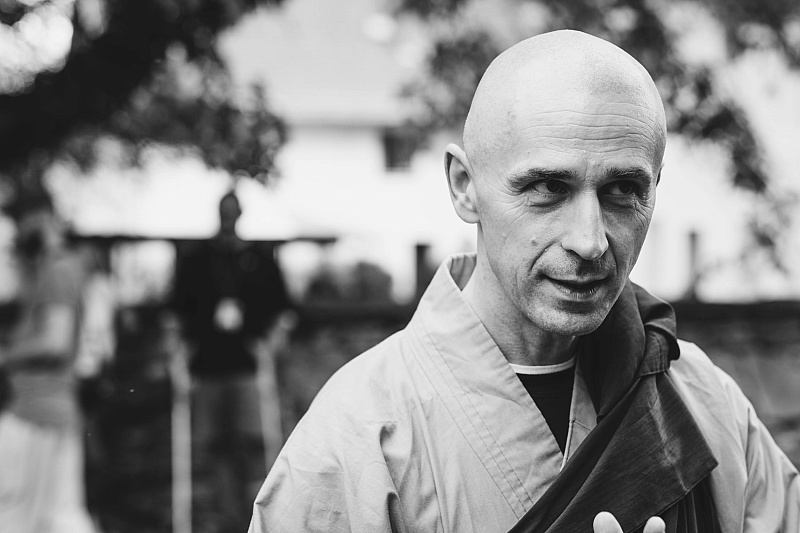 I remember the moment clearly. I was volunteering at the farm at the monastery in early morning. You think California is super hot? Not necessarily in Northern California, and definitely not in the wintertime. I was standing there with one layer of clothes, trying to dig a hole for I don't know what, and I felt cold. I felt lonely. I felt very sad, and I was crying: 'Gosh, what am I doing here?,' I thought. 'I miss my girlfriend. My grandma, my parents. I'm here alone on this farm, and it's so cold.' And I was hungry, because I had already started the practice of eating one meal a day, even though I was not yet a monk. I was so determined to be a "true cultivator," but I had a narrow view of what that meant in those days.
Then, Doug, one of the senior disciples of Master Hua, who was the monastery's founder, came to teach a class. Afterward, I stayed and asked him, with my very broken English: "I don't know that I can make it here. I feel very sad, and I'm struggling. What can I do?"
And Doug said, in his Doug way:
If every moment of your cultivation is easy, you probably don't cultivate.
It hit me towards my heart.
Before, I had created a very comfortable bubble where I felt good and pushed away things that were not that nice. Here, constantly watching my mind — I tell you, it was not a lot of beauty arising. So that is when my practice in many ways began. And the realization, which came to me only later, was simply: what I need to do in my practice, in my journey, is to return home.
Everything since has been that returning.
Oh, this is how normal people feel
When I was ten, my mom decided to move from Poland to the United States — to Chicago, like many Poles at the time, for economic reasons. Soon after, my parents divorced. My world really collapsed, and I was deeply hurt and didn't know how to handle those emotions.
When I was maybe fifteen, my friend Wojtek and I bought two bottles of beer and hid behind the garages. It was the first time we tried alcohol. There is a Polish writer, Małgorzata Halber, who wrote about her addiction, and she says that when she tasted her first glass of wine, immediately a thought came to her heart: 'Oh, this is how normal people feel.' I had a very similar experience taking that beer. Wow. I felt, in many ways, at home. Everything was okay. It was a dangerous choice, because now I had learned to use it to regulate my emotions, to feel "fine".
It fit well with the hippie lifestyle. My elder cousin loved John Lennon; I watched the documentary of The Beatles in India — all those swamis, the flowers, the happy chanting — and something touched my heart: there is another way to be. Buddhism itself I knew only here and there — it was more about how I could impress others with something so niche, like some beads around my hand.
But, in the end, I was tired. Just tired of the consequences of my lifestyle, quite depressed, quite disappointed. I was definitely stuck. I didn't know where to go.
The first bows were basically saying, "I'm sorry"
I was working in an office when I met a woman named Irena. Friends told me she had been a Buddhist nun — a novice, in fact, at the City of Ten Thousand Buddhas. But how she walked her talk — she never raised her voice; difficult situation or easy, she was the same kind of gentle. This shook me: who is this person?
I remember being in room 102 during working hours, and she showed me how to bow — very gently touching the ground with the head. She didn't say, "Do it." She just mentioned it lightly. And something clicked in my heart: maybe this is what I'm supposed to do. I was at a crossroad, so desperate about myself and the world that I could do almost anything to fill the hole I felt in every moment.
I started small: seven bows in the morning, seven in the afternoon, seven in the evening. Irena also gave me a raw, never-published Polish translation of the Sixth Patriarch Sutra, and when I read it, someone put a mirror in front of me. I didn't like what I saw — but it was true. I had harmed a lot of people: by my speech, my actions, even my thoughts. My father especially — we fought almost every time we met. I couldn't even say sorry to my father. But I could bow.
Those first bows were basically saying: I'm sorry. I'm sorry.
Later, I understood why bowing attracted me so deeply. When we bow down, we return to the first position in which we came to this world — like child's pose in yoga. We feel vulnerable. We relax. And when I relax, I feel warmth, and I feel trust. I am returning home, moment by moment, with every bow.
But balance was not my best friend. I was 120 percent or zero — no middle way at any cost. I kept adding bows until it took five hours a day, over 1,500 bows, and unfortunately that pure initial intention got mixed with other things. I counted the numbers. I pictured the ideal cultivator in my heart and tried to fulfill it, and there was always a gap between who I should be and who I am.
That gap created another tension: I fail, I fail again — so do more. Add two hours of meditation, why not three. Wake at 2 a.m. Move off the bed, because the bed is too luxurious. Remove the pillow — pillows are for hedonists. I was like a Dharma Navy SEAL.
I stopped listening to myself — to my body, to my heart. The sense of saying, "I'm sorry" turned into a constant trial.
I was the accused, I was the prosecutor, and I was the judge. And, in the end, it was always the same verdict: Guilty.
Finally my body said: stop.
I broke three times — I had two knee surgeries and one in my L5 back — because I tried to be good, tried so hard that I almost broke my heart. The practice that was supposed to be medicine became almost a poison; I overdosed the prescribed medicine. And then, already in the robes, came a faith crisis. I stopped bowing. My heart was a desert — no life there.
One Word: Gentle
We are very fortunate to have a spiritual friendship with the monks of Abhayagiri Monastery, the Thai Forest Sangha of Ajahn Chah; they come to our monastery in Berkeley every first Tuesday of the month. A year back, Ajahn Karunadhammo came. I knew the ice in my heart was the problem, and intuitively I felt loving-kindness was the way — but when I tried it, it was like putting sugar on something. Oh, I love myself. Come on. I couldn't convince myself.
So after the lecture — desperate again, and I think those are the moments we're ready to receive a teaching — I asked: "Venerable, I have a request. Can you instruct me how to practice loving-kindness?"
He said: you have to be creative in this practice. For instance, I use a one-word mantra. I recite one word: gentle. Any judgment arising, any tension in the body — gentle. Not just saying it, but feeling it somatically, maintaining that gentleness through the day.
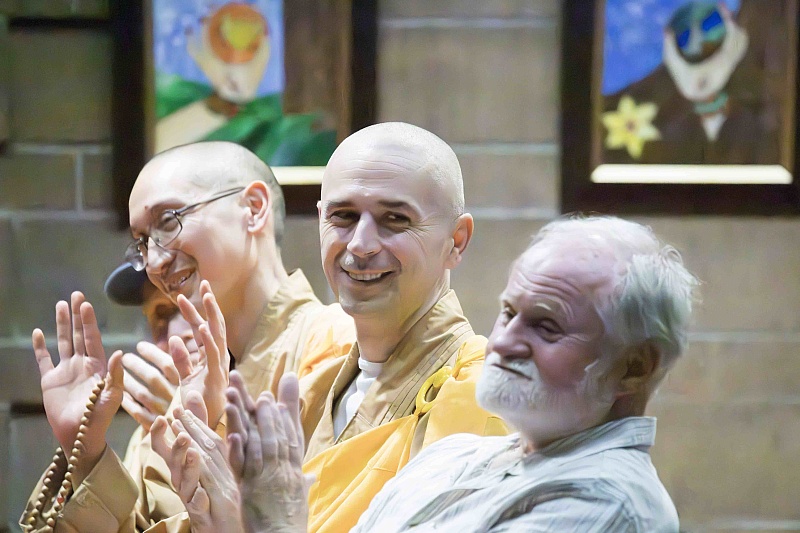 Okay — I'm in.
I remember sitting in the Meditation Hall in the morning and asking myself: "What is my word? What is the key to open my heart?"
Immediately, it came: safe.
I was feeling so much fear, actually, but I hadn't recognized that. So I let it go through my whole system: safe. Safe. How does it feel in the body when I feel safe?
And right after safety, came the picture of my grandma:
I am eight years old in Bialystok, jumping in the back seat — we're going to grandma! Running up to the second floor, the gray doors, the smell, the carpet, the kitchen — her home was her temple, where she served everyone. She gives me a hug and a kiss: "I'm so happy to see you. I love you." I melt in her arms.
I ask myself: can I look at myself with the same kind eyes as my grandma? How does it feel in the body, in the heart?'
And — wow. I feel kindness. I was seeking loving-kindness, and finally: it's there. It was always there. Was I always missing it? That is the irony — looking everywhere, and it was always here. You know the famous book The Body Keeps the Score? Our body remembers our trauma. That's true, for sure, but:
Our body also remembers kindness.
So I started bowing again, and I dropped the numbers. It's not about achieving anything. This is not Olympic bowing; I don't have to be number one with a gold medal. Through kindness, through gentleness, the resentment I had toward myself melted. The demons are still ready to chime in — "I'm no good. You messed it up again" — but I can receive them with the same gentle heart.
This is more a practice of remembering who I am.
I think all of us are deeply kind, compassionate and good at the source. Can we return to it?
When we listen, we're always in the monastery
In the relationships with my family, too, it was a process — and probably part of the process was to stop trying to convince anyone. With my father, the key movement was letting go of my wish to change them. Behind everything, there was always a little expectation: 'You're a good father, but there are a few things you could change.' Can I meet my family as who they are, with all the shortcomings and the beauty, and just listen, and listen again?
I made peace with them before peace occurred in the relational field.
My first principle: don't talk about Buddhism in front of the parents. I just come, hang out, bring a little smile. Two months ago I was in Poland with Reverend Heng Sure, and we gave a talk at the university I graduated from in Bialystok — and maybe thirty percent of the crowd was my family. My father, my stepmother, my brother (who flew from Iceland with his daughter), cousins, uncles, aunts — the whole gang. Two days later, they invited us home for lunch. We are not easy lunch guests — we don't eat meat; no onion, no garlic, there's a whole list. But they made us ten dishes. For me, it was like coming on alms round to receive from my parents. We sat in a circle and talked about favorite childhood memories, and I think I have never had such a good relationship with them in my entire life.
People ask me: you've lived a worldly life and a monastic life — how do we bring the monastery into our homes? If the monastery is a safe place where we honestly meet ourselves with kindness, then all of us are in the monastery, in some sense, in our heart. 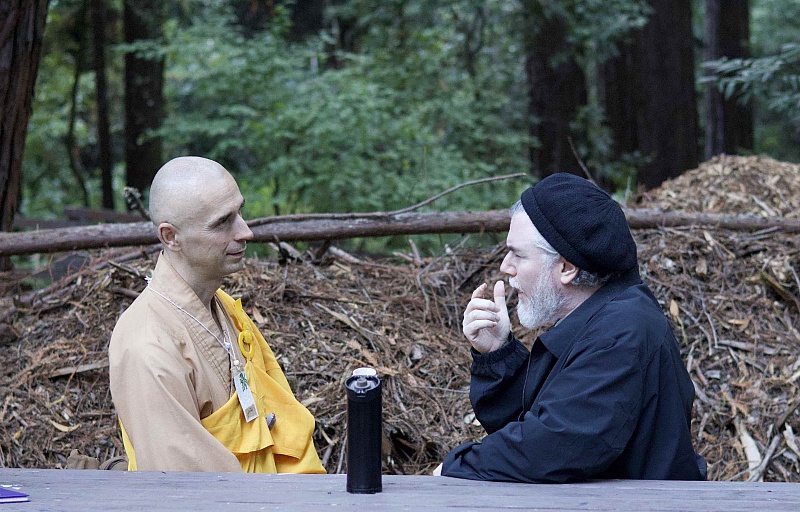 The monastery is the place where we deeply listen. First, listen to the body, in a very relaxed way — the body is always present, the body never lies, the body is always here and now. Then, listen to the heart, which means welcome everything, without judgment. Things can arise that are not beautiful — even ugly. We can meet and invite everything, like welcoming it to a campfire, where everyone and everything can be listened to and met with care.
Once we're connected to the body and listening to our hearts, we naturally start listening to others' hearts.
When we listen, we're always in the monastery.
Sometimes, I think of that cold morning on the farm, crying over a hole in the ground, asking what I was doing there. I was closer to home than I knew — the kindness was already in my body, waiting behind a gray door in Bialystok, waiting at the bottom of every bow. And maybe there is a word waiting in you, too — the key that opens your heart — and the way back to it is only a moment of truly listening.
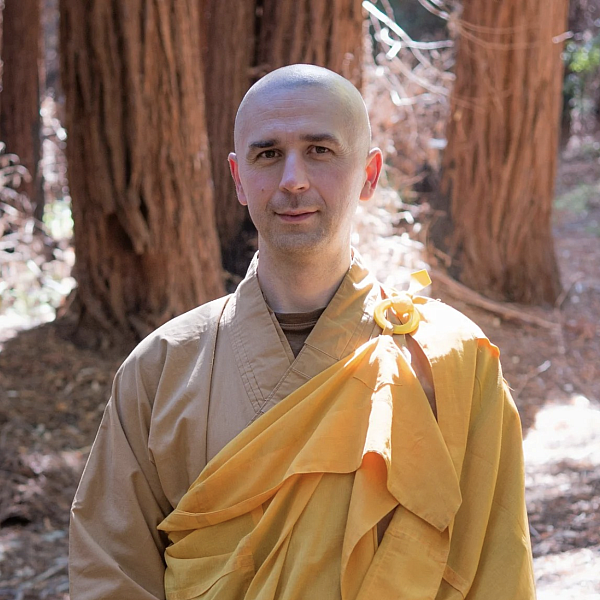 Bhikshu Jin Wei was born in Poland and began his meditation practice in 1999. In 2020, he graduated from Dharma Realm Buddhist University with an M.A. in Buddhist Classics. Today, he stewards
COMMUNITY REFLECTIONS
SHARE YOUR REFLECTION
4 PAST RESPONSES