
Betty Peck a sus 92 años está llena de una radiante belleza que nos recuerda a los cuentos de hadas.  Madrinas y jardines encantados. Visitarla es como caer en la madriguera de Alicia. Una vía férrea con un tren de verdad rodea su casa en Saratoga. Hay muros cubiertos de hiedra, senderos serpenteantes, casas en los árboles, incluso una torre de Rapunzel y un anfiteatro bajo los árboles con un balcón de Romeo y Julieta. Cientos de niños han jugado en el arroyo bañado por el sol, encantados con la sensación de la tierra bajo sus pies descalzos y disfrutando de un mundo rebosante de creatividad, belleza y maravillas. Este es el mundo que Betty Peck regaló a múltiples generaciones de niños.
Y ahora esta increíble profesora tiene un nuevo proyecto que la entusiasma profundamente. Un proyecto que describe con sus propias palabras a continuación, y que comienza con una pregunta sencilla pero profunda...
Quiero saber cómo aprendiste a leer.
Aprender a leer es lo más importante que nos sucede, y ocurre (para la mayoría) en la infancia. Mi esposo, Willys Peck, aprendió a leer con el "Método Pooh". Aquí están sus palabras sobre este increíble acontecimiento:
El método Pooh de lectura aprendida

De niño, mis padres nos leían libros a mi hermano y a mí. Mis favoritos eran Winnie the Pooh y La casa en el rincón de Pooh, de AA Milne. Aunque no me esforzaba conscientemente por memorizar las historias, descubrí, al escucharlas varias veces, que podía recitar los primeros párrafos de memoria. Un día, mientras miraba el libro y lo recitaba de memoria, me di cuenta de que estaba captando palabras que no había memorizado. ¡Fue en ese momento que me di cuenta de que estaba leyendo! Por eso lo llamo aprender a leer con el Método Pooh.
Aprender a leer fue lo más importante que me pasó en primer grado; es lo que me ayudó a convertirme en quien soy. Lo he plasmado en mi libro: Educación preescolar: Liberando el potencial creativo de los niños (Hawthorne Press).
 Mi abuela me contaba todos los cuentos de hadas y rimas infantiles. Qué suerte la de la niña que contiene todas estas palabras de sabiduría ancestral. Yo, a mi vez, me convertiría en la narradora de mis hermanos y hermanas.
Recuerdo el día que aprendí a leer. Yo también, como John Steinbeck, creo que «es quizás el mayor esfuerzo que el ser humano emprende, y debe hacerlo desde niño». Recuerdo el día que llevé mi libro de bolsillo a casa para leérselo a mi madre cuando estaba en primer grado. ¡Había aprendido a leer! La emoción de poder leerle a mi madre todavía me acompaña.
Recuerdo que nos sentamos juntas no lejos de la puerta principal. Le leí el libro entero con gran deleite y alegría. Cuando terminé, me dijo: «Ahora léelo al revés». ¡No creía que hubiera aprendido a leer! Con más alegría que antes, leí el libro entero al revés. Fue en ese momento que sentí que me encontraba en mí misma. Me había convertido en algo más de lo que creía ser. Ahora, usaría la palabra «trascendido» para esta ocasión, porque ahora sabía lo que mi madre no podía saber. Yo, y solo yo, conocía este maravilloso secreto: había aprendido a leer. No necesitaba una celebración; aprender a leer era suficiente celebración.
Cuando mi nieta Sarah aprendió a leer, pregunté si podíamos colocar una foto suya leyéndole a su hermana, Merina, en la sala infantil de la biblioteca de nuestro pueblo para celebrar su aprendizaje. La foto se colgó celebrando uno de los momentos más importantes de la vida, que coincide con la infancia.
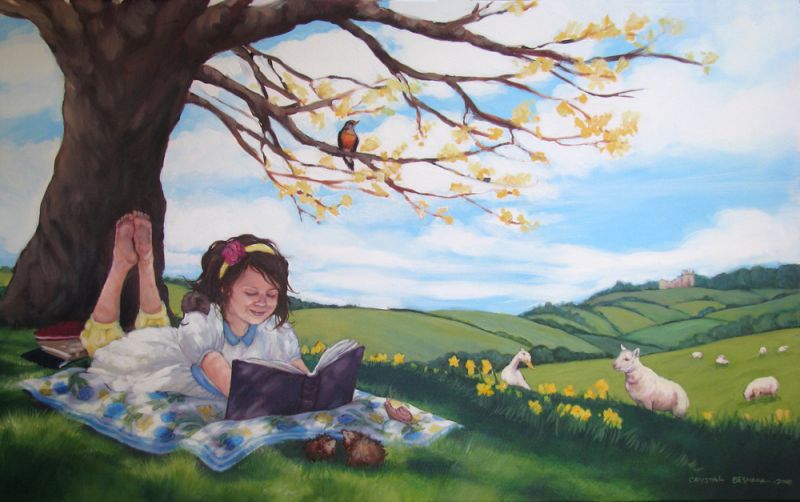 Fue la biblioteca de Los Ángeles, cerca de casa, la que alimentó mi amor por la literatura. Mi madre me leía. Leíamos hasta el último minuto, hasta que llegaba la fecha de entrega, y luego salía corriendo a la biblioteca en patines, siempre sola. Pero fue la Sra. Laverne Perrin, mi maestra de séptimo grado en la escuela Bel Pasi, quien me introdujo a la gran literatura mundial. Teníamos que aprendernos un poema cada semana. Ella leía la obra de Sir Walter Scott y, en un tono diferente, "La cabaña del tío Tom" era un libro donde nos aferrábamos a cada palabra. Estoy segura de que nos leía todo lo que amaba, pues recuerdo su gran pasión por estos libros. Cada cuento era más que sus palabras: abarcaba todo el ámbito de la historia, la cultura, la naturaleza, la filosofía, la religión y la psicología. Gracias a esta herencia, ahora leo y releo varios libros al día, todos los cuales tengo en mi biblioteca.
La lectura es uno de los momentos más importantes en la vida de un ser humano y ocurre en la infancia. ¿Alguna vez has pensado en todas las habilidades necesarias para poder leer? Este emocionante acontecimiento es un regalo de los dioses.
Lo que hacemos con este regalo nos define, y como maestra, me siento privilegiada de ayudar a padres de niños de kínder a sentar las bases para que crezcan ciudadanos productivos que amen la lectura. Espero que se puedan crear celebraciones y rituales en torno al momento en que un niño de hoy aprende a leer. Me ha llevado tanto tiempo darme cuenta de que este es un momento mágico que merece reconocimiento.
¿Cómo aprendiste a leer? Me encantaría escuchar tu historia.
COMMUNITY REFLECTIONS
SHARE YOUR REFLECTION
12 PAST RESPONSES
My best friend taught me how to read. He was three years older than me. Every day after school in his first year he would come over and show me what he'd learned at school that day using the book Green Eggs and Ham. He died two years ago at age 58, I will miss him for the rest of my life.
I remember walking in to kindergarten and straight for the bookshelf. My beautiful new teacher (who was really 80 years old) said to my mother "oh I see we have a reader on our hands, how wonderful is that"? From that day forward, I have always considered myself just that "a reader" and have always lived up to the expectation of my kindergarten teacher. Thank you Mrs. Quaker!!
Satya Narain Goel
In India Ramayan written by Tulsidas is the most read book. For centuries, generations after generations, the women learned to read to enable them to read the story of Ram and Sita in Ramayan. Apart from religious and spritual side of the epic, which Ramayan is, it has made a tremendous contribution to the reading habits of women in India.
Satya Narain Goel, Jodhpur, Rajasthan. India
I cannot remember a time that I wasn't being read to by my parents. My mother had a gift for reading with accents and regional dialects which enthralled me and my siblings. I had numerous children's stories memorized and then I "read" those to my siblings (I have no recollection of the moment when the memorization became truly reading on my own). My father found children's books read over and over and over quite tedious, but he noticed that children love to sit with you and be read to, no matter what is being read (the special attention given the child is the most important part). So, he read what he liked aloud to me and thus, I heard the Wall Street Journal each evening and learned incredible language skills that have served me all my life! My vocabulary skills were enhanced all while I was having a wonderful time. Two of the ladies who babysat my siblings and me would bring stacks of books and read and read until they were hoarse and on the verge of losing their voices! We all three gathered on the couch and were enthralled all evening long. My, we were so blessed! I still love books and reading and stopping wherever there is a bookstore; bookstores even smell wonderful!
[Hide Full Comment]In Eastern India there is a annual festival called Saraswati Puja which revolves around the deity of learning, Saraswati. When a child is about 3 or 4 years old he or she sits down with other children of the same age and they are shown how to write the first alphabet in the Bengali script. Each child has her/ his own miniature handheld blackboard and chalk and it is a occasion of celebration that the child is progressing away from babyhood and getting ready for formal education. The child feels part of a group and seeing the adults reaction they are also enthusiastic about starting to read the alphabet.
Hi Betty,
My mother read to us from early on. She and I would sit in a big chair together, and she would read to me, annunciating each word clearly. So, I learned to read early on. she took delight in showing me off to the family at christmas time, when I recited "twas the night before christmas," from memory. I believe her strong focus on enunciation helped me learn how to read and spell well.
I was 4 years old. My mother was pregnant with my first little brother and she would take a hot bath every morning. I would sit on the bathroom floor with the newspaper spread out on the floor in front of me with my right hand on her tummy to feel the baby move. She would teach me about roots, prefixes and suffixes, how most words were Greek or Latin in origin. I would stumble through the article she chose and she taught me how to find meaning of words I didn't know through context. She was very strict and a very difficult woman to please, but she raised a true reader. I never read children's books. She never talked "baby talk". She felt that if you learn that way, then you would have to un-learn that to learn "real" language. I was an extremely gifted child and she challenged me, constantly. I don't ever remember anyone reading aloud to me, I read aloud to them.
Amazes me that people can remember when they learned to read. The earliest memory I know of is in second grade for me. I am sure I learned to read before then. Sorry.
Beautiful!
Books were my friends. My father was career Army so we moved every year until I was in high school. I learned to read early. My mother still talks about the day when I was in first grade and the teachers asked me to read a story to the third graders. In high school I spent my summers reading from books picked out from the Book mobile. I loved the Book mobile. I can still visualize the driver who would patiently help me find my books and the coolness of the air inside on those hot days. I read all of the available Agatha Christie novels that summer. Today I am the organizer of a neighborhood book club. We have 13 members. We all have been together for 10 years. We lost one member to cancer and we honor her memory by donating books to a needy cause. Reading has shaped my life.
I was four years old. My Grandmother Quigney taught me to read. Every day she would take a break from work cuddle up in her recliner by the living room window and read. Often she would read aloud to me from Reader's Digest or The Education of Hyman Kaplan or Cheaper by the Dozen. And she would read children's picture books, nursery rhymes and of course Winnie the Pooh. I would follow along trying to decipher the swirls on the page. And then one day it just clicked and I read a book about a pony who tries to keep up with the horses; how fitting. Thanks to my Grandmother's efforts I read Every book in my elementary school library. In adulthood (after jobs in women's health & cancer research), I was a Children's Librarian. I had the blessing of creating an entire program and helping thousands of children develop an appreciation for books and reading.
Today I am a Cause-Focused Storyteller & Literacy Advocate. I sold my home & possessions in 2005 to create/facilitate a volunteer literacy project in Belize; the initial thrust was book drives & reading activities. Since then I've donated programs for 33,000 children & trained 800 teachers how to use their own cultural stories in school. I've just returned from Ghana where I donated literacy training for librarians at 6 library/community centers. All because my Grandma instilled a Passion for books & taught me to read. Thank you for your Passion & sharing the Love of reading.
[Hide Full Comment]I learned to read in school, very early in the first grade. I loved the individual letters and their sounds, so I was using phonics before anyone had even coined the term. I like music and language seemed the same thing to me. The individual letter-noises could be combined to make familiar and unfamiliar words, so when I struck an unfamiliar word I knew that had happened, and wanted to learn what those sound patterns were for. It was all very easy and effortless. I was ready in the first grade, and those were the years before child care and kindergarten. We had a lot of kids in the first and second grades (in one room with one teacher) so I had lots of time to myself to play with the sound combinations and see where they went. I am glad I predated the hubbub of day care and kindergarten. We went to school because we were grown up enough to be allowed to, and it was a huge thrill!