
Betty Peck, la 92 de ani, este plină de o frumusețe strălucitoare care amintește de zână  nașe și grădini fermecate. Să o vizitezi este un pic ca și cum ai cădea în gaura de iepure a lui Alice. O cale de tren cu un tren adevărat circulă în jurul casei ei din Saratoga. Există pereți acoperiți cu iederă, poteci șerpuite nebunești, căsuțe în copac, chiar și un turn Rapunzel și un amfiteatru sub copaci, cu balcon Romeo și Julieta. Sute de copii s-au jucat aici în pârâul plin de soare, încântați de senzația pământului sub picioarele goale și s-au bucurat de o lume plină de creativitate, frumusețe și minune. Aceasta este lumea pe care Betty Peck a oferit-o mai multor generații de copii.
Și acum această profesoară uimitoare are un nou proiect de care este profund încântată. Un proiect pe care ea îl descrie cu propriile cuvinte mai jos și care începe cu o întrebare simplă, dar profundă...
Vreau să știu cum ai învățat să citești.
A învăța să citești este cel mai important lucru care ni se întâmplă și se întâmplă (pentru majoritatea) în copilărie. Soțul meu, Willys Peck a învățat să citească prin „Metoda Pooh”. Iată cuvintele lui despre acest eveniment uimitor:
Metoda Pooh de lectură învățată

Când eram copil, părinții mei mi-au citit cărți mie și fratelui meu. Preferatele mele au fost cărțile Winnie the Pooh și The House at Pooh Corner de AA. Milne.Deși nu am făcut un efort conștient de a memora poveștile, am constatat, auzindu-le de mai multe ori, că pot recita din memorie paragrafele inițiale. Într-o zi, în timp ce mă uitam la carte și o recitam din memorie, m-am trezit culegând cuvinte dincolo de cele memorate efectiv. În acel moment mi-am dat seama că citesc! De aceea o numesc a învăța să citești prin Metoda Pooh.
Învățarea mea să citesc a fost cel mai important lucru care mi s-a întâmplat în clasa întâi; este ceea ce m-a ajutat să devin ceea ce sunt. Am scris asta în cartea mea: Kindergarten Education – Freeing Children's Creative Potential (Hawthorne Press).
 Bunica mea mi-a povestit toate basmele și versurile. Norocos este copilul care conține toate aceste cuvinte ale înțelepciunii străvechi. Eu, la rândul meu, aș deveni povestitorul pentru frații și surorile mele.
Îmi amintesc ziua în care am învățat să citesc. Și eu, împreună cu John Steinbeck, cred că „Este poate cel mai mare efort pe care îl întreprinde omul și trebuie să-l facă în copilărie.” Îmi amintesc ziua în care mi-am dus cartea de broșat acasă pentru a o citi pe mama, când eram în clasa întâi. Am invatat sa citesc! Emoția acestei așteptări de a putea citi mamei mele este încă cu mine.
În amintirea mea, ne-am așezat împreună nu departe de ușa din față. I-am citit toată cartea cu mare bucurie și bucurie. Când am terminat, ea mi-a spus: „Acum citește-l înapoi.” Nu credea că am învățat să citesc! Cu mai multă bucurie decât înainte, am citit toată cartea invers. În acel moment am avut senzația că mă aflu pe cont propriu. Devenisem mai mult decât credeam că sunt. Acum, aș folosi cuvântul „depășit” pentru această ocazie, deocamdată știam ceea ce mama nu putea ști. Eu, și numai eu, știam acest secret minunat: învățasem să citesc. Nu aveam nevoie de o sărbătoare; a învăța să citești a fost suficientă sărbătoare.
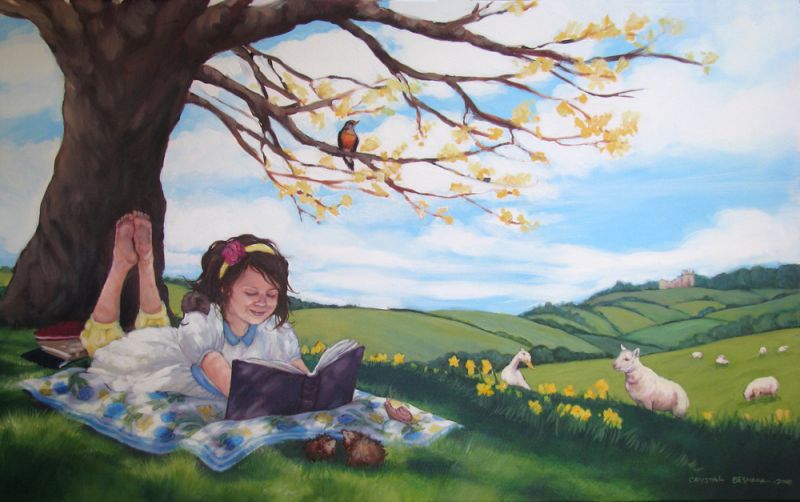
Când nepoata mea Sarah a învățat să citească, am întrebat dacă o poză cu citirea ei surorii ei, Merina, ar putea fi pusă în camera copiilor de la biblioteca din satul nostru, pentru a sărbători că a învățat să citească. Poza a fost agățată sărbătorind unul dintre cei mai importanți pași ai vieții care se întâmplă să cadă în copilărie.
 Biblioteca din Los Angeles de lângă casa noastră a fost cea care mi-a alimentat dragostea pentru literatură. Mama îmi citea. Citeam până în ultimă clipă că cartea se datorează și apoi mă grăbeam la bibliotecă pe patine, mereu singur. Dar doamna Laverne Perrin, profesoara mea de clasa a șaptea la școala Bel Pasi, a fost cea care m-a introdus în marea literatură a lumii. A trebuit să învățăm o poezie în fiecare săptămână. Ea avea să citească lucrarea lui Sir Walter Scott și, într-un sens diferit, „Cabana unchiului Tom; a fost unul în care ne-am agățat de fiecare cuvânt. Ne-a citit, sunt sigur, toate lucrurile pe care le-a iubit, pentru că îmi amintesc de marea ei pasiune pentru aceste cărți. Fiecare poveste era mai mult decât cuvintele ei: era întregul tărâm al istoriei, culturii, naturii, filosofiei, religiei și psihologiei. Datorită acestei moșteniri, acum citesc și recitesc din mai multe cărți pe zi, pe care le dețin în biblioteca mea.
Cititul este unul dintre cele mai importante evenimente din viața unei ființe umane și se întâmplă în copilărie. Te-ai gândit vreodată la toate abilitățile care trebuie să se unească pentru a putea citi? Acest eveniment interesant este un dar de la zei.
Ceea ce facem cu acest dar ajută la determinarea cine suntem și, în calitate de profesor, mă simt privilegiat să ajut părinții de grădiniță să construiască fundația pentru cetățeni productivi, care cresc iubind să citească. Sper că sărbătorile și ritualurile să poată fi construite în jurul evenimentului când un copil de astăzi învață să citească. A durat atât de mult pentru a realiza că acesta este un moment magic care are nevoie de recunoaștere.
Cum ai invatat sa citesti? Mi-ar plăcea să aud povestea ta.
COMMUNITY REFLECTIONS
SHARE YOUR REFLECTION
12 PAST RESPONSES
My best friend taught me how to read. He was three years older than me. Every day after school in his first year he would come over and show me what he'd learned at school that day using the book Green Eggs and Ham. He died two years ago at age 58, I will miss him for the rest of my life.
I remember walking in to kindergarten and straight for the bookshelf. My beautiful new teacher (who was really 80 years old) said to my mother "oh I see we have a reader on our hands, how wonderful is that"? From that day forward, I have always considered myself just that "a reader" and have always lived up to the expectation of my kindergarten teacher. Thank you Mrs. Quaker!!
Satya Narain Goel
In India Ramayan written by Tulsidas is the most read book. For centuries, generations after generations, the women learned to read to enable them to read the story of Ram and Sita in Ramayan. Apart from religious and spritual side of the epic, which Ramayan is, it has made a tremendous contribution to the reading habits of women in India.
Satya Narain Goel, Jodhpur, Rajasthan. India
I cannot remember a time that I wasn't being read to by my parents. My mother had a gift for reading with accents and regional dialects which enthralled me and my siblings. I had numerous children's stories memorized and then I "read" those to my siblings (I have no recollection of the moment when the memorization became truly reading on my own). My father found children's books read over and over and over quite tedious, but he noticed that children love to sit with you and be read to, no matter what is being read (the special attention given the child is the most important part). So, he read what he liked aloud to me and thus, I heard the Wall Street Journal each evening and learned incredible language skills that have served me all my life! My vocabulary skills were enhanced all while I was having a wonderful time. Two of the ladies who babysat my siblings and me would bring stacks of books and read and read until they were hoarse and on the verge of losing their voices! We all three gathered on the couch and were enthralled all evening long. My, we were so blessed! I still love books and reading and stopping wherever there is a bookstore; bookstores even smell wonderful!
[Hide Full Comment]In Eastern India there is a annual festival called Saraswati Puja which revolves around the deity of learning, Saraswati. When a child is about 3 or 4 years old he or she sits down with other children of the same age and they are shown how to write the first alphabet in the Bengali script. Each child has her/ his own miniature handheld blackboard and chalk and it is a occasion of celebration that the child is progressing away from babyhood and getting ready for formal education. The child feels part of a group and seeing the adults reaction they are also enthusiastic about starting to read the alphabet.
Hi Betty,
My mother read to us from early on. She and I would sit in a big chair together, and she would read to me, annunciating each word clearly. So, I learned to read early on. she took delight in showing me off to the family at christmas time, when I recited "twas the night before christmas," from memory. I believe her strong focus on enunciation helped me learn how to read and spell well.
I was 4 years old. My mother was pregnant with my first little brother and she would take a hot bath every morning. I would sit on the bathroom floor with the newspaper spread out on the floor in front of me with my right hand on her tummy to feel the baby move. She would teach me about roots, prefixes and suffixes, how most words were Greek or Latin in origin. I would stumble through the article she chose and she taught me how to find meaning of words I didn't know through context. She was very strict and a very difficult woman to please, but she raised a true reader. I never read children's books. She never talked "baby talk". She felt that if you learn that way, then you would have to un-learn that to learn "real" language. I was an extremely gifted child and she challenged me, constantly. I don't ever remember anyone reading aloud to me, I read aloud to them.
Amazes me that people can remember when they learned to read. The earliest memory I know of is in second grade for me. I am sure I learned to read before then. Sorry.
Beautiful!
Books were my friends. My father was career Army so we moved every year until I was in high school. I learned to read early. My mother still talks about the day when I was in first grade and the teachers asked me to read a story to the third graders. In high school I spent my summers reading from books picked out from the Book mobile. I loved the Book mobile. I can still visualize the driver who would patiently help me find my books and the coolness of the air inside on those hot days. I read all of the available Agatha Christie novels that summer. Today I am the organizer of a neighborhood book club. We have 13 members. We all have been together for 10 years. We lost one member to cancer and we honor her memory by donating books to a needy cause. Reading has shaped my life.
I was four years old. My Grandmother Quigney taught me to read. Every day she would take a break from work cuddle up in her recliner by the living room window and read. Often she would read aloud to me from Reader's Digest or The Education of Hyman Kaplan or Cheaper by the Dozen. And she would read children's picture books, nursery rhymes and of course Winnie the Pooh. I would follow along trying to decipher the swirls on the page. And then one day it just clicked and I read a book about a pony who tries to keep up with the horses; how fitting. Thanks to my Grandmother's efforts I read Every book in my elementary school library. In adulthood (after jobs in women's health & cancer research), I was a Children's Librarian. I had the blessing of creating an entire program and helping thousands of children develop an appreciation for books and reading.
Today I am a Cause-Focused Storyteller & Literacy Advocate. I sold my home & possessions in 2005 to create/facilitate a volunteer literacy project in Belize; the initial thrust was book drives & reading activities. Since then I've donated programs for 33,000 children & trained 800 teachers how to use their own cultural stories in school. I've just returned from Ghana where I donated literacy training for librarians at 6 library/community centers. All because my Grandma instilled a Passion for books & taught me to read. Thank you for your Passion & sharing the Love of reading.
[Hide Full Comment]I learned to read in school, very early in the first grade. I loved the individual letters and their sounds, so I was using phonics before anyone had even coined the term. I like music and language seemed the same thing to me. The individual letter-noises could be combined to make familiar and unfamiliar words, so when I struck an unfamiliar word I knew that had happened, and wanted to learn what those sound patterns were for. It was all very easy and effortless. I was ready in the first grade, and those were the years before child care and kindergarten. We had a lot of kids in the first and second grades (in one room with one teacher) so I had lots of time to myself to play with the sound combinations and see where they went. I am glad I predated the hubbub of day care and kindergarten. We went to school because we were grown up enough to be allowed to, and it was a huge thrill!