
Betty Peck på 92 är full av en strålande ljuvlighet som för tankarna till fe  gudmödrar och förtrollade trädgårdar. Att besöka henne är lite som att falla ner i Alices kaninhål. En tågbana med ett riktigt tåg går runt hennes hem i Saratoga. Det finns murgrönatäckta väggar, galna slingrande stigar, trädkojor, till och med ett Rapunzeltorn och en amfiteater under träden komplett med en Romeo och Julia-balkong. Hundratals barn har lekt i den soldränkta bäcken här, glada över känslan av jord under bara fötter och gläds åt en värld full av kreativitet, skönhet och förundran. Det här är världen som Betty Peck gav till flera generationer av barn.
Och nu har denna fantastiska lärare ett nytt projekt som hon är djupt exalterad över. Ett projekt som hon beskriver med egna ord nedan, och som börjar med en enkel men djupgående fråga...
Jag vill veta hur du lärde dig att läsa.
Att lära sig läsa är det viktigaste som händer oss, och det händer (för de flesta) i barndomen. Min man, Willys Peck, lärde sig läsa genom "The Puh Method". Här är hans ord om denna fantastiska händelse:
Puh-metoden för lärd läsning

När jag var barn läste mina föräldrar böcker för mig och min bror. Mina favoriter var böckerna Nalle Puh och The House at Puh Corner av AA. Milne. Även om jag inte gjorde en medveten ansträngning för att memorera berättelserna, fann jag genom att höra dem flera gånger att jag kunde recitera de inledande styckena från minnet. En dag när jag tittade på boken och reciterade den från minnet, fann jag mig själv att plocka upp ord utöver de som faktiskt memorerades. Det var i det ögonblicket som jag insåg att jag läste! Det är därför jag kallar det att lära sig läsa med Puh-metoden.
Att lära mig läsa var det viktigaste som hände mig i första klass; det är det som hjälpte mig att bli den jag är. Jag har skrivit upp detta i min bok: Kindergarten Education – Freeing Children's Creative Potential (Hawthorne Press).
 Min mormor berättade för mig alla sagor och barnrim. Tur är barnet som innehåller alla dessa ord av uråldrig visdom. Jag i min tur skulle bli berättare för mina bröder och systrar.
Jag minns dagen då jag lärde mig läsa. Jag tror också, tillsammans med John Steinbeck, "Det är kanske den största enskilda ansträngningen som människan gör, och han måste göra det som barn." Jag minns dagen då jag bar hem min pocketbok för att läsa min mamma när jag gick i första klass. Jag hade lärt mig att läsa! Spänningen av denna förväntan att få läsa för min mamma finns fortfarande med mig.
Till mitt minne satte vi oss ner tillsammans inte långt från ytterdörren. Jag läste hela boken för henne med stor förtjusning och glädje. När jag var klar sa hon till mig "Läs det nu baklänges." Hon trodde inte att jag hade lärt mig att läsa! Med mer glädje än tidigare läste jag hela boken baklänges. Det var i det ögonblicket som jag hade känslan av att komma till min rätt. Jag hade blivit mer än jag trodde mig vara. Nu skulle jag använda ordet "överskridande" för detta tillfälle, för nu visste jag vad min mamma inte kunde veta. Jag, och jag ensam, visste denna underbara hemlighet: jag hade lärt mig att läsa. Jag behövde inget firande; att lära sig läsa var firande nog.
När mitt barnbarn Sarah lärde sig läsa, frågade jag om en bild på hur hon läste för sin syster Merina kunde placeras i barnrummet på vårt bybibliotek för att fira att hon lärde sig läsa. Bilden hängdes upp för att fira ett av de viktigaste stegen i livet som bara råkar infalla i barndomen.
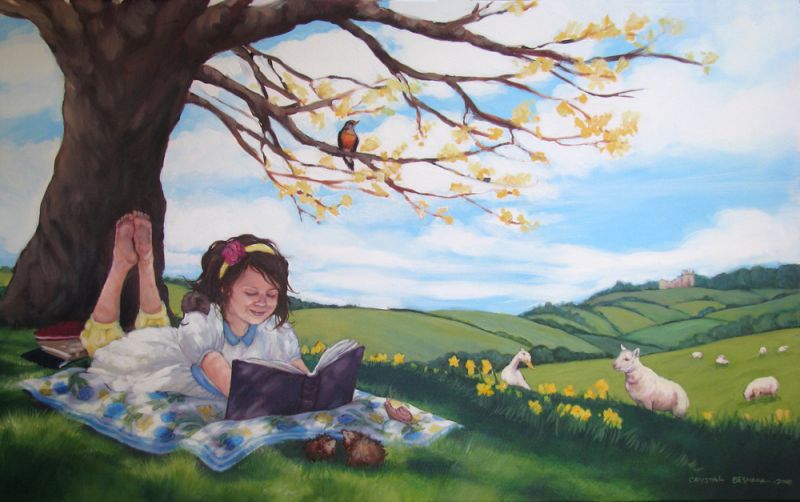 Det var biblioteket i Los Angeles nära vårt hus som gav näring åt min kärlek till litteratur. Min mamma skulle läsa för mig. Vi läste till sista minuten att boken skulle komma och sedan rusade jag iväg till biblioteket på skridskorna, alltid ensam. Men det var fru Laverne Perrin, min lärare i sjunde klass vid Bel Pasi-skolan, som introducerade mig till världens stora litteratur. Vi fick lära oss en dikt varje vecka. Hon skulle läsa Sir Walter Scotts verk, och i en annan riktning, 'Uncle Tom's Cabin; var en där vi hängde på varje ord. Hon läste oss, jag är säker på, allt hon älskade, för jag minns hennes stora passion för dessa böcker. Varje berättelse var mer än dess ord: det var hela riket av historia, kultur, natur, filosofi, religion och psykologi. På grund av detta arv läser jag nu och läser om ur flera böcker om dagen, som jag alla äger i mitt bibliotek.
Läsning är en av de viktigaste händelserna i en människas liv, och det händer i barndomen. Har du någonsin tänkt på alla färdigheter som måste gå ihop för att kunna läsa? Denna spännande händelse är en gåva från gudarna.
Vad vi gör med den här gåvan hjälper till att avgöra vilka vi är, och som lärare känner jag mig privilegierad att få hjälpa föräldrar till dagisbarn att bygga grunden för produktiva medborgare som växer upp och älskar att läsa. Jag hoppas att fester och ritualer kan byggas upp kring händelsen när ett barn av idag lär sig läsa. Det har tagit så lång tid att inse att detta är ett magiskt ögonblick som behöver erkännas.
Hur lärde du dig att läsa? Jag skulle älska att höra din historia.
COMMUNITY REFLECTIONS
SHARE YOUR REFLECTION
12 PAST RESPONSES
My best friend taught me how to read. He was three years older than me. Every day after school in his first year he would come over and show me what he'd learned at school that day using the book Green Eggs and Ham. He died two years ago at age 58, I will miss him for the rest of my life.
I remember walking in to kindergarten and straight for the bookshelf. My beautiful new teacher (who was really 80 years old) said to my mother "oh I see we have a reader on our hands, how wonderful is that"? From that day forward, I have always considered myself just that "a reader" and have always lived up to the expectation of my kindergarten teacher. Thank you Mrs. Quaker!!
Satya Narain Goel
In India Ramayan written by Tulsidas is the most read book. For centuries, generations after generations, the women learned to read to enable them to read the story of Ram and Sita in Ramayan. Apart from religious and spritual side of the epic, which Ramayan is, it has made a tremendous contribution to the reading habits of women in India.
Satya Narain Goel, Jodhpur, Rajasthan. India
I cannot remember a time that I wasn't being read to by my parents. My mother had a gift for reading with accents and regional dialects which enthralled me and my siblings. I had numerous children's stories memorized and then I "read" those to my siblings (I have no recollection of the moment when the memorization became truly reading on my own). My father found children's books read over and over and over quite tedious, but he noticed that children love to sit with you and be read to, no matter what is being read (the special attention given the child is the most important part). So, he read what he liked aloud to me and thus, I heard the Wall Street Journal each evening and learned incredible language skills that have served me all my life! My vocabulary skills were enhanced all while I was having a wonderful time. Two of the ladies who babysat my siblings and me would bring stacks of books and read and read until they were hoarse and on the verge of losing their voices! We all three gathered on the couch and were enthralled all evening long. My, we were so blessed! I still love books and reading and stopping wherever there is a bookstore; bookstores even smell wonderful!
[Hide Full Comment]In Eastern India there is a annual festival called Saraswati Puja which revolves around the deity of learning, Saraswati. When a child is about 3 or 4 years old he or she sits down with other children of the same age and they are shown how to write the first alphabet in the Bengali script. Each child has her/ his own miniature handheld blackboard and chalk and it is a occasion of celebration that the child is progressing away from babyhood and getting ready for formal education. The child feels part of a group and seeing the adults reaction they are also enthusiastic about starting to read the alphabet.
Hi Betty,
My mother read to us from early on. She and I would sit in a big chair together, and she would read to me, annunciating each word clearly. So, I learned to read early on. she took delight in showing me off to the family at christmas time, when I recited "twas the night before christmas," from memory. I believe her strong focus on enunciation helped me learn how to read and spell well.
I was 4 years old. My mother was pregnant with my first little brother and she would take a hot bath every morning. I would sit on the bathroom floor with the newspaper spread out on the floor in front of me with my right hand on her tummy to feel the baby move. She would teach me about roots, prefixes and suffixes, how most words were Greek or Latin in origin. I would stumble through the article she chose and she taught me how to find meaning of words I didn't know through context. She was very strict and a very difficult woman to please, but she raised a true reader. I never read children's books. She never talked "baby talk". She felt that if you learn that way, then you would have to un-learn that to learn "real" language. I was an extremely gifted child and she challenged me, constantly. I don't ever remember anyone reading aloud to me, I read aloud to them.
Amazes me that people can remember when they learned to read. The earliest memory I know of is in second grade for me. I am sure I learned to read before then. Sorry.
Beautiful!
Books were my friends. My father was career Army so we moved every year until I was in high school. I learned to read early. My mother still talks about the day when I was in first grade and the teachers asked me to read a story to the third graders. In high school I spent my summers reading from books picked out from the Book mobile. I loved the Book mobile. I can still visualize the driver who would patiently help me find my books and the coolness of the air inside on those hot days. I read all of the available Agatha Christie novels that summer. Today I am the organizer of a neighborhood book club. We have 13 members. We all have been together for 10 years. We lost one member to cancer and we honor her memory by donating books to a needy cause. Reading has shaped my life.
I was four years old. My Grandmother Quigney taught me to read. Every day she would take a break from work cuddle up in her recliner by the living room window and read. Often she would read aloud to me from Reader's Digest or The Education of Hyman Kaplan or Cheaper by the Dozen. And she would read children's picture books, nursery rhymes and of course Winnie the Pooh. I would follow along trying to decipher the swirls on the page. And then one day it just clicked and I read a book about a pony who tries to keep up with the horses; how fitting. Thanks to my Grandmother's efforts I read Every book in my elementary school library. In adulthood (after jobs in women's health & cancer research), I was a Children's Librarian. I had the blessing of creating an entire program and helping thousands of children develop an appreciation for books and reading.
Today I am a Cause-Focused Storyteller & Literacy Advocate. I sold my home & possessions in 2005 to create/facilitate a volunteer literacy project in Belize; the initial thrust was book drives & reading activities. Since then I've donated programs for 33,000 children & trained 800 teachers how to use their own cultural stories in school. I've just returned from Ghana where I donated literacy training for librarians at 6 library/community centers. All because my Grandma instilled a Passion for books & taught me to read. Thank you for your Passion & sharing the Love of reading.
[Hide Full Comment]I learned to read in school, very early in the first grade. I loved the individual letters and their sounds, so I was using phonics before anyone had even coined the term. I like music and language seemed the same thing to me. The individual letter-noises could be combined to make familiar and unfamiliar words, so when I struck an unfamiliar word I knew that had happened, and wanted to learn what those sound patterns were for. It was all very easy and effortless. I was ready in the first grade, and those were the years before child care and kindergarten. We had a lot of kids in the first and second grades (in one room with one teacher) so I had lots of time to myself to play with the sound combinations and see where they went. I am glad I predated the hubbub of day care and kindergarten. We went to school because we were grown up enough to be allowed to, and it was a huge thrill!