
Betty Peck w wieku 92 lat jest pełna promiennego uroku, który przywodzi na myśl wróżki  matki chrzestne i zaczarowane ogrody. Wizyta u niej jest trochę jak wpadnięcie do króliczej nory Alicji. Tory kolejowe z prawdziwym pociągiem biegną wokół jej domu w Saratodze. Są porośnięte bluszczem ściany, szalone kręte ścieżki, domki na drzewach, nawet wieża Roszpunki i amfiteatr pod drzewami, w komplecie z balkonem Romea i Julii. Setki dzieci bawiło się tutaj w nasłonecznionym strumieniu, zachwycone dotykiem ziemi pod bosymi stopami i radujące się światem pełnym kreatywności, piękna i cudów. To jest świat, który Betty Peck podarowała wielu pokoleniom dzieci.
A teraz ta niesamowita nauczycielka ma nowy projekt, który bardzo ją ekscytuje. Projekt, który opisuje własnymi słowami poniżej, a który zaczyna się od prostego, ale głębokiego pytania...
Chcę wiedzieć, jak nauczyłeś się czytać.
Nauka czytania jest najważniejszą rzeczą, jaka nam się przytrafia, a przytrafia się (większości) w dzieciństwie. Mój mąż, Willys Peck nauczył się czytać „metodą Puchatka”. Oto jego słowa o tym niesamowitym wydarzeniu:
Metoda nauki czytania „Puchatek”

Kiedy byłem dzieckiem, moi rodzice czytali książki mnie i mojemu bratu. Moimi ulubionymi były książki Kubuś Puchatek i Domek Puchatka autorstwa AA Milne'a. Chociaż nie podejmowałem świadomego wysiłku, aby zapamiętać historie, odkryłem, że słuchając ich wielokrotnie, potrafię wyrecytować z pamięci początkowe akapity. Pewnego dnia, patrząc na książkę i recytując ją z pamięci, zauważyłem, że wyłapuję słowa wykraczające poza te, które faktycznie zapamiętałem. To właśnie w tym momencie zdałem sobie sprawę, że czytam! Dlatego nazywam to nauką czytania metodą Puchatka.
Nauka czytania była dla mnie najważniejszą rzeczą, jaka przydarzyła mi się w pierwszej klasie; to pomogło mi stać się tym, kim jestem. Opisałem to w mojej książce: Kindergarten Education –Freeing Children's Creative Potential (Hawthorne Press).
 Moja babcia opowiadała mi wszystkie bajki i rymowanki. Szczęśliwe jest dziecko, które zawiera wszystkie te słowa starożytnej mądrości. Ja z kolei staję się gawędziarzem dla moich braci i sióstr.
Pamiętam dzień, w którym nauczyłem się czytać. Ja również wierzę, podobnie jak John Steinbeck, „To prawdopodobnie największy wysiłek, jaki podejmuje człowiek, i musi to zrobić jako dziecko”. Pamiętam dzień, w którym przyniosłem do domu książkę w miękkiej oprawie, aby czytać ją mamie, gdy byłem w pierwszej klasie. Nauczyłem się czytać! Ekscytacja związana z oczekiwaniem na możliwość czytania mamie jest we mnie nadal.
W moim wspomnieniu, usiedliśmy razem niedaleko drzwi wejściowych. Przeczytałem jej całą książkę z wielką przyjemnością i radością. Kiedy skończyłem, powiedziała do mnie: „Teraz przeczytaj ją od tyłu”. Nie wierzyła, że nauczyłem się czytać! Z większą radością niż wcześniej przeczytałem całą książkę od tyłu. To był moment, w którym poczułem, że wchodzę w siebie. Stałem się kimś więcej, niż myślałem, że jestem. Teraz użyłbym słowa „przekroczony” na tę okazję, ponieważ teraz wiedziałem to, czego moja matka nie mogła wiedzieć. Ja, i tylko ja, znałem ten cudowny sekret: nauczyłem się czytać. Nie potrzebowałem świętowania; nauka czytania była wystarczającym świętowaniem.
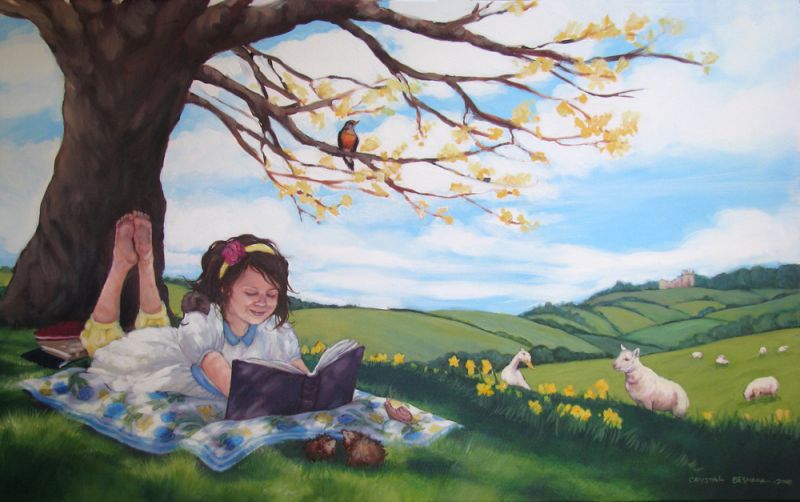
Kiedy moja wnuczka Sarah nauczyła się czytać, zapytałam, czy zdjęcie, na którym czyta siostrze Merinie, mogłoby zostać umieszczone w pokoju dziecięcym w naszej wiejskiej bibliotece, aby uczcić jej naukę czytania. Zdjęcie zostało powieszone, aby uczcić jeden z najważniejszych etapów życia, który akurat przypada na dzieciństwo.
 To biblioteka w Los Angeles niedaleko naszego domu pielęgnowała moją miłość do literatury. Moja mama mi czytała. Czytaliśmy do ostatniej minuty, kiedy książka miała być oddana, a potem pędziłem do biblioteki na łyżwach, zawsze sam. Ale to pani Laverne Perrin, moja nauczycielka w siódmej klasie w Bel Pasi School, zapoznała mnie z wielką literaturą świata. Musieliśmy nauczyć się jednego wiersza co tydzień. Ona czytała dzieło Sir Waltera Scotta, a w innym duchu „Chata wuja Toma” była jedną z tych, przy których kurczowo trzymaliśmy się każdego słowa. Jestem pewien, że czytała nam wszystko, co kochała, bo pamiętam jej wielką pasję do tych książek. Każda historia była czymś więcej niż tylko słowami: była całym królestwem historii, kultury, natury, filozofii, religii i psychologii. Ze względu na to dziedzictwo teraz czytam i czytam ponownie kilka książek dziennie, a wszystkie z nich mam w swojej bibliotece.
Czytanie jest jednym z najważniejszych wydarzeń w życiu człowieka i ma miejsce w dzieciństwie. Czy kiedykolwiek pomyślałeś o wszystkich umiejętnościach, które muszą się połączyć, aby móc czytać? To ekscytujące wydarzenie jest darem od bogów.
To, co robimy z tym darem, pomaga określić, kim jesteśmy, a jako nauczycielka czuję się uprzywilejowana, mogąc pomagać rodzicom przedszkolaków budować fundamenty dla produktywnych obywateli, którzy dorastają kochając czytać. Mam nadzieję, że wokół wydarzenia, kiedy dzisiejsze dziecko uczy się czytać, można zbudować celebracje i rytuały. Zajęło nam tyle czasu, aby zdać sobie sprawę, że jest to magiczny moment, który wymaga uznania.
Jak nauczyłeś się czytać? Chciałbym usłyszeć twoją historię.
COMMUNITY REFLECTIONS
SHARE YOUR REFLECTION
12 PAST RESPONSES
My best friend taught me how to read. He was three years older than me. Every day after school in his first year he would come over and show me what he'd learned at school that day using the book Green Eggs and Ham. He died two years ago at age 58, I will miss him for the rest of my life.
I remember walking in to kindergarten and straight for the bookshelf. My beautiful new teacher (who was really 80 years old) said to my mother "oh I see we have a reader on our hands, how wonderful is that"? From that day forward, I have always considered myself just that "a reader" and have always lived up to the expectation of my kindergarten teacher. Thank you Mrs. Quaker!!
Satya Narain Goel
In India Ramayan written by Tulsidas is the most read book. For centuries, generations after generations, the women learned to read to enable them to read the story of Ram and Sita in Ramayan. Apart from religious and spritual side of the epic, which Ramayan is, it has made a tremendous contribution to the reading habits of women in India.
Satya Narain Goel, Jodhpur, Rajasthan. India
I cannot remember a time that I wasn't being read to by my parents. My mother had a gift for reading with accents and regional dialects which enthralled me and my siblings. I had numerous children's stories memorized and then I "read" those to my siblings (I have no recollection of the moment when the memorization became truly reading on my own). My father found children's books read over and over and over quite tedious, but he noticed that children love to sit with you and be read to, no matter what is being read (the special attention given the child is the most important part). So, he read what he liked aloud to me and thus, I heard the Wall Street Journal each evening and learned incredible language skills that have served me all my life! My vocabulary skills were enhanced all while I was having a wonderful time. Two of the ladies who babysat my siblings and me would bring stacks of books and read and read until they were hoarse and on the verge of losing their voices! We all three gathered on the couch and were enthralled all evening long. My, we were so blessed! I still love books and reading and stopping wherever there is a bookstore; bookstores even smell wonderful!
[Hide Full Comment]In Eastern India there is a annual festival called Saraswati Puja which revolves around the deity of learning, Saraswati. When a child is about 3 or 4 years old he or she sits down with other children of the same age and they are shown how to write the first alphabet in the Bengali script. Each child has her/ his own miniature handheld blackboard and chalk and it is a occasion of celebration that the child is progressing away from babyhood and getting ready for formal education. The child feels part of a group and seeing the adults reaction they are also enthusiastic about starting to read the alphabet.
Hi Betty,
My mother read to us from early on. She and I would sit in a big chair together, and she would read to me, annunciating each word clearly. So, I learned to read early on. she took delight in showing me off to the family at christmas time, when I recited "twas the night before christmas," from memory. I believe her strong focus on enunciation helped me learn how to read and spell well.
I was 4 years old. My mother was pregnant with my first little brother and she would take a hot bath every morning. I would sit on the bathroom floor with the newspaper spread out on the floor in front of me with my right hand on her tummy to feel the baby move. She would teach me about roots, prefixes and suffixes, how most words were Greek or Latin in origin. I would stumble through the article she chose and she taught me how to find meaning of words I didn't know through context. She was very strict and a very difficult woman to please, but she raised a true reader. I never read children's books. She never talked "baby talk". She felt that if you learn that way, then you would have to un-learn that to learn "real" language. I was an extremely gifted child and she challenged me, constantly. I don't ever remember anyone reading aloud to me, I read aloud to them.
Amazes me that people can remember when they learned to read. The earliest memory I know of is in second grade for me. I am sure I learned to read before then. Sorry.
Beautiful!
Books were my friends. My father was career Army so we moved every year until I was in high school. I learned to read early. My mother still talks about the day when I was in first grade and the teachers asked me to read a story to the third graders. In high school I spent my summers reading from books picked out from the Book mobile. I loved the Book mobile. I can still visualize the driver who would patiently help me find my books and the coolness of the air inside on those hot days. I read all of the available Agatha Christie novels that summer. Today I am the organizer of a neighborhood book club. We have 13 members. We all have been together for 10 years. We lost one member to cancer and we honor her memory by donating books to a needy cause. Reading has shaped my life.
I was four years old. My Grandmother Quigney taught me to read. Every day she would take a break from work cuddle up in her recliner by the living room window and read. Often she would read aloud to me from Reader's Digest or The Education of Hyman Kaplan or Cheaper by the Dozen. And she would read children's picture books, nursery rhymes and of course Winnie the Pooh. I would follow along trying to decipher the swirls on the page. And then one day it just clicked and I read a book about a pony who tries to keep up with the horses; how fitting. Thanks to my Grandmother's efforts I read Every book in my elementary school library. In adulthood (after jobs in women's health & cancer research), I was a Children's Librarian. I had the blessing of creating an entire program and helping thousands of children develop an appreciation for books and reading.
Today I am a Cause-Focused Storyteller & Literacy Advocate. I sold my home & possessions in 2005 to create/facilitate a volunteer literacy project in Belize; the initial thrust was book drives & reading activities. Since then I've donated programs for 33,000 children & trained 800 teachers how to use their own cultural stories in school. I've just returned from Ghana where I donated literacy training for librarians at 6 library/community centers. All because my Grandma instilled a Passion for books & taught me to read. Thank you for your Passion & sharing the Love of reading.
[Hide Full Comment]I learned to read in school, very early in the first grade. I loved the individual letters and their sounds, so I was using phonics before anyone had even coined the term. I like music and language seemed the same thing to me. The individual letter-noises could be combined to make familiar and unfamiliar words, so when I struck an unfamiliar word I knew that had happened, and wanted to learn what those sound patterns were for. It was all very easy and effortless. I was ready in the first grade, and those were the years before child care and kindergarten. We had a lot of kids in the first and second grades (in one room with one teacher) so I had lots of time to myself to play with the sound combinations and see where they went. I am glad I predated the hubbub of day care and kindergarten. We went to school because we were grown up enough to be allowed to, and it was a huge thrill!