
Betty Peck di usia 92 tahun penuh dengan kecantikan berseri yang mengingatkan pada peri  ibu baptis dan taman ajaib. Mengunjunginya seperti terjatuh ke lubang kelinci Alice. Rel kereta api dengan kereta sungguhan mengelilingi rumahnya di Saratoga. Ada dinding yang ditumbuhi tanaman ivy, jalan berliku yang gila, rumah pohon, bahkan menara Rapunzel, dan amfiteater di bawah pepohonan lengkap dengan balkon Romeo dan Juliet. Ratusan anak telah bermain di sungai yang disinari matahari di sini, senang merasakan tanah di bawah kaki telanjang dan bersukacita di dunia yang penuh dengan kreativitas, keindahan, dan keajaiban. Inilah dunia yang dihadiahkan Betty Peck kepada beberapa generasi anak-anak.
Dan kini guru yang luar biasa ini memiliki proyek baru yang sangat ia sukai. Sebuah proyek yang ia uraikan dengan kata-katanya sendiri di bawah ini, dan dimulai dengan sebuah pertanyaan sederhana namun mendalam...
Saya ingin tahu bagaimana Anda belajar membaca.
Belajar membaca adalah hal terpenting yang terjadi pada kita, dan itu terjadi (bagi kebanyakan orang) di masa kanak-kanak. Suami saya, Willys Peck belajar membaca dengan "Metode Pooh". Berikut ini adalah kata-katanya tentang peristiwa menakjubkan ini:
Metode Pooh untuk Membaca Terpelajar

Ketika saya masih kecil, orang tua saya suka membacakan buku untuk saya dan saudara laki-laki saya. Buku favorit saya adalah Winnie the Pooh dan The House at Pooh Corner karya AA. Milne. Meskipun saya tidak berusaha keras untuk menghafal cerita-cerita itu, saya menemukan bahwa dengan mendengarkannya berulang kali, saya dapat melafalkan paragraf pembuka dari ingatan. Suatu hari, ketika melihat buku itu dan melafalkannya dari ingatan, saya menemukan kata-kata yang lebih banyak daripada yang sebenarnya saya hafalkan. Saat itulah saya menyadari bahwa saya sedang membaca! Itulah sebabnya saya menyebutnya belajar membaca dengan Metode Pooh.
Belajar membaca adalah hal terpenting yang terjadi pada saya di kelas satu; hal itulah yang membantu saya menjadi diri saya sendiri. Saya telah menuliskannya dalam buku saya: Kindergarten Education –Freeing Children's Creative Potential (Hawthorne Press).
 Nenek saya menceritakan semua dongeng dan lagu anak-anak kepada saya. Beruntunglah anak yang memiliki semua kata-kata bijak kuno ini. Saya, pada gilirannya, akan menjadi pendongeng bagi saudara-saudari saya.
Saya ingat hari ketika saya belajar membaca. Saya juga percaya, seperti John Steinbeck, "Itu mungkin usaha terbesar yang dilakukan manusia, dan ia harus melakukannya saat masih anak-anak." Saya ingat hari ketika saya membawa pulang buku saku saya untuk dibacakan kepada ibu saya ketika saya masih di kelas satu. Saya telah belajar membaca! Kegembiraan atas antisipasi untuk bisa membacakan buku untuk ibu saya masih ada dalam diri saya.
Dalam ingatanku, kami duduk bersama tidak jauh dari pintu depan. Aku membacakan seluruh buku kepadanya dengan sangat gembira dan gembira. Ketika aku selesai, dia berkata kepadaku, "Sekarang bacalah secara terbalik." Dia tidak percaya aku telah belajar membaca! Dengan lebih gembira dari sebelumnya, aku membaca seluruh buku secara terbalik. Pada saat itulah aku merasa menjadi diriku sendiri. Aku telah menjadi lebih dari yang kupikirkan. Sekarang, aku akan menggunakan kata 'melampaui' untuk kesempatan ini, karena sekarang aku tahu apa yang tidak dapat diketahui ibuku. Aku, dan hanya aku, yang tahu rahasia yang luar biasa ini: Aku telah belajar membaca. Aku tidak butuh perayaan; belajar membaca sudah cukup perayaan.
Ketika cucu saya Sarah belajar membaca, saya bertanya apakah fotonya yang sedang membaca untuk saudara perempuannya, Merina, dapat dipajang di ruang anak-anak di perpustakaan desa kami untuk merayakan keberhasilannya dalam membaca. Foto itu digantung untuk merayakan salah satu langkah terpenting dalam hidup yang kebetulan terjadi di masa kanak-kanak.
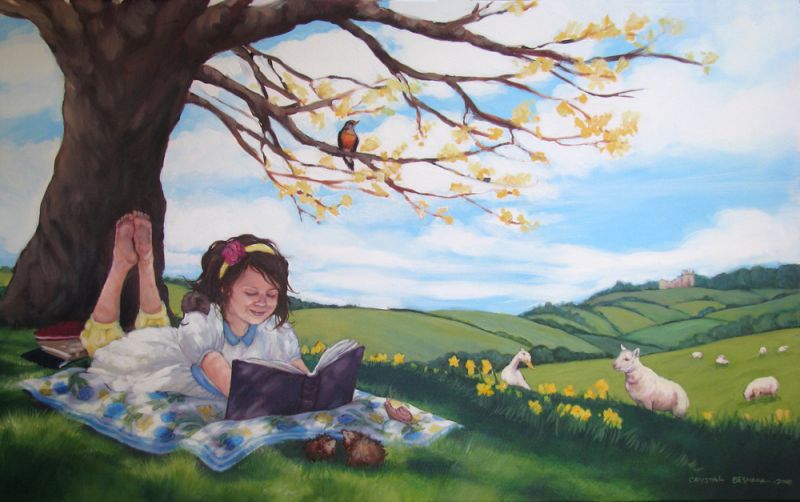 Perpustakaan di Los Angeles dekat rumah kamilah yang menumbuhkan kecintaan saya pada sastra. Ibu saya akan membacakan buku untuk saya. Kami akan membaca sampai menit terakhir bahwa buku itu harus dikembalikan dan kemudian saya akan bergegas ke perpustakaan dengan sepatu roda saya, selalu sendirian. Tetapi Mrs. Laverne Perrin, guru kelas tujuh saya di Sekolah Bel Pasi, yang memperkenalkan saya pada sastra hebat dunia. Kami harus belajar sebuah puisi setiap minggu. Dia akan membaca karya Sir Walter Scott, dan dalam nada yang berbeda, 'Uncle Tom's Cabin; adalah salah satu tempat kami berpegang teguh pada setiap katanya. Dia membacakan kami, saya yakin, semua hal yang dia sukai, karena saya ingat hasratnya yang besar terhadap buku-buku ini. Setiap cerita, lebih dari sekadar kata-katanya: itu adalah seluruh bidang sejarah, budaya, alam, filsafat, agama, dan psikologi. Karena warisan ini, saya sekarang membaca, dan membaca ulang dari beberapa buku sehari, yang semuanya saya miliki di perpustakaan saya.
Membaca merupakan salah satu kegiatan terpenting dalam kehidupan manusia, dan itu terjadi sejak masa kanak-kanak. Pernahkah Anda berpikir tentang semua keterampilan yang harus dimiliki untuk bisa membaca? Kegiatan yang mengasyikkan ini merupakan anugerah dari para dewa.
Apa yang kita lakukan dengan hadiah ini membantu menentukan siapa kita, dan sebagai seorang guru, saya merasa terhormat dapat membantu orang tua dari anak-anak TK membangun fondasi bagi warga negara yang produktif yang tumbuh dengan suka membaca. Saya berharap perayaan dan ritual dapat dibangun di seputar peristiwa ketika seorang anak zaman sekarang belajar membaca. Butuh waktu lama untuk menyadari bahwa ini adalah momen ajaib yang perlu diakui.
Bagaimana Anda belajar membaca? Saya ingin sekali mendengar cerita Anda.
COMMUNITY REFLECTIONS
SHARE YOUR REFLECTION
12 PAST RESPONSES
My best friend taught me how to read. He was three years older than me. Every day after school in his first year he would come over and show me what he'd learned at school that day using the book Green Eggs and Ham. He died two years ago at age 58, I will miss him for the rest of my life.
I remember walking in to kindergarten and straight for the bookshelf. My beautiful new teacher (who was really 80 years old) said to my mother "oh I see we have a reader on our hands, how wonderful is that"? From that day forward, I have always considered myself just that "a reader" and have always lived up to the expectation of my kindergarten teacher. Thank you Mrs. Quaker!!
Satya Narain Goel
In India Ramayan written by Tulsidas is the most read book. For centuries, generations after generations, the women learned to read to enable them to read the story of Ram and Sita in Ramayan. Apart from religious and spritual side of the epic, which Ramayan is, it has made a tremendous contribution to the reading habits of women in India.
Satya Narain Goel, Jodhpur, Rajasthan. India
I cannot remember a time that I wasn't being read to by my parents. My mother had a gift for reading with accents and regional dialects which enthralled me and my siblings. I had numerous children's stories memorized and then I "read" those to my siblings (I have no recollection of the moment when the memorization became truly reading on my own). My father found children's books read over and over and over quite tedious, but he noticed that children love to sit with you and be read to, no matter what is being read (the special attention given the child is the most important part). So, he read what he liked aloud to me and thus, I heard the Wall Street Journal each evening and learned incredible language skills that have served me all my life! My vocabulary skills were enhanced all while I was having a wonderful time. Two of the ladies who babysat my siblings and me would bring stacks of books and read and read until they were hoarse and on the verge of losing their voices! We all three gathered on the couch and were enthralled all evening long. My, we were so blessed! I still love books and reading and stopping wherever there is a bookstore; bookstores even smell wonderful!
[Hide Full Comment]In Eastern India there is a annual festival called Saraswati Puja which revolves around the deity of learning, Saraswati. When a child is about 3 or 4 years old he or she sits down with other children of the same age and they are shown how to write the first alphabet in the Bengali script. Each child has her/ his own miniature handheld blackboard and chalk and it is a occasion of celebration that the child is progressing away from babyhood and getting ready for formal education. The child feels part of a group and seeing the adults reaction they are also enthusiastic about starting to read the alphabet.
Hi Betty,
My mother read to us from early on. She and I would sit in a big chair together, and she would read to me, annunciating each word clearly. So, I learned to read early on. she took delight in showing me off to the family at christmas time, when I recited "twas the night before christmas," from memory. I believe her strong focus on enunciation helped me learn how to read and spell well.
I was 4 years old. My mother was pregnant with my first little brother and she would take a hot bath every morning. I would sit on the bathroom floor with the newspaper spread out on the floor in front of me with my right hand on her tummy to feel the baby move. She would teach me about roots, prefixes and suffixes, how most words were Greek or Latin in origin. I would stumble through the article she chose and she taught me how to find meaning of words I didn't know through context. She was very strict and a very difficult woman to please, but she raised a true reader. I never read children's books. She never talked "baby talk". She felt that if you learn that way, then you would have to un-learn that to learn "real" language. I was an extremely gifted child and she challenged me, constantly. I don't ever remember anyone reading aloud to me, I read aloud to them.
Amazes me that people can remember when they learned to read. The earliest memory I know of is in second grade for me. I am sure I learned to read before then. Sorry.
Beautiful!
Books were my friends. My father was career Army so we moved every year until I was in high school. I learned to read early. My mother still talks about the day when I was in first grade and the teachers asked me to read a story to the third graders. In high school I spent my summers reading from books picked out from the Book mobile. I loved the Book mobile. I can still visualize the driver who would patiently help me find my books and the coolness of the air inside on those hot days. I read all of the available Agatha Christie novels that summer. Today I am the organizer of a neighborhood book club. We have 13 members. We all have been together for 10 years. We lost one member to cancer and we honor her memory by donating books to a needy cause. Reading has shaped my life.
I was four years old. My Grandmother Quigney taught me to read. Every day she would take a break from work cuddle up in her recliner by the living room window and read. Often she would read aloud to me from Reader's Digest or The Education of Hyman Kaplan or Cheaper by the Dozen. And she would read children's picture books, nursery rhymes and of course Winnie the Pooh. I would follow along trying to decipher the swirls on the page. And then one day it just clicked and I read a book about a pony who tries to keep up with the horses; how fitting. Thanks to my Grandmother's efforts I read Every book in my elementary school library. In adulthood (after jobs in women's health & cancer research), I was a Children's Librarian. I had the blessing of creating an entire program and helping thousands of children develop an appreciation for books and reading.
Today I am a Cause-Focused Storyteller & Literacy Advocate. I sold my home & possessions in 2005 to create/facilitate a volunteer literacy project in Belize; the initial thrust was book drives & reading activities. Since then I've donated programs for 33,000 children & trained 800 teachers how to use their own cultural stories in school. I've just returned from Ghana where I donated literacy training for librarians at 6 library/community centers. All because my Grandma instilled a Passion for books & taught me to read. Thank you for your Passion & sharing the Love of reading.
[Hide Full Comment]I learned to read in school, very early in the first grade. I loved the individual letters and their sounds, so I was using phonics before anyone had even coined the term. I like music and language seemed the same thing to me. The individual letter-noises could be combined to make familiar and unfamiliar words, so when I struck an unfamiliar word I knew that had happened, and wanted to learn what those sound patterns were for. It was all very easy and effortless. I was ready in the first grade, and those were the years before child care and kindergarten. We had a lot of kids in the first and second grades (in one room with one teacher) so I had lots of time to myself to play with the sound combinations and see where they went. I am glad I predated the hubbub of day care and kindergarten. We went to school because we were grown up enough to be allowed to, and it was a huge thrill!