
92-aastane Betty Peck on täis säravat armsust, mis toob silme ette haldja  ristiemad ja nõiutud aiad. Tema külastamine on veidi nagu Alice'i jäneseauku alla kukkumine. Tema Saratoga kodu ümber kulgeb päris rongiga rongitee. Seal on luuderohuga kaetud seinad, pöörased käänulised teed, puumajad, isegi Rapuntsli torn ja amfiteater puude all koos Romeo ja Julia rõduga. Sajad lapsed on siin päikesepaistelises ojas mänginud, paljaste jalgade all tundunud mulda ja tundnud rõõmu maailmast, mis on täis loovust, ilu ja imesid. See on maailm, mille Betty Peck kinkis mitmele põlvkonnale lastele.
Ja nüüd on sellel hämmastaval õpetajal uus projekt, millest ta on väga põnevil. Projekt, mida ta kirjeldab allpool oma sõnadega ja mis algab lihtsa, kuid sügava küsimusega...
Ma tahan teada, kuidas sa lugema õppisid.
Lugema õppimine on kõige olulisem asi, mis meiega juhtub, ja see juhtub (enamiku jaoks) lapsepõlves. Minu abikaasa Willys Peck õppis lugema Puhhi meetodi abil. Siin on tema sõnad selle hämmastava sündmuse kohta:
Puhhi õpitud lugemise meetod

Kui ma olin laps, lugesid mu vanemad mulle ja mu vennale raamatuid. Minu lemmikud olid AA raamatud Karupoeg Puhh ja Maja Puhhinurgas. Milne.Kuigi ma ei pingutanud teadlikult, et lugusid pähe õppida, avastasin neid mitu korda kuuldes, et suudan alguses olevad lõigud peast ette lugeda. Ühel päeval raamatut vaadates ja seda mälu järgi ette lugedes avastasin, et korjasin sõnu peale nende, mis tegelikult pähe jäid. Sel hetkel sain aru, et loen! Seetõttu nimetan seda Puhhi meetodil lugema õppimiseks.
Lugema õppimine oli kõige olulisem asi, mis minuga esimeses klassis juhtus; see aitas mul saada selleks, kes ma olen. Olen selle üles kirjutanud oma raamatus: Lasteaiaharidus – laste loomingulise potentsiaali vabastamine (Hawthorne Press).
 Minu vanaema rääkis mulle kõik muinasjutud ja lastelaulud. Õnnelik on laps, kes sisaldab kõiki neid iidse tarkuse sõnu. Minust saaks omakorda oma vendade ja õdede jutuvestja.
Mäletan päeva, mil õppisin lugema. Ka mina usun koos John Steinbeckiga: "See on võib-olla suurim üksik pingutus, mille inimene ette võtab, ja ta peab seda lapsena tegema." Mäletan päeva, kui ma esimeses klassis käisin oma pehmekaanelist raamatut koju ema lugema. Ma õppisin lugema! Põnevus sellest ootusärevusest, et saan emale ette lugeda, on minus siiani.
Minu mäletamist mööda istusime koos maha, mitte kaugel välisuksest. Lugesin talle kogu raamatu suure rõõmu ja rõõmuga. Kui ma lõpetasin, ütles ta mulle: "Nüüd lugege seda tagurpidi." Ta ei uskunud, et olin lugema õppinud! Varasemast suurema rõõmuga lugesin terve raamatu tagurpidi läbi. Sel hetkel tekkis mul tunne, et tulen enda omaks. Minust oli saanud rohkem, kui olin arvanud end olevat. Nüüd kasutaksin ma selleks puhuks sõna "ületatud", sest praegu teadsin seda, mida mu ema ei võinud teada. Mina ja ainult mina teadsime seda imelist saladust: olin õppinud lugema. Ma ei vajanud tähistamist; lugema õppimine oli piisav pidu.
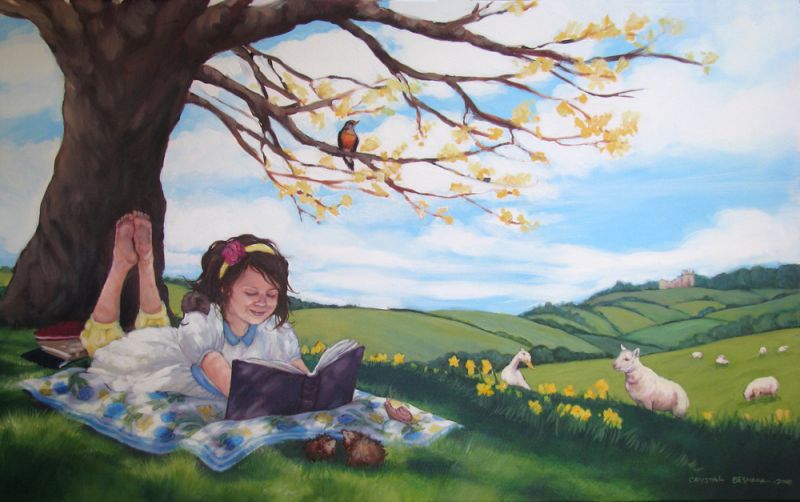
Kui mu lapselaps Sarah lugema õppis, küsisin, kas meie külaraamatukogu lastetuppa võiks tema lugemaõppimise tähistamiseks panna pildi, kus ta luges oma õele Merinale. Pilt riputati üles tähistamaks üht elu tähtsaimat sammu, mis lapsepõlves lihtsalt juhtub.
 Just meie maja lähedal asuv Los Angelese raamatukogu toitis minu kirjanduse armastust. Mu ema luges mulle ette. Lugesime viimase minutini, et raamat on käes, ja siis tormasin uiskudel raamatukogusse, alati üksi. Aga see oli minu Bel Pasi kooli seitsmenda klassi õpetaja proua Laverne Perrin, kes tutvustas mulle maailma suurt kirjandust. Iga nädal pidime ühe luuletuse ära õppima. Ta luges Sir Walter Scotti teost ja teises mõttes "Onu Tomi majake; oli selline, kus me jäime iga sõna külge. Olen kindel, et ta luges meile kõike, mida ta armastas, sest ma mäletan tema suurt kirge nende raamatute vastu. Iga lugu oli rohkem kui selle sõnad: see oli kogu ajaloo, kultuuri, looduse, filosoofia, religiooni ja psühholoogia valdkond. Selle pärandi tõttu loen nüüd ja loen uuesti mitu raamatut päevas, mis kõik on minu raamatukogus.
Lugemine on üks olulisemaid sündmusi inimese elus ja see juhtub lapsepõlves. Kas olete kunagi mõelnud kõikidele oskustele, mis peavad lugemiseks kokku saama? See põnev sündmus on jumalate kingitus.
See, mida me selle kingitusega teeme, aitab kindlaks teha, kes me oleme, ja õpetajana tunnen ma privilegeeritust aidata lasteaialaste vanematel luua alus produktiivsetele kodanikele, kes kasvavad üles lugemist armastavatele inimestele. Loodan, et selle sündmuse ümber saab üles ehitada pidustused ja rituaalid, kui tänapäeva laps õpib lugema. Nii kaua on kulunud arusaamine, et see on maagiline hetk, mis vajab tunnustamist.
Kuidas sa lugema õppisid? Mulle meeldiks teie lugu kuulda.
COMMUNITY REFLECTIONS
SHARE YOUR REFLECTION
12 PAST RESPONSES
My best friend taught me how to read. He was three years older than me. Every day after school in his first year he would come over and show me what he'd learned at school that day using the book Green Eggs and Ham. He died two years ago at age 58, I will miss him for the rest of my life.
I remember walking in to kindergarten and straight for the bookshelf. My beautiful new teacher (who was really 80 years old) said to my mother "oh I see we have a reader on our hands, how wonderful is that"? From that day forward, I have always considered myself just that "a reader" and have always lived up to the expectation of my kindergarten teacher. Thank you Mrs. Quaker!!
Satya Narain Goel
In India Ramayan written by Tulsidas is the most read book. For centuries, generations after generations, the women learned to read to enable them to read the story of Ram and Sita in Ramayan. Apart from religious and spritual side of the epic, which Ramayan is, it has made a tremendous contribution to the reading habits of women in India.
Satya Narain Goel, Jodhpur, Rajasthan. India
I cannot remember a time that I wasn't being read to by my parents. My mother had a gift for reading with accents and regional dialects which enthralled me and my siblings. I had numerous children's stories memorized and then I "read" those to my siblings (I have no recollection of the moment when the memorization became truly reading on my own). My father found children's books read over and over and over quite tedious, but he noticed that children love to sit with you and be read to, no matter what is being read (the special attention given the child is the most important part). So, he read what he liked aloud to me and thus, I heard the Wall Street Journal each evening and learned incredible language skills that have served me all my life! My vocabulary skills were enhanced all while I was having a wonderful time. Two of the ladies who babysat my siblings and me would bring stacks of books and read and read until they were hoarse and on the verge of losing their voices! We all three gathered on the couch and were enthralled all evening long. My, we were so blessed! I still love books and reading and stopping wherever there is a bookstore; bookstores even smell wonderful!
[Hide Full Comment]In Eastern India there is a annual festival called Saraswati Puja which revolves around the deity of learning, Saraswati. When a child is about 3 or 4 years old he or she sits down with other children of the same age and they are shown how to write the first alphabet in the Bengali script. Each child has her/ his own miniature handheld blackboard and chalk and it is a occasion of celebration that the child is progressing away from babyhood and getting ready for formal education. The child feels part of a group and seeing the adults reaction they are also enthusiastic about starting to read the alphabet.
Hi Betty,
My mother read to us from early on. She and I would sit in a big chair together, and she would read to me, annunciating each word clearly. So, I learned to read early on. she took delight in showing me off to the family at christmas time, when I recited "twas the night before christmas," from memory. I believe her strong focus on enunciation helped me learn how to read and spell well.
I was 4 years old. My mother was pregnant with my first little brother and she would take a hot bath every morning. I would sit on the bathroom floor with the newspaper spread out on the floor in front of me with my right hand on her tummy to feel the baby move. She would teach me about roots, prefixes and suffixes, how most words were Greek or Latin in origin. I would stumble through the article she chose and she taught me how to find meaning of words I didn't know through context. She was very strict and a very difficult woman to please, but she raised a true reader. I never read children's books. She never talked "baby talk". She felt that if you learn that way, then you would have to un-learn that to learn "real" language. I was an extremely gifted child and she challenged me, constantly. I don't ever remember anyone reading aloud to me, I read aloud to them.
Amazes me that people can remember when they learned to read. The earliest memory I know of is in second grade for me. I am sure I learned to read before then. Sorry.
Beautiful!
Books were my friends. My father was career Army so we moved every year until I was in high school. I learned to read early. My mother still talks about the day when I was in first grade and the teachers asked me to read a story to the third graders. In high school I spent my summers reading from books picked out from the Book mobile. I loved the Book mobile. I can still visualize the driver who would patiently help me find my books and the coolness of the air inside on those hot days. I read all of the available Agatha Christie novels that summer. Today I am the organizer of a neighborhood book club. We have 13 members. We all have been together for 10 years. We lost one member to cancer and we honor her memory by donating books to a needy cause. Reading has shaped my life.
I was four years old. My Grandmother Quigney taught me to read. Every day she would take a break from work cuddle up in her recliner by the living room window and read. Often she would read aloud to me from Reader's Digest or The Education of Hyman Kaplan or Cheaper by the Dozen. And she would read children's picture books, nursery rhymes and of course Winnie the Pooh. I would follow along trying to decipher the swirls on the page. And then one day it just clicked and I read a book about a pony who tries to keep up with the horses; how fitting. Thanks to my Grandmother's efforts I read Every book in my elementary school library. In adulthood (after jobs in women's health & cancer research), I was a Children's Librarian. I had the blessing of creating an entire program and helping thousands of children develop an appreciation for books and reading.
Today I am a Cause-Focused Storyteller & Literacy Advocate. I sold my home & possessions in 2005 to create/facilitate a volunteer literacy project in Belize; the initial thrust was book drives & reading activities. Since then I've donated programs for 33,000 children & trained 800 teachers how to use their own cultural stories in school. I've just returned from Ghana where I donated literacy training for librarians at 6 library/community centers. All because my Grandma instilled a Passion for books & taught me to read. Thank you for your Passion & sharing the Love of reading.
[Hide Full Comment]I learned to read in school, very early in the first grade. I loved the individual letters and their sounds, so I was using phonics before anyone had even coined the term. I like music and language seemed the same thing to me. The individual letter-noises could be combined to make familiar and unfamiliar words, so when I struck an unfamiliar word I knew that had happened, and wanted to learn what those sound patterns were for. It was all very easy and effortless. I was ready in the first grade, and those were the years before child care and kindergarten. We had a lot of kids in the first and second grades (in one room with one teacher) so I had lots of time to myself to play with the sound combinations and see where they went. I am glad I predated the hubbub of day care and kindergarten. We went to school because we were grown up enough to be allowed to, and it was a huge thrill!