
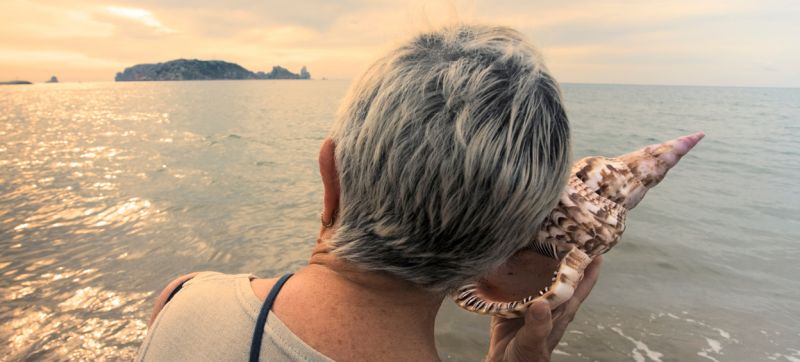
 El meu temps a la Terra m'ha portat a creure en dos instruments poderosos que converteixen l'experiència en amor: abraçar i escoltar. Perquè cada vegada que he abraçat o m'han abraçat, cada vegada que he escoltat o m'han escoltat, l'experiència crema com la llenya en aquest foc etern i em trobo en presència d'amor. Això sempre ha estat així. Considereu aquestes dues antigues creences que porten la saviesa i el repte d'abraçar i escoltar.
La primera és la idea ancestral que quan acostes una closca a l'orella, pots sentir l'oceà. Sempre sembla que funciona. L'escrutini de la medicina ha revelat que quan acostes aquesta closca a l'orella, en realitat sents les teves pròpies pulsacions, l'oceà de la teva sang que es reprodueix cap a tu. Tot i això, aquest fet no disminueix aquest misteri. Només l'augmenta. Perquè acostar una closca a l'orella ens ensenya a escoltar el Tot a través de la part i a trobar l'Univers dins nostre. Ens ensenya que quan ens atrevim a acostar un altre ésser, com una closca, a l'orella, sentim tant el misteri de tota la vida com l'oceà de la nostra pròpia sang.
Sorprenentment, cada ésser té la història de l'Univers codificada dins seu. Cada ànima és una closca modelada pels corrents de les profunditats. Fins i tot físicament, l'oïda interna —aquesta delicada font d'equilibri— té forma de petxina de conquilla. I així, tot allò que retenim i escoltem ens mostrarà on viu al món i en nosaltres.
Això ens porta a la segona creença: la tradició popular que si un cavall es trenca una pota, s'ha de sacrificar. He descobert que això no és cert. Oh, és cert que passa. Els criadors disparen als cavalls amb les potes trencades com si no hi hagués res a fer. Però ara sé que ho fan per ells mateixos, sense voler cuidar d'un cavall que no pot córrer.
D'aquesta manera, les persones temoroses i egoistes tallen el cordó amb aquells que estan trencats, sense voler seure amb un amic que no pot trobar el demà, sense voler ser carregats amb algú que els freni, sense voler afrontar el que està trencat en ells mateixos. En això rau el repte de la compassió. Perquè quan ens atrevim a abraçar aquells que estan obligats a aterrar, quan ens atrevim a abraçar-los a prop, la veritat d'abraçar i escoltar canta i ens transporta la saviesa dels ossos trencats i de com les coses es curen.
Aquestes són valentia silenciosa que tots necessitem. El coratge d'esperar i observar amb tot el que som. El coratge d'admetre que no estem sols. El coratge d'abraçar-nos els uns als altres a prop de l'orella del nostre cor. I el coratge de cuidar les coses que estan trencades.
El terreny de pràctica per a aquestes valentias són sempre les petites coses que tenim a mà. D'alguna manera, a través de la pràctica de fer petites coses amb gran amor, com diu la Mare Teresa, aprenem a ser valents. En veritat, l'obra de l'amor és atendre completament les petites coses. Aquesta atenció obre el misteri. Per la generositat de la nostra més petita atenció, entrem a l'oceà d'amor que ens porta a tots.
Simplement i profundament, l'obra de l'amor és estimar. Perquè en aquest acte, l'Univers cobra vida. Aquesta vitalitat és l'espai que s'obre entre nosaltres, com diu Martin Buber, quan dos s'inclinen i es toquen de manera veritable.
Mark Nepo de "El risc exquisit: atrevir-se a viure una vida autèntica"
COMMUNITY REFLECTIONS
SHARE YOUR REFLECTION
2 PAST RESPONSES
This made me happy, which has been rare recently. Thanks for sharing and writing this. -Marc
The Pilgrim and the Poustinik - a very short story
The pilgrim had been traveling for many days, through many moons. He had seen much during his journey, learned many things, but still had not found what his heart was searching for.
Finally, while walking at night in a dark wood where only small, barely visible animal paths guided him, he saw a dim glow in the distance. As he got closer he realized the light came from a small dwelling, a shack which seemed to glow itself? He approached the poustinia with both great anticipation and great fear.
Now at the door he could make out the form of an old hermit, a poustinik. “Ah pilgrim, I have been waiting for you, welcome.” “Sir, who are you?” asked the pilgrim. “Who I am does not matter, but I have your answer.”
The pilgrim was puzzled but mysteriously hopeful. He had not even posed the question on his heart, he had only asked “Who are you?” “Come, tell me of your travels, what have you seen and learned?” The poustinik seemed genuinely interested to hear the pilgrim’s story?
The pilgrim seemed to sense that the poustinik already knew all about his journey, that he had somehow seen it all? So, his reply was short but to the point of his heart. “I have traveled many miles through many countries and towns, yet I still have not found the answer. Sir, can you tell me, what is the meaning of life?”
“I will tell you pilgrim what your heart already knows, and has known since your birth. Love (God) and enjoy (Them) forever.” A great pause followed . . .
The pilgrim knew immediately that this was indeed The Answer to his question, to all questions. He pondered the depth and the love for what seemed like hours?!
“But how do I do this Sir? What does this life look like?”
“For each one emanating from Divine LOVE Themselves it will look different yet the same. We all love (God) by loving what They have created. In serving and caring for all Creation; earth, plants, animals, humans, we are returning the great LOVE we have received. So, you see though it will look different for each of us, it is the same.”
The pilgrim bowed his head, gave thanks, and left the way he had come, but transformed with peace and contentment in his heart.
}:- ♥️ a.m.
Hoofnote: This story, this dream vision came to me just before I awoke this morning. I share it in gratitude. ♥️🙏🏼
[Hide Full Comment]